Roberto Rossellini — Director (31)
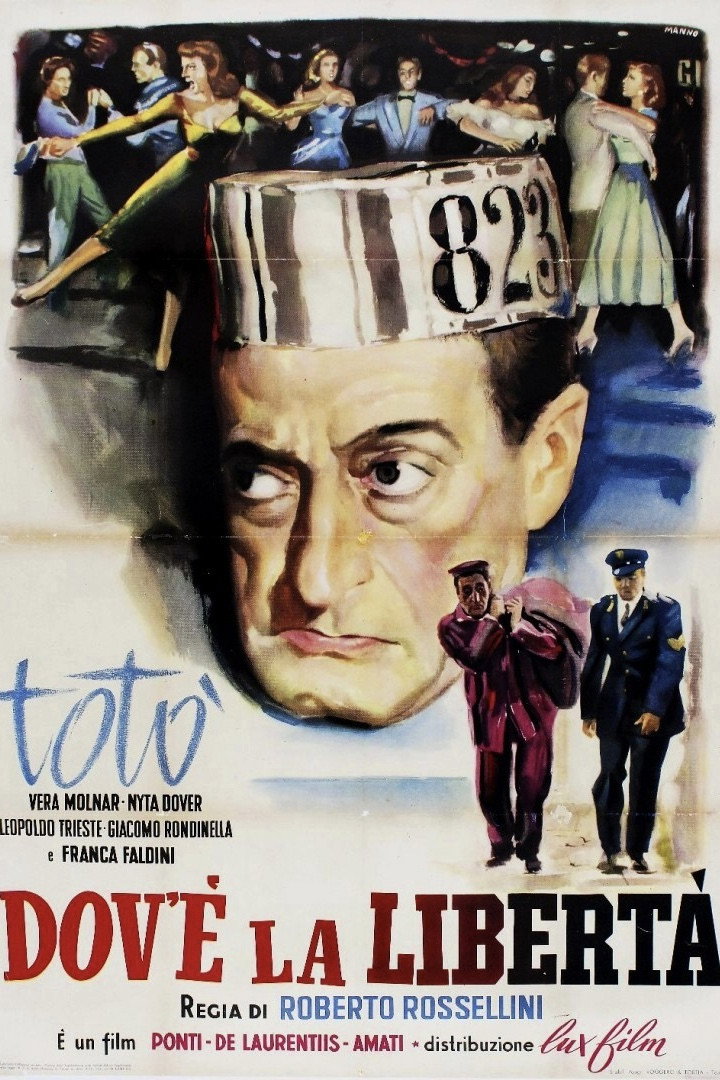
Where Is Freedom? (1954) [Movie] TMDB IMDb WikiData
Dov'è la libertà...?
director: 罗伯托·罗西里尼 actor: Totò / Vera Molnar
other title: Wo ist die Freiheit? / Où est la liberté ?
A barber, murderer because of jealousy, spends twenty years in jail. He cannot, however adjust himself to a changed world and to the hypocrisy of his own relatives and decides to return behind bars.
瓦尼娜·瓦尼尼 (1961) [Movie] Douban
Vanina Vanini
director: 罗伯托·罗西里尼 actor: 桑德拉·米洛 / 洛朗·特兹弗
other title: Vanina Vanini
Vanina Vanini, a bored, spoiled Roman countess, falls in love with a dedicated young patriot who is in Rome to assassinate a traitor to the brotherhood of the Free Masons.
Desiderio (1946) [Movie] Douban
Desiderio
director: 马塞洛·巴格利埃罗 / 罗伯托·罗西里尼 actor: 马西莫·吉洛蒂 / 卡尔洛·尼奇
other title: 欲望 / Desire
Released in the United States in the early 50's under the title of WOMAN, this obscure early Rossellini film was made at the end of the war and completed by Marcello Pagliero. It is a sensational little tragedy about a prostitute who returns from the city to her home town where she is variously loved, spurned, and lusted over. The grim, fatalistic atmosphere bears a good deal of resemblance to the much better known contemporary masterpiece OSSESSIONE, by Luchino Visconti. In fact Massimo Girotti appears in both films. Elli Parvo is quite riveting in the main role.
The Messiah (1976) [Movie] Douban WikiData IMDb TMDB
Il Messia
other title: 弥赛亚 / Il Messia
Dubbed "the most Catholic of all film directors" by one critic, I guess it was only a matter of time before Roberto Rossellini tackled the life of Christ on celluloid. Ironically, this he did in what proved to be his last feature film which was, in itself, a follow-up to his TV mini-series ACTS OF THE APOSTLES (1969). That earlier work was interesting for treating little-known passages from the New Testament but, with an unhurried pace and a generally unassuming tone, the end result was decidedly meandering. Conversely, THE MESSIAH presents all-too-familiar events – with the overall effect feeling lengthy still, yet distinctly more cinematic. That said, it starts off with the arrival of the Jews in the Promised Land and the appointment of their first king (Saul) before moving on to the life of Christ; actually, this is also one of the few films to show the famous incident in which Jesus is lost in the temple as a boy. Unsurprisingly, it doesn't stray much from the spirit – or word – of the Gospels: even so, in the throes of an agonizing death, Herod The Great (played by Vittorio Caprioli – though his trademark flustered demeanor is downplayed by having his voice dubbed) is seen planning the annihilation of his own subjects akin to the practice of ancient Egyptian rulers!
Incidentally, the rich and commanding voice of Christ himself is supplied by Enrico Maria Salerno – a superb actor in his own right who had actually already handled the very same task in THE GOSPEL ACCORDING TO ST. MATTHEW (1964) – which is effectively contrasted with the inconspicuous appearance of the young man who appears in the role (perhaps best approximating the Lothaire Bluteau of Jesus OF MONTREAL [1989]). This Messiah, then, is far removed from the striking good-looks of Jeffrey Hunter (KING OF KINGS [1961]) and Robert Powell (the Jesus OF NAZARETH [1977] TV mini-series) or the brooding power of Max von Sydow (THE GREATEST STORY EVER TOLD [1965]) and Willem Dafoe (THE LAST TEMPTATION OF Christ [1988])! Naturally, the bulk of the narrative is devoted to Christ's public life – though no overdue emphasis is placed on the miracles he performed (these are mentioned but rarely seen) – which also provides the film with its essential core…since the latter section, revolving around the more commonly-depicted events of Jesus' trial (where Jean Martin, the French Colonel in THE BATTLE OF ALGIERS [1966], nonetheless makes for a fine Pontius Pilate), crucifixion and eventual resurrection are curiously skimped here!
The subplot involving John The Baptist, however, is quite nicely handled; by the way, the only other recognizable face in the cast is that of Tina Aumont (even if her contribution amounts to no more than a few minutes of screen-time!) as the adulteress Christ famously pardons by denouncing her pursuers instead. The score is, once again, by Mario Nascimbene – though it's not as prominent as his work on ACTS OF THE APOSTLES. On the visual side, the film seems closest to the contemporaneous Jesus OF NAZARETH – yet the lyrical style and quiet dignity on display makes of THE MESSIAH a more than worthy companion piece to Pier Paolo Pasolini's aforementioned (and more renowned) THE GOSPEL ACCORDING TO ST. MATTHEW. With this in mind, while perhaps not the definitive film on the subject, it certainly emerges as an underrated achievement – both among the myriad treatments (including those by such great directors as D. W. Griffith, Carl Theodor Dreyer, Cecil B. DeMille and Abel Gance) of Christ's life over the years and in Rossellini's own highly respected canon.
Augustine of Hippo (1972) [Movie] Douban
Agostino d'Ippona
director: 罗伯托·罗西里尼 actor: Dary Berkani / Virgilio Gazzolo
other title: 希波主教奥古斯丁 / Agostino d'Ippona
It does a reasonably good job of situating the drama in 5th century Roman Africa, even though the external sets are obviously contemporary (to Rossellini) Roman remains. The interiors are well done and convincing. The drama is dramatic when it needs to be, though there are some lengthy theological discussions, and one does get a sense of the power of St. Augustine's preaching, of the theological disputes of the time and of the tasks of a bishop. The scenes from his life, though limited till his later life, are well chosen to illustrate his character and accomplishments.
The Seven Deadly Sins (1952) [Movie] Douban
Les sept péchés capitaux
director: 伊夫·阿莱格雷 / 克洛德·奥当-拉哈 actor: 米歇尔·摩根 / 弗朗索瓦丝·罗赛
other title: 七宗罪 / Les sept péchés capitaux
Joan of Arc at the Stake (1954) [Movie] Douban
Giovanna d'Arco al rogo
director: 罗伯托·罗西里尼 actor: 英格丽·褒曼 / 托里奥·卡米纳提
other title: 火刑柱上的贞德 / Giovanna d'Arco al rogo
在英法百年战争中,圣女贞德带领法国军队对抗英军的入侵,带兵多次打败英格兰的侵略者,然而在贡比涅一次小冲突中贞德被勃艮第公国所俘,不久为英格兰人以重金购去,由英格兰当局控制下的宗教裁判所以异端和女巫罪判处她火刑,在法国鲁昂当众处死。
飞行员归来 (1942) [Movie] Douban
Un Pilota ritorna
director: 罗伯托·罗西里尼 actor: 马西莫·吉洛蒂 / Michela Belmonte
other title: Un Pilota ritorna / A Pilot Returns
A Fascist pilot, Lt. Gino Rossati (Massimo Girotti), is flying a bombing run from Italy to Greece in the early spring of 1941. He is shot down by British aircraft and becomes a prisoner of war, first of the British and later the Greeks. In one of the prison camps, he falls in love with Anna (Michela Belmonte), the teenage daughter of an Italian doctor. The film's supervisor and story author, "Tito Silvio Mursino," the screen pseudonym of Vittorio Mussolini, was the son of Italy's Fascist dictator Benito Mussolini.
For the first time I've seen a film by Roberto Rossellini prior to his Neorealist classics, based on a story by il Duce's son, Vittorio Mussolini (credited with the anagram Tito Silvio Mursino). So by its date and origin it may be labeled a "Fascist film", but not surprisingly Rossellini avoids any overt reference to or exaltation of the regime, from a screenplay co-written with Michelangelo Antonioni, among others. At first I thought I was going to see a sort of Italian "Top Gun" as the movie takes around 20 minutes describing the activities of Italian pilots, but soon the airplane of the title hero (Massimo Girotti, the star of Visconti's "Ossessione") is knocked down and he is imprisoned by the British officers. Suddenly the hunter becomes the hunted, and Rossellini elaborates on his belief that personal stories are illustrations of history and politics: the pilot is nothing but a puppet of his country's foreign policy. Rossellini then describes the state of the prisoners, as they endure cold, hunger and disease, and are taken by the British from an old farm to a port in the Mediterranean, while bombs are dropped over roads, fields and bridges, to a patriotic ending (that is revealed by the title). Rossellini tells this story in 85 minutes, with early examples of what Bazin would describe as "image fact": long takes, where the camera moves (including a 360° turn) not to advance the story, but to show the environment, the conditions where the characters interact. Rossellini narrates fast and synthesizes the fable, though his economy was not determined --as in "Romà, citta aperta"-- by the surrounding events (war), showing the development of a style that would grow during the Neorealist movement
The Man with the Cross (1943) [Movie] Douban
L' Uomo dalla croce
director: 罗伯托·罗西里尼 actor: Alberto Tavazzi / Roswita Schmidt
other title: 背负十字架的人 / L' Uomo dalla croce
An extremely rare film by Roberto Rossellini, his third feature, made under the Fascist control of Italy. Basically rejected after the War because of the Fascist content of the film, "Rossellini produces a work which focuses upon the Italian expeditionary forces on the Eastern Front and upon a Catholic chaplain representative of Italy's religious majority…the principal character's humanity and sacrifice seem to prefigure the good-natured priest of Rome, Open City who works with leftist Resistance leaders…Rossellini underlines the common humanity in Fascist and Bolshevik alike" (Peter Bonadella, Italian Cinema from Neo-Realism to Present).
Made during the fascist years ,this is par excellence a propaganda movie.Roberto Rossellini 's work is sometimes preachy,mainly in the third part,when his hero tries to convince -and succeeds- the Russians that he is no sorcerer and that God loves everyone provided that he redeems his soul and comes back on the right way.The final recalls Jesus's death on the cross,the converted man playing the the good thief's part.Besides ,everybody speaks Italian and that does not help the credibility of the situations.
But Rossellini's genius -which would blossom is such works as " Europa 51" "Roma cita aperta " or " Germano anno zero " occasionally surfaces: except for the opening scenes -one of the first pictures shows doves-,the world depicted in "uomo della croce" is an apocalyptic one,we keep hearing shots during almost the whole movie : overwhelming sequences display a little boy screaming,a woman having her baby as a man is dying near her,while,outside,man's madness knows no bounds.
Man with a Cross was originally released in Italy as L'Uomo della Croce. Evidently, Roberto Rosselini had some difficulty concentrating on this one. He directed the film at the behest of the fascist government, at a time when his thoughts were probably focussed on his long-anticipated (and never-finished) Desiderio. The religious aspects of the plotline tend to be subordinate to the Mussolini party line. Man with a Cross contains next to none of the neorealism of Rossellini's later works
The White Ship (1941) [Movie] Douban
La nave bianca
director: 罗伯托·罗西里尼 actor: Augusto Basso / Elena Fondi
other title: 白船 / La nave bianca
此片由意大利海军出资,是罗西里尼“法西斯三部曲”的第一部,其他两部是《飞行员回归》(Un pilota ritorna,1942)和《带十字架的男子》(L'uomo dalla croce,1943)。影片讲述二战期间,一支意大利舰队驶离塔兰托港,在海上与盟军发生战斗,交火中被击中的意军战舰伤员,被转送到医院船“阿诺”号上进行救治
The Taking of Power by Louis XIV (1966) [Movie] IMDb Douban TMDB WikiData
La prise de pouvoir par Louis XIV
7.3 (11 ratings) director: 罗伯托·罗西里尼 actor: Jean-Marie Patte / Raymond Jourdan
other title: 路易十四的崛起 / La prise de pouvoir par Louis XIV
Cardinal Mazarin dies, leaving a power vacuum in which the young Louis asserts his intention to govern as well as rule. Mazarin's fiscal advisor, Colbert, warns against Fouquet, the Superintendant who has been systematically looting the treasury and wants to be prime minister. Fouquet believes Louis will soon tire of exercizing power and overplays his hand by offering a bribe to Louis' mistress to be his ally. She reports this to the king who arrests Fouquet. Louis and Colbert design a brilliant strategy to keep merchants making money, nobles in debt, the urban poor working and fed, and peasants untaxed.
Cartesius (1974) [Movie] Douban TMDB IMDb
Cartesius
director: 罗伯托·罗西里尼 actor: Ugo Cardea / Anne Pouchie
other title: 笛卡尔 / Descartes
本片为电视电影,记述了法国哲学家笛卡尔(1596—1650)的杰出一生。
Machine to Kill Bad People (1952) [Movie] Douban TMDB IMDb WikiData
La macchina ammazzacattivi
7.4 (5 ratings) director: 罗伯托·罗西里尼 actor: Gennaro Pisano / Marilyn Buferd
other title: 秘密炸弹 / La macchina ammazzacattivi
In Amalfi, a village on the Italian coast, an old man who seems to have strange powers gives Celestino Esposito, the local photographer, a dangerous ability.