
Jean Cocteau — Playwright (26)

勿忘我 (2022) [Movie] Douban
Forget Me Not
director:
诺尔·亚历杭德罗
actor:
泽维尔·德斯里昂
/
Abel Sanztin
other title:
No Me Olvidéis
/
让我分手的那场性爱(台)
…
A revelational sexual encounter with a young artist sets protagonist Leo off on a spiral of questioning his relationship with boyfriend Raul, ultimately breaking things off. While a desperate Raul tries to talk his ex into returning over the phone, Leo’s gaze keeps darting to the center of the room he has found himself in. There, a coffin rests with its door open. In the pursuit of a fulfilling life, what are we willing to sacrifice?


俄狄浦斯王 [Performance] Douban
Œdipus rex
other title:
Œdipus rex
/
Oedipus rex
theater:
Théâtre Sarah Bernhardt
director:
未知
Act 1
The Narrator greets the audience, explaining the nature of the drama they are about to see, and setting the scene: Thebes is suffering from a plague, and the men of the city lament it loudly. Œdipus, king of Thebes and conqueror of the Sphinx, promises to save the city. Creon, brother-in-law to Œdipus, returns from the oracle at Delphi and declaims the words of the gods: Thebes is harboring the murderer of Laius, the previous king. It is the murderer who has brought the plague upon the city. Œdipus promises to discover the murderer and cast him out. He questions Tiresias, the soothsayer, who at first refuses to speak. Angered at this silence, Œdipus accuses him of being the murderer himself. Provoked, Tiresias speaks at last, stating that the murderer of the king is a king. Terrified, Œdipus then accuses Tiresias of being in league with Creon, whom he believes covets the throne. With a flourish from the chorus, Jocasta appears.
Act 2
Jocasta calms the dispute by telling all that the oracles always lie. An oracle had predicted that Laius would die at his son's hand, when in fact he was murdered by bandits at the crossing of three roads. This frightens Œdipus further: he recalls killing an old man at a crossroads before coming to Thebes. A messenger arrives: King Polybus of Corinth, whom Œdipus believes to be his father, has died. However, it is now revealed that Polybus was only the foster-father of Œdipus, who had been, in fact, a foundling. An ancient shepherd arrives: it was he who had found the child Œdipus in the mountains. Jocasta, realizing the truth, flees. At last, the messenger and shepherd state the truth openly: Œdipus is the child of Laius and Jocasta, killer of his father, husband of his mother. Shattered, Œdipus leaves. The messenger reports the death of Jocasta: she has hanged herself in her chambers. Œdipus breaks into her room and puts out his eyes with her pin. He departs Thebes forever as the chorus at first vents their anger, and then mourns the loss of the king they loved.
The Narrator greets the audience, explaining the nature of the drama they are about to see, and setting the scene: Thebes is suffering from a plague, and the men of the city lament it loudly. Œdipus, king of Thebes and conqueror of the Sphinx, promises to save the city. Creon, brother-in-law to Œdipus, returns from the oracle at Delphi and declaims the words of the gods: Thebes is harboring the murderer of Laius, the previous king. It is the murderer who has brought the plague upon the city. Œdipus promises to discover the murderer and cast him out. He questions Tiresias, the soothsayer, who at first refuses to speak. Angered at this silence, Œdipus accuses him of being the murderer himself. Provoked, Tiresias speaks at last, stating that the murderer of the king is a king. Terrified, Œdipus then accuses Tiresias of being in league with Creon, whom he believes covets the throne. With a flourish from the chorus, Jocasta appears.
Act 2
Jocasta calms the dispute by telling all that the oracles always lie. An oracle had predicted that Laius would die at his son's hand, when in fact he was murdered by bandits at the crossing of three roads. This frightens Œdipus further: he recalls killing an old man at a crossroads before coming to Thebes. A messenger arrives: King Polybus of Corinth, whom Œdipus believes to be his father, has died. However, it is now revealed that Polybus was only the foster-father of Œdipus, who had been, in fact, a foundling. An ancient shepherd arrives: it was he who had found the child Œdipus in the mountains. Jocasta, realizing the truth, flees. At last, the messenger and shepherd state the truth openly: Œdipus is the child of Laius and Jocasta, killer of his father, husband of his mother. Shattered, Œdipus leaves. The messenger reports the death of Jocasta: she has hanged herself in her chambers. Œdipus breaks into her room and puts out his eyes with her pin. He departs Thebes forever as the chorus at first vents their anger, and then mourns the loss of the king they loved.

The Phantom Baron (1943) [Movie] Douban
Le Baron fantôme
director:
塞尔日·德·波利尼
actor:
安德烈·勒福尔
/
奥黛特·茹瓦耶
…
other title:
幽灵男爵
/
Le Baron fantôme

Black Crown (1951) [Movie] Douban
La Corona Negra
director:
Luis Saslavsky
actor:
玛丽亚·费力克斯
/
罗萨诺·布拉齐
…
other title:
黑色王冠
/
La Corona Negra
根据Jean Cocteau的剧本改编成的电影。
Excellent Argentinian Saslavsky started his career in Spain with this adaption of a story by Cocteau. Set in Tangier but shot in Spain, the plot concerns a woman (Felix) who loses her memory after killing her husband who was about to divorce her because of her affair with Maurizio (Gassman). The dazed murderess befriended by a young engineer (Brazzi) but her lover catches up with her and forces her to reveal where her rich husband's jewels were hidden. Since she put them in the coffin together with the corpse, the murder is discovered but Gassman becomes the main suspect and, in a desperate bid to escape, he is killed. The end sees the unfortunate adulteress sink into madness as she embraces the dead body of the only man she really loved. The plot is unraveled through numerous flashbacks and punctuated with dream sequences full of hallucinatory images of witches, clutching hands emerging from a grave, the black-clad widow being pursued by a dwarf in a brilliant white cemetery, and the symbolic black crown itself: the formation of ravens as they circle above a corpse. The movie was released in Italy as 'La corona nera'. Saslavsky made other films in Europe but none justified the reputation which had preceded him on his arrival from Argentina. Produced by Suevia Films, Madrid.
Excellent Argentinian Saslavsky started his career in Spain with this adaption of a story by Cocteau. Set in Tangier but shot in Spain, the plot concerns a woman (Felix) who loses her memory after killing her husband who was about to divorce her because of her affair with Maurizio (Gassman). The dazed murderess befriended by a young engineer (Brazzi) but her lover catches up with her and forces her to reveal where her rich husband's jewels were hidden. Since she put them in the coffin together with the corpse, the murder is discovered but Gassman becomes the main suspect and, in a desperate bid to escape, he is killed. The end sees the unfortunate adulteress sink into madness as she embraces the dead body of the only man she really loved. The plot is unraveled through numerous flashbacks and punctuated with dream sequences full of hallucinatory images of witches, clutching hands emerging from a grave, the black-clad widow being pursued by a dwarf in a brilliant white cemetery, and the symbolic black crown itself: the formation of ravens as they circle above a corpse. The movie was released in Italy as 'La corona nera'. Saslavsky made other films in Europe but none justified the reputation which had preceded him on his arrival from Argentina. Produced by Suevia Films, Madrid.

The Human Voice (2014) [Movie] Douban
La voce umana
director:
爱德华多·庞蒂
actor:
索菲娅·罗兰
/
恩里克·洛维索
…
other title:
人之声
/
La voce umana
'Human Voice' is based on Jean Cocteau's iconic one woman play of the same name. Set against the backdrop of Naples, Italy, in 1950, this romantic drama tells the story of Angela, (played by Sophia Loren), a woman in the twilight of her years who rides the emotional roller coaster of her last telephone conversation with the man she loves as he is leaving her for another woman.

让·谷克多致辞2000年 (1962) [Movie] Douban
Jean Cocteau s'adresse... à l'an 2000
other title:
Jean Cocteau s'adresse... à l'an 2000
This is not the end of the Cocteau story, of course, for as we have constantly witnessed, he is always oriented towards the future due to his undimmed faith in the creative act, and none more so than in the medium of film. Indeed, he was even more advanced in his preparations for death and the after-life of his work than originally thought.
Just a couple of months before his death, in August 1963, he made one last film: a 25-minute short entitled Jean Cocteau s’adresse à l’an 2000 (Cocteau addresses the year 2000). The film comprises one still and highly sober shot of Cocteau facing the camera head-on to address the youth of the future. Once recorded, this spoken message for the 21st century was wrapped up, sealed and posted on the understanding that it would be opened only in the year 2000 (as it turned out, it was discovered and exhumed a few years shy of that date). If in The Testament Cocteau portrays himself as a living anachronism, a lonesome classical modernist loitering in space-time in the same buckskin jacket and tie while lost in the spectral light of his memories, here he acknowledges explicitly the irony of his phantom-like state: by the time the viewer sees this image, he, J. C., our saviour Poet, will long be dead.
Temporality is typically skewed: speaking from both 1963 and 2000 Cocteau is at once nostalgic for the present that will have passed and prophetic about the future. There is thus both a documentary aspect and projective thrust to the film, another new configuration of ‘superior realism’ and fantasy enhanced by Cocteau’s seamless performance as himself and his now ‘immortal’ status as a member of the Académie Française. He reiterates some of his long-standing artistic themes and principles: death is a form of life; poetry is beyond time and a kind of superior mathematics; we are all a procession of others who inhabit us; errors are the true expression of an individual, and so on. The tone is at once speculative and uncompromising, as when Cocteau pours vitriolic scorn on the many awards bestowed upon him, which he calls ‘transcendent punishments’. He also revels in the fact that he can say now what he likes with absolute freedom and impunity since he will not be around to suffer the consequences.
The status of Jean Cocteau s’adresse à l’an 2000 remains ultimately unclear. Is it a new testament or confession, or a heroic demonstration of the need for human endurance, or a pure ‘farce of anti-gravitation’ as he puts it? Or everything at once? It is entirely characteristic of Cocteau to leave us hanging on this suspended paradox. What is certain, however, and what we have consistently seen, is that Cocteau’s life and body are his work, and his work in turn is always mysteriously alive. This is Cocteau’s final gift to his fellow human beings. Let us retain and celebrate the force of that gesture. He is resurrected before our eyes, ever-present, defiant and joyfully queer.
Jean Cocteau is dead, long live Cocteau!
(James S. Williams)
Just a couple of months before his death, in August 1963, he made one last film: a 25-minute short entitled Jean Cocteau s’adresse à l’an 2000 (Cocteau addresses the year 2000). The film comprises one still and highly sober shot of Cocteau facing the camera head-on to address the youth of the future. Once recorded, this spoken message for the 21st century was wrapped up, sealed and posted on the understanding that it would be opened only in the year 2000 (as it turned out, it was discovered and exhumed a few years shy of that date). If in The Testament Cocteau portrays himself as a living anachronism, a lonesome classical modernist loitering in space-time in the same buckskin jacket and tie while lost in the spectral light of his memories, here he acknowledges explicitly the irony of his phantom-like state: by the time the viewer sees this image, he, J. C., our saviour Poet, will long be dead.
Temporality is typically skewed: speaking from both 1963 and 2000 Cocteau is at once nostalgic for the present that will have passed and prophetic about the future. There is thus both a documentary aspect and projective thrust to the film, another new configuration of ‘superior realism’ and fantasy enhanced by Cocteau’s seamless performance as himself and his now ‘immortal’ status as a member of the Académie Française. He reiterates some of his long-standing artistic themes and principles: death is a form of life; poetry is beyond time and a kind of superior mathematics; we are all a procession of others who inhabit us; errors are the true expression of an individual, and so on. The tone is at once speculative and uncompromising, as when Cocteau pours vitriolic scorn on the many awards bestowed upon him, which he calls ‘transcendent punishments’. He also revels in the fact that he can say now what he likes with absolute freedom and impunity since he will not be around to suffer the consequences.
The status of Jean Cocteau s’adresse à l’an 2000 remains ultimately unclear. Is it a new testament or confession, or a heroic demonstration of the need for human endurance, or a pure ‘farce of anti-gravitation’ as he puts it? Or everything at once? It is entirely characteristic of Cocteau to leave us hanging on this suspended paradox. What is certain, however, and what we have consistently seen, is that Cocteau’s life and body are his work, and his work in turn is always mysteriously alive. This is Cocteau’s final gift to his fellow human beings. Let us retain and celebrate the force of that gesture. He is resurrected before our eyes, ever-present, defiant and joyfully queer.
Jean Cocteau is dead, long live Cocteau!
(James S. Williams)

Princess of Cleves (1961) [Movie] Douban TMDB IMDb WikiData
La princesse de Clèves
director:
让·德拉努瓦
actor:
玛丽那·维拉迪
/
让·马雷
…
other title:
克莱芙王妃
/
La princesse de Clèves
…
When a young teen marries the Prince of Cleves, more than twice her age, she automatically becomes an official Princess and takes her new position to heart. Although distracted by the elite entertainments found at court, the princess cannot help but mourn her impossible love for the dashing Duc de Nemours.


The Queen's Lover (1948) [Movie] Douban TMDB IMDb WikiData
Ruy Blas
director:
皮埃尔·比永
actor:
让·马雷
/
达尼埃尔·达里约
…
other title:
吕布拉斯
/
Ruy Blas
…
Exiled from the court of Spain, Don Salluste, the chief of police, wants to take revenge on the Queen. One day he meets Ruy Blas, a young student who happens to be a lookalike of Don Cesar, his nephew. Salluste disguises Ruy Blas and presents him as Don Cesar. It doesn't take long before Ruy Blas, intelligent, virtuous and generous as he is becomes popular and the Queen, who has fallen in love with him, appoints him Prime Minister. All seems for the best in the best of worlds but Salluste has not forgotten his revenge, far from that ...


The Eternal Return (1943) [Movie] Douban TMDB IMDb WikiData
L'éternel retour
director:
让·德拉努瓦
actor:
Madeleine Sologne
/
让·马雷
…
other title:
永恒的回忆
/
L'éternel retour
…
A retelling of Tristan and Isolde set in 1940s France.

The Human Voice (1966) [Movie] Douban
The Human Voice
director:
特德·科特切夫
actor:
英格丽·褒曼
other title:
人类的呼声
/
人声
…
原本是 ABC Stage 67(美国ABC电视台1967年推出的持续了26周的一个系列,包括不同的戏剧电影、纪录片、音乐剧等)。原剧本是让·谷克多(Jean Cocteau,法国作家、导演)1930年写的,讲了一个巴黎女子接了一通5年的情人的电话,说他明前就要和另一个女子结婚了。这通电话崩溃了她的神经。1940年代第一次搬上银幕。这个电视电影的导演是加拿大人 Ted Kotcheff,并请到了斯嘉丽·褒曼主演.(以上根据原文资料资料编译)

The Eagle has Two Heads (1948) [Movie] Douban TMDB IMDb WikiData
L'aigle à deux têtes
other title:
双头鹰之死
/
L'aigle à deux têtes
…
Political intrigue and psychological drama run parallel. The queen is in seclusion, veiling her face for the ten years since her husband's assassination, longing to join him in death. Stanislas, a poet whose pen name is Azrael, is a suicidal anarchist, his imagination haunted into hate by longing for this queen who's drawn apart. He enters her private quarters intent on killing her then himself, but they fall in love, in part because he looks like the king. Stanislas wants her to regain political power by appearing to the public, and she tries to convince him to find hope and escape. All the while, the queen's enemies plot to keep the lovers together but to thwart their plans.

The Mystery of Oberwald (1981) [Movie] Douban TMDB WikiData IMDb
Il Mistero di Oberwald
director:
米开朗基罗·安东尼奥尼
actor:
莫尼卡·维蒂
/
保罗·博纳切利
…
other title:
奥伯瓦尔德的秘密
/
Il Mistero di Oberwald
…
A man, mirroring the assassinated King, infiltrates a castle to kill the Queen but hesitates, leading to a deadly dare and revelation of shared history.

The Storm Within (1948) [Movie] Douban TMDB IMDb WikiData
Les Parents Terribles
other title:
可怕的父母
/
Les Parents Terribles
…
Young Michel is in love with the attractive Madeleine, so he decides to tell his parents of his intention to marry her. He thinks his announcement is innocent enough; his engagement, however, threatens to reveal dark secrets lurking within his family's home. Yvonne, Michel's overbearing mother, concocts an elaborate scheme to drive Madeleine away, thus keeping uncomfortable household truths from being exposed.
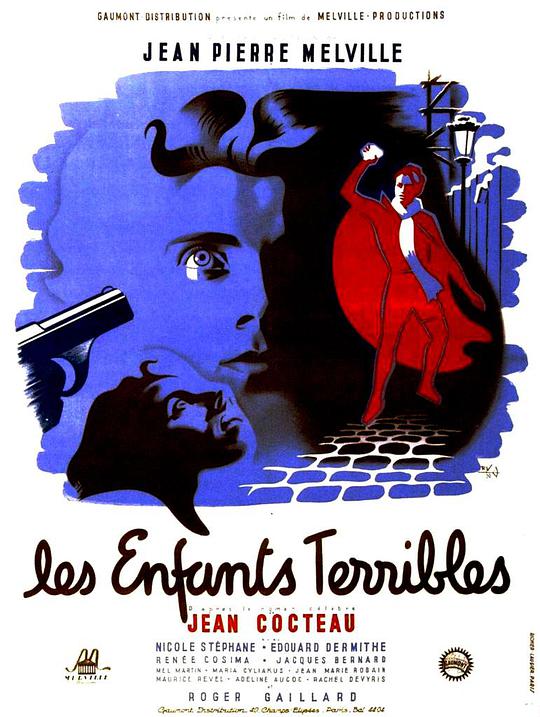
The Strange Ones (1950) [Movie] Douban IMDb WikiData TMDB
Les enfants terribles
other title:
可怕的孩子们
/
Les enfants terribles
…
影片改编自1929年发表的让·考克多的自传体小说,讲述一对姐弟的非正常生活。他们之间进行着外人看起来过分的游戏,但对于他们来说又是必要的。在新人走进他们的生活之后,嫉妒和欺骗产生了。
让-皮埃尔·梅尔维尔曾执导《独行杀手》《红圈》等着名影片。他并非科班出身,因为喜欢电影自组独立制片公司开始从事创作。但当时他忽视法国电影界传统的制片方式,很受到各方面的注意,特别是受到诗人让考克多的赏识。因此考克多提供一千七百万法郎的制片费,请他导演他的小说《可怕的孩子们》,结果很成功,而被誉为战后法国电影界最有才华的新人,被视为法国新潮电影间接的先驱者。
Elisabeth is very protective of her teenage brother Paul, who is injured in a snowball fight at school and has to rest in bed most of the time. The siblings are inseparable, living in the same room, fighting, playing secret games, and rarely leaving the house; though Paul's friend Gerard often stays with them. One day Elisabeth brings home Agathe to live with them also. She bears a strong resemblance to Dargelos, a schoolboy whom Paul had a crush on, and who injured him. Paul and Agathe become attracted to each other, causing Elizabeth to be very jealous.
大致意思是关于兄妹和介入者的感情纠葛,贝托鲁奇的《戏梦巴黎》部分灵感源于此片。
让-皮埃尔·梅尔维尔曾执导《独行杀手》《红圈》等着名影片。他并非科班出身,因为喜欢电影自组独立制片公司开始从事创作。但当时他忽视法国电影界传统的制片方式,很受到各方面的注意,特别是受到诗人让考克多的赏识。因此考克多提供一千七百万法郎的制片费,请他导演他的小说《可怕的孩子们》,结果很成功,而被誉为战后法国电影界最有才华的新人,被视为法国新潮电影间接的先驱者。
Elisabeth is very protective of her teenage brother Paul, who is injured in a snowball fight at school and has to rest in bed most of the time. The siblings are inseparable, living in the same room, fighting, playing secret games, and rarely leaving the house; though Paul's friend Gerard often stays with them. One day Elisabeth brings home Agathe to live with them also. She bears a strong resemblance to Dargelos, a schoolboy whom Paul had a crush on, and who injured him. Paul and Agathe become attracted to each other, causing Elizabeth to be very jealous.
大致意思是关于兄妹和介入者的感情纠葛,贝托鲁奇的《戏梦巴黎》部分灵感源于此片。

