Glazunov: Complete Songs and Romances
Douban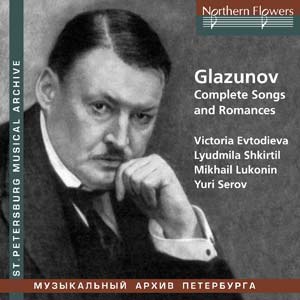
Overview
Providence proved to be extremely benevolent to Alexander Constantinovich Glazunov. He was born in 1865 into the happy family of a well–known Petersburg book publisher, in a large and cozy house, with his parents’ love and care around him. He was endowed with a remarkable musical talent, and a phenomenal memory and ear; abilities glorified in lots of tales and jokes retold by several generations of Petersburg musicians. Thanks to his mother, his gift was noticed very early. The renowned Mily Balakirev and Nikolai Rimsky-Korsakov became his teachers. At the very outset of his creative career, he was greatly encouraged and funded by Mitrofan Belyaev, a timber businessman, passionate music lover, and one of the most important Russian patrons of art.
The First Symphony written by Glazunov at the age of 16 (after 18 months of studies with Rimsky–Korsakov) and performed on March 17, 1882 during a concert of the Free School of Music under Balakirev’s baton, impressed the audience with its clarity, well-finished form, and easy utterance. In his review of the premiere, Cesar Cui commented that the young author “is a composer fully equipped with talent and knowledge”. The composer himself shyly came out to bow in his na?ve tunic of a secondary school pupil. The same year, Rimsky–Korsakov conducted the symphony at the Industry & Arts Exhibition in Moscow. Through efforts of M. Belyaev and Franz Liszt, the opus was performed in Weimar in 1884, which started to promote Glazunov’s recognition abroad.
Inborn modesty, reserve, unaffected manners, unusual diligence and responsible attitude to professional composer The First Symphony written by Glazunov at the age of 16 (after 18 months of studies with Rimsky’Korsakov) and performed on March 17, 1882 during a concert of the Free School of Music under Balakirev’s baton, impressed the audience with its clarity, well-finished form, and easy utterance. In his review of the premiere, Cesar Cui commented that the young author “is a composer fully equipped with talent and knowledge”. The composer himself shyly came out to bow in his na?ve tunic of a secondary school pupil. The same year, Rimsky–Korsakov conducted the symphony at the Industry & Arts Exhibition in Moscow. Through efforts of M. Belyaev and Franz Liszt, the opus was performed in Weimar in 1884, which started to promote Glazunov’s recognition abroad.s work, honesty, and willingness to help - these personality traits of Glazunov made his name a kind of moral purity standard in the musical world of Petersburg and Russia. The years of his directorship at the Conservatoire of Petersburg (Leningrad) (1905 – 1928), which happened to be years of very dramatic historical cataclysms, are still remembered as one of the most bright and efficient in its history.
In the office of director, Glazunov did not compose much, doing all he could for proper functioning of the Conservatoire. Not only did he know every student by name, but also all of their examination programs, constantly attending the classes and exams. After 1917, he had to deal with matters of heating, food allowances for students and professors, and to 'extort' funds for maintenance of the institution from the government.
The peak of Glazunov’s composing was reached in the late 19th and early 20th century. It was then that he created his ballets of astounding beauty (Raymonda, 1897, Les ruses d’amour, 1898, and The Seasons, 1899), his Fifth (1895), Sixth (1896), Seventh (1902), and Eighth (1906) Symphonies, the famous violin concerto (1904), both piano sonatas, and his best string quartets. In these years, the most fruitful for him, he composes much, but he also constantly conducts, reads lectures at the Conservatoire, and is engaged in public activity.
Glazunov died in 1936 in Paris, where he stayed from 1928 ‘on leave’ off his office as Director of Leningrad Conservatoire by permission of the Soviet Government (being in fact an émigré). He died after a long and painful illness, having left a colossal heritage of compositions comprising eight symphonies, an immense number of orchestral overtures and fantasias, ballets, works for choir and for choir and orchestra, instrumental concertos, seven string quartets, and numerous ensembles and piano pieces.
He always went his own way in music. Being Rimsky-Korsakov’s close friend and follower, Glazunov had as well a sincere liking for his “Moscow opposition׆, i.e. Tchaikovsky and Taneyev. His creative work lacks search for new ways in music so typical for the early 20th century, and might seem to be stuck in time. He always remained loyal to the ideals of his musical youth – romantic excitement, exultant air, liveliness.
His compositions seemed obsolete to young contemporaries like Prokofiev and Shostakovich. His composing style looked eclectic, as Glazunov absorbed nearly all of the best things in Russian music of those days that surrounded him. He borrowed commitment to Russian folklore from Balakirev, and he had a lot in common with Rimsky–Korsakov, affinity to colorful and virtuoso orchestration in the first place. The epic beginning of many works of Glazunov reminds the best pages of Borodin’s works. He shared Tchaikovsky’s lyrical attitude, and of course, Taneyev’s commitment to detailed polyphonic development.
Glazunov always tried to achieve a synthesis of what he valued in Russian music. He succeeded in elaborating his own creative style, probably not without certain traits of academism, but possessing a high inner integrity. His compositions are nearly always sanguine and optimistic in their musical images, bright in color, clear in form, and diverse in harmony. They are always works of a true master, a composer for whom Beauty was the main criterion of creative achievement.
Vocal music was not a favorite genre of Alexander Glazunov. Just over thirty songs, including those of his youth period, but most of all his dislike of opera, indicate that the composer had no interest in writing for voice. The core and bulk of his heritage is instrumental music. Glazunov's immense intellect was inclined to exploration of ‘pure’ genres such as symphony, quartet, instrumental concertos, and ballet music.
Romances and songs of Alexander Constantinovich Glazunov are released on CDs for the first time. We selected 29 of 31 finished compositions. The remaining two pieces of his young age (to Lermontov’s poems “As Soon As The Night With Its Veil” and “No, It's Not You I Love So Ardently”) were left out for one clear reason. They look much less uninfluenced than other songs of the early period of composing. The vocal heritage of Glazunov is still an under-explored stratum of Russian music, and it is to be hoped that this compact disk will find its insightful and attentive listener.
Performer’s remarks
From Hafiz and The Belle, both to words by Pushkin, open the program. These are already quite mature pieces of music. By that time, Glazunov was already author of two symphonies and several orchestral opuses, quartets, and instrumental music. While the first of the two songs is wholly integral and very laconic in its form and tools selected (curious are its resilient 'empty' intervals hinting at the Oriental color of the poem), The Belle openly displays the intention to sophisticate the composing language. Unexpected modulations, and abundant minor ‘details’ in the piano accompaniment indicate laborious search in the art of songwriting. Interestingly, the same Pushkin’s poem attracted the attention of Rimsky–Korsakov seven years after.
The two songs to words by A.S. Pushkin (op. 27) are among the best pages of Glazunov’s vocal music. Why Do I Not Hear The Roar Of Joy? strikes you with sophisticated contrivances in harmony. The composer chose to stylize the piano part to resemble ancient harp. The archaic scales used also add to the ‘Bacchic’ color. As to Oriental Romanza (“My Blood Is Burning With Desire… ”), it is really a soft sensation in Russian music. Glinka's famous masterpiece to the same verses - resiliently rhythmic, excited, and dashing – was totally revised musically. The young composer plunged the small Pushkin poem into an atmosphere of Oriental comfort and love bliss, emphasized its erotic shades, and probably came nearer to the truth in his musical concept of the poem.
The twelve songs, op. 59 and op. 60, written in 1898 are undoubtedly the most interesting in Glazunov’s vocal heritage. The point here is not that it is virtually the only case when the mature composer addressed the lyrical vocal genre (a few later songs, scattered in time and stylistics, should hardly be considered); what is important is the especially high quality of the pieces, and a special historical context that called these opuses into being.
Rimsky–Korsakov, whose artistic and personal (the latter was even greater) impression on Glazunov is hard to overestimate, wrote over 50 songs in the summer of 1897. He created them after many years of crisis in this genre. There were times when he composed several songs a day, comprehending a new style of vocal composing based on melodized recitative narration, and thus preparing for creation of Czar’s Bride. The poetical substrate of those songs was mainly poems by Pushkin, Ap. Maikov, and Alexey Tolstoy. Without any doubt, the creative quest of his senior friend urged Glazunov to resume working on vocal miniatures, also because Rimsky–Korsakov had frequently reproached Glazunov for lack of liking for vocal music, and strongly advised him to start writing songs.
Glazunov did not ‘argue’ with Rimsky–Korsakov, using the same literary texts (although a few similar intonations (sometimes almost ‘quotations’) indicate an extremely powerful influence of Rimsky–Korsakov’s vocal style on Glazunov in the late 1890’s). Still, borrowing much from him, Glazunov as always advances his own way. What is really the most important in these opuses is a new great lyrical warmness and special cordiality. Some of the songs (When Your Eyes, Delia, Desire) suggest that we take a new look not only at Glazunov’s vocal heritage, but also at his style of composing in general. Deep tenderness, implied passion, elegiac attitude, and soft rhythms of the tunes reveal the author of Raymonda, and show us some of the inner world of the ever-reserved Alexander Constantinovich.
Addressing home genres typical for Glazunov’s stylistics can also be seen in Opuses 59 and 60. The composer uses the forms of waltz (Delia), mazurka (The Grace Cup), elegy (Desire), and barcarole (Near The Land Where Golden Venice Reigns). As in his other compositions, Glazunov is masterful experimenting with ancient scales, for which purpose, most suitable were the poems by Korinfsky (from Petrarca: We Used To Live At The Foot Of A Hill and If You Want To Love). All the twelve songs of 1898 are strongly distinctive, unlike each other, carefully polished, full of vocal splendor, and represent an excellent recital material, which is still so scarcely used in the performing practice.
Dominating in the duo Hey You, My Free Song! are the tones of a Russian drawling folk song, but an undeniable influence of the amazing Six Duos, op. 46 of Peter Tchaikovsky is also felt.
The arrangement of the Russian traditional song Masha Is Told Not To Cross The River ndicates the composer’s deep knowledge of Russian background voice polyphony. It is one of the best samples of this style in Russian vocal music.
The two 1916 compositions are Glazunov’s last efforts in vocal music. The gloomy colors of Shakespeare’s Sonnet LXVI are implemented in a lapidary and somewhat ascetic musical form. The piece definitely contains a special inner strain. Nina’s Song from the music to Lermontov’s The Masquerade is styled as a ‘fierce’ home romance, and remains one of the most popular and performable vocal pieces by the composer up to this day.
The vocal compositions of Alexander Glazunov as a young man are very curious for several reasons. He paid much more attention to songs in the initial years of his composing than in later periods; the earlier pieces allow to trace in detail the development (rapid development!) of the composer's abilities; the texts of the poems tell us much about the outlook of young Glazunov, and his progress as personality. The composer always kept plenty of books at home, and his passion for reading was a life–long one. This is the source of his many selections from Heine’s translations, and of profound affinity to Pushkin and Lermontov as literary ‘idols’ of Russia’s educated society. Taken on the whole, the initial vocal experiments of Glazunov are very interesting, melodic, and written simply and cordially, after the fashion of the 19th century Russian home romances. The somewhat pathetic, dramatic, and brisk Stifling! ; the exquisite Spanish Romanza (again arguing over one and the same text by Pushkin, but this time, with Dargomyzhsky's masterpiece); Lermontov's Whenever I Hear Your Voice, a 'lovely' one with a broad vocal part amplitude; and My Songs Are Venomous… being nearly an imitation of Borodin. (For his own song to the same text named “My Songs Are Full Of Poison”, Borodin had translated Heine’s poem himself).
The five songs of Opus 4 are selected from the young man’s compositions of 1881–1885. They differ much in the expressive power of images and in stylistics. The choice of the poetical base is representative: Koltsov’s poem alone, a subtle and airy one, may be referred to as high poetry. The rest are translations. Two of these are from Heine (the Russian translation by Dobrolyubov is very much ‘russified’), and two are traditional (Arab and Spanish) texts. Still, the composer was successful in many pages of these early songs. Spanish Song and Arab Melody deserve a closest attention of performers. In full compliance with the abundant Russian tradition of ‘orientalism’, they have catching tunes provided with all appropriate ‘ethnic’ intonations, characteristic resilient rhythms, and passionate narrative ‘exclamations’; in all fairness, they should prove successful when played onstage. To Your Snow–White Bosom and When I Look Into Your Eyes lack such striking individuality, but are interesting because of their fruitful research in harmony and format. The Nightingale is somewhat detached in this cycle: young Alexander surely knew Rimsky–Korsakov’s borrowing of that same poem of Koltsov, and largely he simply copied his teacher. The two pieces are too consonant in their atmosphere, and in their distribution of the literary material within the music’s time frame.