Bryman's Social Research Methods
Douban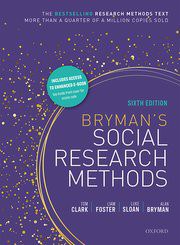
Tom Clark / Liam Foster …
Overview
Clear, comprehensive, and trusted, Bryman's Social Research Methods has guided over a quarter of a million students through their research methods course and student research project. The thoroughly updated sixth edition offers unrivalled coverage of quantitative, qualitative, and mixed methods with renewed focus and a fresh, modern feel.
Exceptionally comprehensive but practical and student-friendly, offering clear and complete coverage of all the key areas of social research methods.
Provides lasting value by supporting social science students twice over: initially, as an essential companion for a research methods module, and later as an invaluable source of information and tips when conducting independent research.
Clear theoretical explanations in the main text are enhanced by 'Key concept' boxes, which summarize important terms and processes, and 'Thinking deeply' boxes, which encourage students to go further in considering an issue or debate.
Numerous examples of published research, in 'Research in focus' boxes, help bridge the gap between theory and practice. Spanning cultures, geographies, and academic disciplines, these studies reflect the breadth of issues explored in social science: they cover a huge range of topics, from political protests, veganism, and climate change, to online dating, emojis, and Instagram selfies.
Students seeking practical guidance for conducting their own research can hone in on punchy 'Tips and skills' boxes, end-of-chapter 'Checklists', and new 'Learn from experience' boxes in which recent graduates share insights from their research into a variety of fascinating topics - including social media attitudes towards the LGBT+ community, and the experiences of Pakistani Muslim single mothers.
Extensive digital resources help students grasp key concepts and develop practical research skills. They include multiple choice questions, templates and examples, a 'research process in practice' simulation, videos from the 'Learn from experience' graduates, and screencast tutorials for the main data analysis software programmes (SPSS, Nvivo, R, and Stata).
Also available as an e-book enhanced with self-assessment activities and multi-media content to offer a fully immersive experience and extra learning support.
New to this edition
Thoroughly but sensitively updated by three new authors. Dr Tom Clark, Dr Liam Foster, and Dr Luke Sloan bring specialist expertise and have worked closely with students and lecturers to build on Alan Bryman's impressive legacy.
Extensively streamlined to provide even more focused coverage of the key aspects of social research, with adjustments made throughout to improve clarity and aid navigation.
A more straightforward writing style makes the content easier for all students to follow, particularly those for whom English is not a first language. Vocabulary is simpler, jargon and idiomatic phrases have been removed, and complex discussions have been broken into manageable parts.
A clean, attractive new design makes the material easier than ever to read and use.
Coverage - including citations and real research examples - has been broadened to better reflect the concerns and contexts of the book's geographically diverse, multi-disciplinary readership. Discussions of feminist perspectives have also been updated to highlight wider issues relating to marginalised groups and power dynamics in research, and inclusive, ethical practices are consistently endorsed.
New material on recent developments within social research, including social media research and big data, has been embedded throughout and the numerous examples of real research have been thoroughly updated.
In new 'Learn from experience' boxes, recent social science graduates from across the UK and Europe share their experiences of conducting a student research project. These candid accounts will inspire readers and help them to avoid common pitfalls and emulate successful approaches.
Expanded digital resources now include a 'research process in practice' simulation, answers to the end-of-chapter questions, videos from the new 'Learn from experience' graduate panel, and screencast tutorials covering the data analysis software packages SPSS, Nvivo, R, and Stata.
contents
Part 1: The research process
1:The nature and process of social research
2:Social research strategies: quantitative research and qualitative research
3:Research designs
4:Planning a research project and formulating research questions
5:Reviewing the literature
6:Ethics and politics in social research
Part 2: Quantitative research
7:The nature of quantitative research
8:Sampling in quantitative research
9: Structured interviewing
10:Self-completion questionnaires
11:Asking questions
12:Structured observation
13:Content analysis
14:Using existing data
15:Quantitative data analysis
Part 3: Qualitative research
16:The nature of qualitative research
17:Sampling in qualitative research
18:Ethnography and participant observation
19:Interviewing in qualitative research
20:Focus groups
21:Language in qualitative research
22:Documents as sources of data
23:Qualitative data analysis
Part 4: Mixed methods research and writing up
24:Mixed methods research
25:Writing up social research