Major New York Times bestseller
Winner of the National Academy of Sciences Best Book Award in 2012
Selected by the New York Times Book Review as one of the best books of 2011
A Globe and Mail Best Books of the Year 2011 Title
One of The Economist’s 2011 Books of the Year
One of The Wall Street Journal's Best Nonfiction Books of the Year 2011
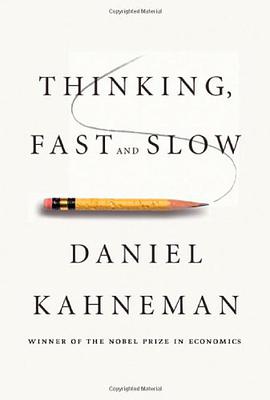
In the international bestseller, Thinking, Fast and Slow, Daniel Kahneman, the renowned psychologist and winner of the Nobel Prize in Economics, takes us on a groundbreaking tour of the mind and explains the two systems that drive the way we think. System 1 is fast, intuitive, and emotional; System 2 is slower, more deliberative, and more logical. The impact of overconfidence on corporate strategies, the difficulties of predicting what will make us happy in the future, the profound effect of cognitive biases on everything from playing the stock market to planning our next vacation—each of these can be understood only by knowing how the two systems shape our judgments and decisions.
Engaging the reader in a lively conversation about how we think, Kahneman reveals where we can and cannot trust our intuitions and how we can tap into the benefits of slow thinking. He offers practical and enlightening insights into how choices are made in both our business and our personal lives—and how we can use different techniques to guard against the mental glitches that often get us into trouble. Winner of the National Academy of Sciences Best Book Award and the Los Angeles Times Book Prize and selected by The New York Times Book Review as one of the ten best books of 2011, Thinking, Fast and Slow is destined to be a classic.
One of the New York Times Book Review's Top 10 Books of 2011
Editorial Reviews
Amazon.com Review
Amazon Best Books of the Month, November 2011: Drawing on decades of research in psychology that resulted in a Nobel Prize in Economic Sciences, Daniel Kahneman takes readers on an exploration of what influences thought example by example, sometimes with unlikely word pairs like "vomit and banana." System 1 and System 2, the fast and slow types of thinking, become characters that illustrate the psychology behind things we think we understand but really don't, such as intuition. Kahneman's transparent and careful treatment of his subject has the potential to change how we think, not just about thinking, but about how we live our lives. Thinking, Fast and Slow gives deep--and sometimes frightening--insight about what goes on inside our heads: the psychological basis for reactions, judgments, recognition, choices, conclusions, and much more. --JoVon Sotak
Review
“A tour de force. . . Kahneman’s book is a must read for anyone interested in either human behavior or investing. He clearly shows that while we like to think of ourselves as rational in our decision making, the truth is we are subject to many biases. At least being aware of them will give you a better chance of avoiding them, or at least making fewer of them.”—Larry Swedroe, CBS News
“Daniel Kahneman demonstrates forcefully in his new book, Thinking, Fast and Slow, how easy it is for humans to swerve away from rationality.”—Christopher Shea, The Washington Post
“An outstanding book, distinguished by beauty and clarity of detail, precision of presentation and gentleness of manner. Its truths are open to all those whose System 2 is not completely defunct. I have hardly touched on its richness.”— Galen Strawson, The Guardian
“Brilliant . . . It is impossible to exaggerate the importance of Daniel Kahneman’s contribution to the understanding of the way we think and choose. He stands among the giants, a weaver of the threads of Charles Darwin, Adam Smith and Sigmund Freud. Arguably the most important psychologist in history, Kahneman has reshaped cognitive psychology, the analysis of rationality and reason, the understanding of risk and the study of happiness and well-being . . . A magisterial work, stunning in its ambition, infused with knowledge, laced with wisdom, informed by modesty and deeply humane. If you can read only one book this year, read this one.”— Janice Gross Stein, The Globe and Mail
“A sweeping, compelling tale of just how easily our brains are bamboozled, bringing in both his own research and that of numerous psychologists, economists, and other experts...Kahneman has a remarkable ability to take decades worth of research and distill from it what would be important and interesting for a lay audience...Thinking, Fast and Slow is an immensely important book. Many science books are uneven, with a useful or interesting chapter too often followed by a dull one. Not so here. With rare exceptions, the entire span of this weighty book is fascinating and applicable to day-to-day life. Everyone should read Thinking, Fast and Slow.” —Jesse Singal, Boston Globe
“We must be grateful to Kahneman for giving us in this book a joyful understanding of the practical side of our personalities.” —Freeman Dyson, The New York Review of Books
“Brilliant . . . It is impossible to exaggerate the importance of Daniel Kahneman’s contribution to the understanding of the way we think and choose. He stands among the giants, a weaver of the threads of Charles Darwin, Adam Smith and Sigmund Freud. Arguably the most important psychologist in history, Kahneman has reshaped cognitive psychology, the analysis of rationality and reason, the understanding of risk and the study of happiness and well-being . . . A magisterial work, stunning in its ambition, infused with knowledge, laced with wisdom, informed by modesty and deeply humane. If you can read only one book this year, read this one.” — Janice Gross Stein, The Globe and Mail
“It is an astonishingly rich book: lucid, profound, full of intellectual surprises and self-help value. It is consistently entertaining and frequently touching, especially when Kahneman is recounting his collaboration with Tversky . . . So impressive is its vision of flawed human reason that the New York Times columnist David Brooks recently declared that Kahneman and Tversky’s work ‘will be remembered hundreds of years from now,’ and that it is ‘a crucial pivot point in the way we see ourselves.’ They are, Brooks said, ‘like the Lewis and Clark of the mind’ . . . By the time I got to the end of Thinking, Fast and Slow, my skeptical frown had long since given way to a grin of intellectual satisfaction. Appraising the book by the peak-end rule, I overconfidently urge everyone to buy and read it. But for those who are merely interested in Kahenman’s takeaway on the Malcolm Gladwell question it is this: If you've had 10,000 hours of training in a predictable, rapid-feedback environment—chess, firefighting, anesthesiology—then blink. In all other cases, think.”—The New York Times Book Review
“Ask around and you hear pretty much the same thing. 'Kahneman is the most influential psychologist since Sigmund Freud,' says Christopher Chabris, a professor of psychology at Union College, in New York. 'No one else has had such a broad impact on so many fields' . . . It now seems inevitable that Kahneman, who made his reputation by ignoring or defying conventional wisdom, is about to be anointed the intellectual guru of our economically irrational times.”— Evan R. Goldstein, The Chronicle of Higher Education
“There have been many good books on human rationality and irrationality, but only one masterpiece. That masterpiece is Daniel Kahneman’s Thinking, Fast and Slow . . . This is one of the greatest and most engaging collections of insights into the human mind I have read.”—William Easterly, Financial Times
“[Thinking, Fast and Slow] is wonderful, of course. To anyone with the slightest interest in the workings of his own mind, it is so rich and fascinating that any summary would seem absurd.”— Michael Lewis, Vanity Fair
“Absorbingly articulate and infinitely intelligent . . . What's most enjoyable and compelling about Thinking, Fast and Slow is that it's so utterly, refreshingly anti-Gladwellian. There is nothing pop about Kahneman's psychology, no formulaic story arc, no beating you over the head with an artificial, buzzword-encrusted Big Idea. It's just the wisdom that comes from five decades of honest, rigorous scientific work, delivered humbly yet brilliantly, in a way that will forever change the way you think about thinking.”—Maria Popova, The Atlantic
“I will never think about thinking quite the same. [Thinking, Fast and Slow] is a monumental achievement.”—Roger Lowenstein, Bloomberg/Businessweek
“Profound . . . As Copernicus removed the Earth from the centre of the universe and Darwin knocked humans off their biological perch, Mr. Kahneman has shown that we are not the paragons of reason we assume ourselves to be.” —The Economist
“[Kahneman’s] disarmingly simple experiments have profoundly changed the way that we think about thinking . . . We like to see ourselves as a Promethean species, uniquely endowed with the gift of reason. But Mr. Kahneman’s simple experiments reveal a very different mind, stuffed full of habits that, in most situations, lead us astray.” —Jonah Lehrer, The Wall Street Journal
“[A] tour de force of psychological insight, research explication and compelling narrative that brings together in one volume the high points of Mr. Kahneman's notable contributions, over five decades, to the study of human judgment, decision-making and choice . . . Thanks to the elegance and force of his ideas, and the robustness of the evidence he offers for them, he has helped us to a new understanding of our divided minds—and our whole selves.” —Christoper F. Chabris, The Wall Street Journal
“The ramifications of Kahenman’s work are wide, extending into education, business, marketing, politics . . . and even happiness research. Call his field “psychonomics,” the hidden reasoning behind our choices. Thinking, Fast and Slow is essential reading for anyone with a mind.” —Kyle Smith, The New York Post
“A major intellectual event . . . The work of Kahneman and Tversky was a crucial pivot point in the way we see ourselves.” —David Brooks, The New York Times
“Kahneman provides a detailed, yet accessible, description of the psychological mechanisms involved in making decisions.” —Jacek Debiec, Nature
“With Kahneman’s expert help, readers may understand this mix of psychology and economics better than most accountants, therapists, or elected representatives. VERDICT A stellar accomplishment, a book for everyone who likes to think and wants to do it better.” —Library Journal
“The mind is a hilariously muddled compromise between incompatible modes of thought in this fascinating treatise by a giant in the field of decision research. Nobel-winning psychologist Kahneman (Attention and Effort) posits a brain governed by two clashing decision-making processes. The largely unconscious System 1, he contends, makes intuitive snap judgments based on emotion, memory, and hard-wired rules of thumb; the painfully conscious System 2 laboriously checks the facts and does the math, but is so "lazy" and distractible that it usually defers to System 1. Kahneman uses this scheme to frame a scintillating discussion of his findings in cognitive psychology and behavioral economics, and of the ingenious experiments that tease out the irrational, self-contradictory logics that underlie our choices. We learn why we mistake statistical noise for cohere...