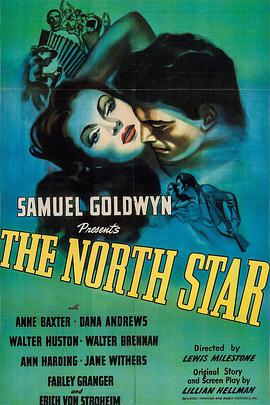
Erich von Stroheim — Actor (29)
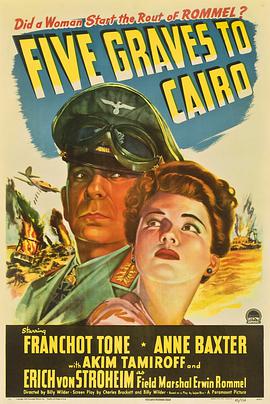
Movie
Five Graves to Cairo (1943)
Five Graves to Cairo WikiData IMDb TMDB Douban
other title:
开罗谍报战
/
大败罗美尔(港)
…
The British Army, retreating ahead of victorious Rommel, leaves a lone survivor on the Egyptian border who finds refuge at a remote desert hotel. He assumes the identity of a recently deceased waiter and is helped by the hotel's owner, despite protest from the French chambermaid, who fears the imminent arrival of Rommel and the Germans.


Movie
Marthe Richard (1937)
Marthe Richard, au service de la France WikiData IMDb TMDB Douban
other title:
Marthe Richard au service de la France
/
Marthe Richard, au service de la France
At the start of the First World War, Marthe Richard sees her parents arrested by German soldiers, taken away and shot. When she loses contact with her fiancé, André, a soldier on the Western Front, the young woman hastens to Paris with one thought in her mind – to take revenge on the Germans by serving her country. She is engaged by Commandant Rémond to work as a spy. She is sent to Saint-Sébastien in Spain to make contact with two senior German officers, von Ludow and von Falken. Von Ludow is easily seduced by Marthe’s charms and offers her work as a spy. Having gained the confidence of her enemies, Marthe stands every chance of fulfilling her mission, to determine the whereabouts of a hidden submarine base. However, von Ludow’s mistress, Mata Hari, sees Marthe as a rival and sets out to thwart her mission...
Marthe Richard au service de la France is one of three films by director Raymond Bernard which were set at the time of the First World War. The other two were: Les Croix de bois (1932) and Les Otages (1938). The film is based on the memoirs of Marthe Richard who, as a young woman, worked as a spy for the French during WWI. Richard would later became a leading campaigner against prostitution in France, a staunch supporter of the law that would result in the closure of brothels in 1946.
The main attraction of this film is its cast. The part of Marthe Richard is played by Edwige Feuillère, an engaging and very talented actress who was one of the stars of French cinema in the 1930s and 1940s. Her co-star is the impressive Erich von Stroheim, who had established himself as an actor in Hollywood after an inspired but largely unsuccessful career as a film director. This was the first of around half a dozen French films which von Stroheim starred in before his return to the United States at the start of World War II. It was immediately followed by La Grande illusion, in which von Stroheim again plays a German officer during WWI, arguably the actor’s most memorable film role. At the time, von Stroheim could not speak French and had to learn his lines phonetically, but that did not prevent him from giving a powerful, intensely human performance.
Unlike most of Raymond Bernard’s films, Marthe Richard au service de la France has not aged well. This is partly to do with the quality of the special effects – the air-sea battle sequence at the end of the film was clearly too ambitious to be realised convincingly with the available resources and looks risible compared with comparable Hollywood offerings of the period. However, what most dates the film is its flagrant appeal to nationalism. In contrast to Bernard’s earlier WWI film (the excellent Les Croix de bois), it shows a grotesquely idealised view of war, with John Buchan-style heroes, bloodless conflict and no end of flag-waving crowds. Obviously, the film was an appeal to patriotism as a time when war in Europe looked imminent, when a more realistic approach would have been a much harder sell. It is interesting to compare this with Bernard’s next film, Les Otages, also set during World War I. Whilst this later film also takes a patriotic line, it does so in a far more subtle way, whilst giving a more honest and convincing portrayal of the horrors of war.
One of the main themes of Marthe Richard au service de la France is the question of identity, of people not realising who the real enemy is during a period of crisis. Bernard seems to be strangely prescient of the problems that would beset the French nation when it fell under German occupation in the early 1940s, a time when no one could know for certain who was a collaborator or who was a resistance supporter, a time when persecuted minorities and free-thinkers had to conceal their identities or face deportation to the Nazi death camps. This would provide the subject for Raymond Bernard’s Un ami viendra ce soir (1946), the first film he made after a period of obscurity during the Second World War, one of his darkest and most interesting films. ~ James [email protected]

Movie
Alraune (1952)
Alraune WikiData IMDb TMDB Douban KevGa-NeoDB +2
亚瑟·玛丽亚·拉布纳拉
actor:
卡尔海因茨·伯姆
/
海蒂嘉德·纳福
…
other title:
阿尔劳娜
/
Unnatural
…
1952 film by Arthur Maria Rabenalt


Movie
Foolish Wives (1922)
Foolish Wives WikiData IMDb TMDB Douban
埃里克·冯·施特罗海姆
actor:
鲁道夫·克里斯提
/
杜邦小姐
…
other title:
情场现形记
/
愚妻
…
A con artist masquerades as Russian nobility and attempts to seduce the wife of an American diplomat.

Movie
The Grand Illusion (1937)
La grande illusion WikiData IMDb TMDB Douban Eggplant.place Skybridge +3
Jean Renoir
actor:
让·迦本
/
迪塔·帕尔洛
…
other title:
大幻影
/
La grande illusion
…
1937 film by Jean Renoir

Movie
Sunset Boulevard (1950)
Sunset Boulevard WikiData IMDb TMDB Douban Min reol Eggplant.place Skybridge +4
Billy Wilder
actor:
William Holden
/
Gloria Swanson
…
other title:
선셋 대로
/
サンセット大通り
…
A hack screenwriter writes a screenplay for a former silent film star who has faded into Hollywood obscurity.