Evgeniy Evstigneev — Actor (36)

Movie

Naval Cadets, Charge! (1988)
Гардемарины, вперед! IMDb TMDB
other title: Гардемарины, вперед!
Three naval cadets accidentally get possession of a secret diary that was stolen from Bestuzhev, a vice-chancellor of Russia. If this diary ever gets abroad, the consequences for the country would be grave. The cadets are trying to return the papers to their owner, but there are others who want to get the papers...

Movie

The Hyperboloid of Engineer Garin (1965)
Гиперболоид инженера Гарина WikiData IMDb TMDB Douban
other title: 工程师加林的双曲面 / Гиперболоид инженера Гарина …
Soviet era science-fiction is something that holds a great fascination as an x-ray of the zeitgeist of its times in exactly the same way that 1950s Hollywood B movies are fascinating historical artefacts for the way that they amplify fears of the Atomic Age and of the Communist threat. The Soviet films are fascinating in very different ways to their American counterparts – you can, for example, look through any of the Eastern Bloc science-fiction films of this era in vain in search of a work where they fear an invasion of the USSR by aliens that are a thinly disguised allegory for the United States. Moreover, there was only a single Soviet film, Letters from a Dead Man (1986) – which was made well into the era of perestroika – that deals with the issue of nuclear war and none at all that feature atomic monsters. Rather most of the Soviet science-fiction films of the 1950s and 60s seem political/ideologically driven works that feature noble scientists and engineers of the regime as they boldly carry the Communist cause to the stars. See efforts such as The Heavens Call (1959), Storm Planet (1962), Andromeda Nebula (1967), Moscow-Cassiopeia (1973), and works from non-Russian countries such as First Spaceship on Venus (1959) and Ikarie XB-1/Voyage to the End of the Universe (1963). Most of these were brought up by Roger Corman and AIP and re-edited into titles like Battle Beyond the Sun (1963), Voyage to the Prehistoric Planet (1965), Queen of Blood (1966) and Voyage to the Planet of Prehistoric Women (1968). These are not fearful films like their American counterparts, rather they seem lit up by the grand ideals of colonising the universe that caught the Soviet imagination during the Space Age. The Hyperboloid of Engineer Garin is based on The Hyperboloid of Engineer Garin/The Garin Death Ray (1927), a novel by Alexei Tolstoy, the writer whose original work also became the basis of the very first Soviet science-fiction film, the silent classic Aelita (1924). The film would appear to be a fairly accurate translation of the book from what I can gather, even retaining the 1920s setting of its original publication. The one thing that left me puzzled was the reference to the death ray as an hyperboloid. My immediate thought was to think of the literary term ‘hyperbole’, which means a form of exaggeration that is not meant to be taken literally, but apparently an hyperboloid is a curved three-dimensional surface. The first half of The Hyperboloid of Engineer Garin takes place as a spy thriller. It is fascinating to see as a counterpoint to the numerous English-language spy films that were being made around this era such as the James Bond and Harry Palmer films or more serious works like The Spy Who Came in from the Cold (1965). These often featured the Soviets as villains but here we are seeing a spy film from the opposite side of the political fence. Like many of these others, The Hyperboloid of Engineer Garin takes place in a series of freewheeling international locations, which are often lavishly presented. I began to get into the film, impressed by the directorial style that Alexander Gintsburg was showing where many of the scenes are shot in an exaggeratedly heavy contrast of light and shadow that immediately recalls the world of The Third Man (1949). On the minus side, you get the feeling that the film is compacting down the complicated plotting that takes place in the book. What we end up with is a murkily incomprehensible plot that involves the murder of a double of Garin, international blackmail and sabotage, multiple murder plots and a number of factions running around all seeking to either kill Garin or get their hands on his discovery, at the same time as he tries to find a colleague who has gone into hiding in a remote part of the world. It is when it unveils its hyperboloid about halfway through that The Hyperboloid of Engineer Garin starts to come to life as a science-fiction film. There is the fascinating scene where Yevgeny Yevstigneyev’s Garin is holed up in a villa as several people come after him and so switches the hyperboloid on and eliminates all his opponents by sweeping the heat ray across the door. Thereafter the film abandons the spy thriller aspect and becomes a film about an amazing discovery. Here it starts to resemble one of the German classics of the early sound era – the likes of F.P.1 Does Not Answer (1932), The Tunnel (1933) and Gold (1934), which were films made about scientific discoveries that marvelled in the sheer power of engineering projects. There is a great fascination to the scenes of the machine drilling through the Earth to reach the olivine layer, the vast project built on the island and especially the scenes where Yevgeny Yevstigne

Movie

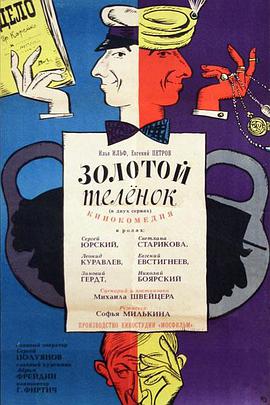
The Golden Calf (1968)
Золотой телёнок Douban
米哈伊尔·施维采尔 actor: 谢尔盖·尤尔斯基 / 列昂尼德·库拉夫廖夫 …
other title: 金牛犊 / Золотой телёнок …
在《十二把椅子》结尾被杀害的奥斯塔普·班德尔并没有死,他奇迹般地活了下来。为了一夜暴富,前往从小期盼的里约热内卢生活,这次他的目标是一位通过不义手段攒下大量钱财的苏联地下百万富翁科列科。班德尔再次带着一群跟班,在苏联各地展开行骗之旅……

Movie

Jazzmen (1984)
Мы из джаза Douban
Karen Shakhnazarov actor: Yelena Tsyplakova / 伊戈尔·斯克利亚尔 …
other title: 生为爵士狂 / Мы из джаза …
有人戏称这部电影是“四个男人的一台戏”。 影片中基本没有特别引人的情节,没有激烈的动作打斗场面,甚至没有撩人心弦的爱情故事,然而绕有趣味的是,影片除却赢得了1700万观众,还被当时权威电影杂志《苏联银幕》评为1983年最佳影片。 这样一部既叫座又叫好的影片讲述了前苏联20年代四个青年音乐家组办爵士乐队的故事。在那样一个“火红的年代”,属于“资本主义意识形态”的爵士乐很难被苏联官方接受。出现在影片中几乎所有文化场合的标语“艺术要为劳动人民服务!”是那个时代的典型象征。四个热爱爵士乐的青年就这样不合时宜、一波三折地进行着他们“不可能完成的任务”。 影片拍摄完成的80年代,苏联人已经开始通过一些“非法渠道”接触西方文化,当时,《巴黎最后的探戈》录像带开始半地下流行,持不同政见歌手的音乐会也几乎场场爆满。因此,在这样一种社会背景下影片中发生的故事立刻能得到观众的认同,主人公们对理想的执着、对自我价值的肯定、对友谊的坚持也让人感觉亲近和鼓舞。 影片运用幽默诙谐的手法对时代进行嘲讽,用优美的音乐旋律和舞蹈动作打动观众,一个本应沉重的题材得以让人轻松地内省。 导演卡·沙赫纳扎罗夫、编剧亚·巴拉基杨斯基、摄影弗·舍弗兹伊克构成了一个强力组合, 剧本经过10次修改,人物性格设计上的差异赋予了演员极大的发挥空间。透视片中时代里的个体、音乐里的个性,我们看到一种俄罗斯哲学的智慧。或许有一天,你已经忘记了影片故事的情节,但是某些掺杂着辛酸与甜蜜、沮丧与欣喜的电影画面会在脑海中悄然浮现。 影片获1984年法国格勒诺布尔国际音乐片电影节评委会特别奖,波兰罗兹国际电影节银奖,并参展1984年伦敦、芝加哥、贝尔格莱德等电影节。

Movie

Nine Days of One Year (1962)
Девять дней одного года WikiData IMDb TMDB Douban
米哈伊尔·罗姆 actor: 阿列克谢·巴塔洛夫 / 因诺肯季·斯莫克图诺夫斯基 …
other title: 一年中的九天 / Девять дней одного года …
Set in the Soviet scientific community, the story follows two dedicated physicists whose close friendship unfolds amid dangerous nuclear research, shaped by their shared affection for a strong-willed woman. Radiation exposure, scientific ambition, and romantic rivalries intersect as the characters confront the physical risks of their work and the personal consequences of their choices.

Movie

Sandu Follows the Sun (1961)
Человек идет за солнцем Douban
other title: 跟随太阳走的人 / Человек идет за солнцем …
Мне удалось это кино посмотреть в далеком 1962 году! Кроме цензуры запретительной, в то время была еще и цензура косвенная, когда прокат выносился из центра в окраинные кинотеатры. Я знал о существовании этого фильма от родителей (профессиональных киношников), которые видели его в Доме кино и остались под огромным впечатлением. Мне было всего 12 лет. И вот, гуляя с кузинами в Зеленогорске (пригороде СПб), я вижу афишу. На утреннем сеансе (!) «Человек идет за солнцем». Я, помня рассказы предков, говорю, что фильм надо обязательно посмотреть, но был уверен, что меня не пустят, так как, с совковых позиций, он явно тянул на «детям до 16-ти». С трепетом спрашиваем в кассе билеты… есть! «А можно ли мальчику пойти?» «Конечно!» — отвечает кассирша. — «Это кино про маленького ребенка…» Так мне удалось увидеть тогда этот фильм, и вот я уже 46 лет помню и этого мальчика с цветными стеклышками, и знаменитый диалог «кого хоронят? — человека хоронят!», и, конечно, романс «У тебя такие глаза», текст которого осел в детской памяти почти полностью. Уж очень это искусство выпадало из обоймы общего «духовного питания». Недавно попался диск Мр3 Микаэла Таривердиева в том числе и с этим романсом… А буквально вчера наткнулся в инете на авишку этого фильма. Жалко, конечно, что качество сохранившейся копии гнусное, но все равно с наслаждением снова окунулся в атмосферу этого опередившего свое время фильма.

Movie

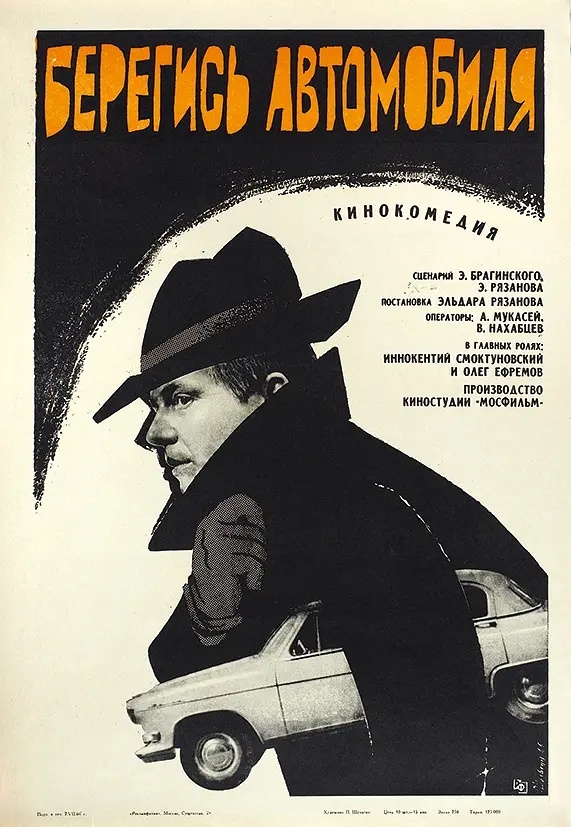
Beware of the Car (1966)
Берегись автомобиля WikiData IMDb TMDB Douban
★ 7.8 9 ratings
埃利达尔·梁赞诺夫 actor: 因诺肯季·斯莫克图诺夫斯基 / 奥列格·叶甫列莫夫 …
other title: 看好你的车 / Берегись автомобиля …
An insurance agent who moonlights as a car thief steals cars various crooks and never from the common people. He sells the stolen cars and gives the money to charity. His best friend, a cop, is assigned to bring in this modern robin hood.

Movie

Heart of a Dog (1988)
Собачье сердце
★ 7.6 10 ratings
other title: 狗心 / Собачье сердце …
"Heart of a Dog" is a Soviet film adaptation of Mikhail Bulgakov’s iconic novella. Set in 1920s Moscow, it tells the satirical and darkly humorous story of a stray dog named Sharik, who is transformed into a human by Professor Preobrazhensky through a daring medical experiment. The resulting man, Poligraf Poligrafovich Sharikov, embodies the social and ideological tensions of early Soviet society. With its sharp critique of class struggle, human nature, and the perils of radical change, the film is celebrated for its faithful adaptation, brilliant performances, and rich allegorical depth.

Movie

Welcome, or No Trespassing (1964)
Добро пожаловать, или Посторонним вход воспрещен
★ 8.5 35 ratings
依莱姆·克里莫夫 actor: 叶甫根尼·耶夫斯基格涅耶夫 / 阿日娜·阿列尼科娃 …
other title: Benvenuti ovvero vietato l'ingresso agli estranei / Добро пожаловать, или Посторонним вход воспрещен …
A satirical comedy about the excessive restrictions that children face during their vacation in a Young Pioneer camp.