Bill Viola — Director (16)

Movie

Sweet Light (1977)
Sweet Light WikiData IMDb TMDB
Using a camera moving along a predetermined path to create the effect of a simulated zoom, Sweet Light refers to the seduction of illumination, focusing on the phototropic vision of a moth. Writes Viola, "A moth emerges from a discarded letter as the spirit of a dead thought and — after an attempted flight to freedom — an individual appears, is inexorably drawn into the source of light, and consumed."

Movie

Chott el-Djerid (A Portrait in Light and Heat) (1979)
Chott el-Djerid (A Portrait in Light and Heat) IMDb TMDB
Driven by a quest to capture a landscape reduced to flatness and sky, Viola travels to Chott El-Djerid. The film opens with images of snowy prairies and winter scenes, mirrored by warm, vibrating desert vistas. Through powerful telephoto lenses, shimmering mirages and warped forms emerge under extreme heat and light. These visuals evoke a space where dream and waking reality merge. Viola’s journey transcends documentation, transforming viewing into a reflective exploration of the limits of perception.

Movie

Ancient of Days (1982)
Ancient of Days IMDb TMDB
Ancient of Days is a remarkable series of "canons and fugues for video" that comprises Viola's most sophisticated structural and metaphorical explorations of time. Mathematical notations of precise time-code editing were applied to construct illustrations of temporal symmetry, duality and transposition — time-based equivalents of musical compositional principles such as counterpoint and serialism. Astonishing temporal interventions — a 180-degree pan gazing downward on a New York City street that progresses from day to night, an image of Mount Rainier in which the foreground and background unfold in different time planes — unfold as symbolic transformations of natural and urban landscapes.

Movie

Return (1975)
Return IMDb TMDB
Return is a methodical construction of the approach of an individual towards an unseen goal, which assumes metaphorical significance. Viola moves toward the camera/viewer, pausing every few steps to ring a bell, at which point he is momentarily thrust back to his starting place, and then advanced again. Finally reaching his destination, he is taken through all of the previous stages in a single instant and returned to the source of his journey.

Movie

The Innocents (2008)
The Innocents TMDB
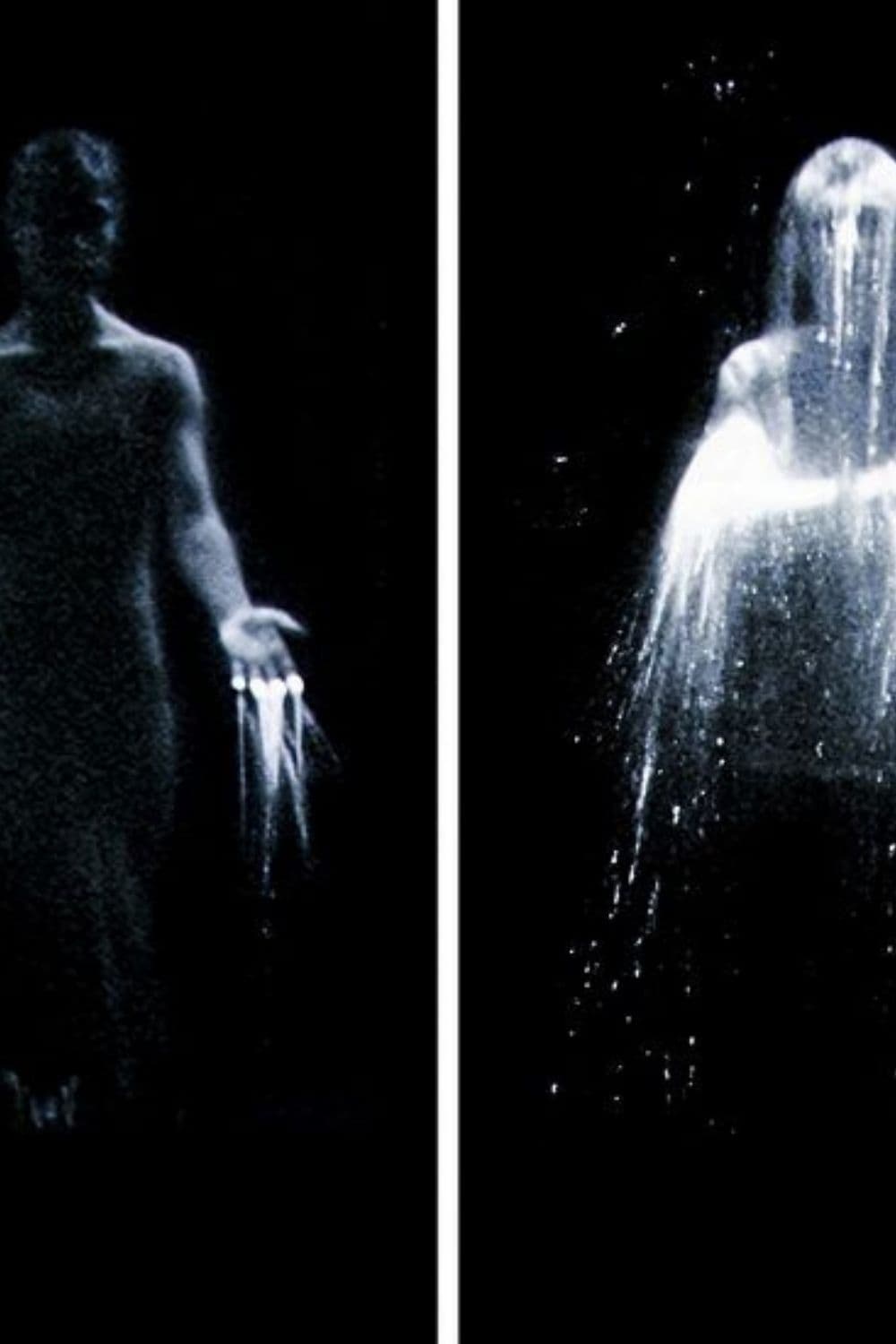
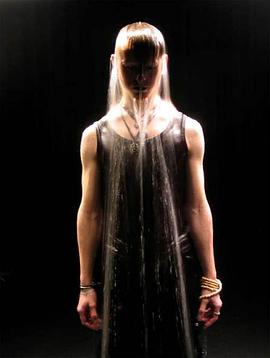
Part of Bill Viola’s Transfiguration series, The Innocents explores the presence of the dead in the world of the living. The video documents a boy and a girl who slowly approach out of the darkness and into the light. Shown on separate screens, they break through what is, at first, an invisible threshold of water, suggestive of a passage from the spiritual world into a physical plane of existence. Once incarnate, however, all beings realize that their presence is finite, and so the figures eventually turn away from material existence to return from whence they came.

Movie

Migration (1976)
Migration (for Jack Nelson) IMDb TMDB Douban
other title: Migration (for Jack Nelson)
"The idea for Migration came to Viola while he was walking down a street one rainy day in New York. His glasses were covered with raindrops and he saw that each drop was a lens. Everything around him was covered with little hemispherical lenses that contained optical microcosms of the environment. He was surrounded by worlds within worlds . He couldn't see the images in the beads of water on a passing car but he knew they were there. It was a question of scale. He recalled an exhibition of satellite photos that showed first the east coast, then the New York area, then just Manhattan, then just lower Manhattan . What fascinated him was not that one could see buildings from that distance, but that such detail wasn't the result of a zoom or a blowup as we normally understand them. They hadn't used four different telephoto lenses and made four different pictures . It was all one computer-enhanced electronic image, a database. The information in the closeup existed already in the larger-scale".

Movie

The Raft (2004)
The Raft Douban
other title: 筏 / 救生筏
Nineteen people of varying age, race and sex gather in tight physical proximity, as a compact human mob, when without warning a gushing onslaught of water from both sides of the screen knocks them into one another and down to the ground.

Movie

I Do Not Know What It Is I Am Like (1986)
I Do Not Know What It Is I Am Like Douban
other title: 我不知道自己是什么样子
I Do Not Know What It Is I Am Like includes the following chapters: Il Corpo Scuro (The Dark Body) The Language of the Birds The Night of Sense Stunned by the Drum The Living Flame An epic journey in five chapters, I Do Not Know What It Is I Am Like is a personal investigation into the inner states and connections to animal consciousness we all possess. In a stream of images of striking clarity, depth and beauty, woven within a subtle fabric of natural sound, Bill Viola evokes a timeless view of the natural world and our place in it. This is a major contribution to contemporary video art that masterfully speaks to us in the inner language of subjective thoughts and collective memories. Bill Viola and Kira Perov gathered images for this video work over a period of two years. In the course of their travels they spent several weeks with a freely roaming herd of buffalo in Wind Cave National Park, South Dakota, recorded a time-lapse sequence beside a glacial lake in the Canadian Rocky Mountains, and attended a week-long firewalking ritual at a Hindu Temple on the island of Fiji. During This time, Viola was also artist-in-residence at the San Diego Zoo.

Movie

The Reflecting Pool (1997)
The Reflecting Pool IMDb TMDB Douban
★ 9.0 7 ratings
other title: 倒影池
Bill Viola's The Reflecting Pool created from 1977 to 1979 is largely concerned with water. The camera angle of this film never moves. The camera is positioned in the same place for the entirety of the piece. In the beginning of the film you see a square pool which has the color and feel of an impressionist painting. You hear the sound of outside, both airplanes and running water. From the woods you slowly see a man appear and he stands by the edge of the pool. The viewer is captivated with him standing there staring at the pool. Then there is a freeze frame of the man doing a cannon ball into the pool. There is movement of water as if something had dropped but the image is still lingering above the pool. A reflection of a person walking is able to be made out in the water. There is no person walking to be causing that reflection though. Then you see the frozen image over the water disappear. Now there are two reflections walking. Again there is no figure to cause such a reflection. There are ripples of water in the pool and then the single image reflection appears again. Then the person that was in the cannon ball freeze frame swims to the edge of the pool and get out, walking back into the woods. The Reflecting Pool seems to be a full circle. Starting from the woods and ending in the woods. Is this an analogy for life--starting at one point and ending at another with many strange things occurring in between? Sometimes there is no explanation for incidents, just like the reflections and you don't necessarily need to see the splash to believe that when you jump you eventually are going to land. The person getting out of the pool was a way of answering whether or not he was in that pool. This film made you think about the process of human thought. How everything doesn't need to physically be shown to know they are there.

Movie

First Dream (1981)
Hatsu Yume IMDb TMDB Douban
other title: 第一场梦 / Hatsu Yume …
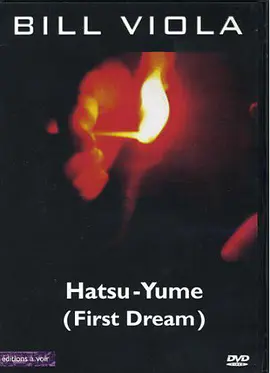
Hatsu-Yume (First Dream) is Bill Viola’s masterpiece, the greatest work by one of the most important video artists in the world. A spiritual allegory equating light and dark with life and death. Hatsu-Yume was produced in Japan in 1981 while Viola was artist-in-residence at the Sony Corporation. The title refers to Japanese folklore, wherein things done on the first day of a new year are significant. But the tape is not to be taken literally as a dream. For Viola, it’s more like the aboriginal concept of dreamtime, the creation of the world. That’s why, as a whole and in its parts, Hatsu-Yume progresses from darkness to light, stillness to motion, silence to sound, simplicity to complexity, nature to civilization. There are two interwoven themes: the dark water world of fish, and Buddhist rituals invoking the souls of dead ancestors. As in a dream, we frequently can’t tell if these wordless streams of image and sound are unfolding in real time, slow-motion or time-lapse. A work of extravagant pictorial beauty, Hatsu-Yume represents the most painterly use of light in the history of video. Form is content: the light that lures fish to their death protects human life. At once ominous majestic, and deeply spiritual, Hatsu-Yume is the work of a visionary poet of image and sound.