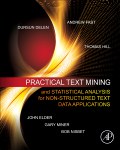
Practical Text Mining and Statistical Analysis for Non-structured Text Data Applications [Book] Douban
author:
Gary Miner
/
John Elder
…
publishing house:
Academic Press
2012
- 1
Practical Text Mining and Statistical Analysis for Non-structured Text Data Applications brings together all the information, tools and methods a professional will need to efficiently use text mining applications and statistical analysis. Winner of a 2012 PROSE Award in Computing and Information Sciences from the Association of American Publishers, this book presents a comprehensive how-to reference that shows the user how to conduct text mining and statistically analyze results. In addition to providing an in-depth examination of core text mining and link detection tools, methods and operations, the book examines advanced preprocessing techniques, knowledge representation considerations, and visualization approaches. Finally, the book explores current real-world, mission-critical applications of text mining and link detection using real world example tutorials in such varied fields as corporate, finance, business intelligence, genomics research, and counter terrorism activities. The world contains an unimaginably vast amount of digital information which is getting ever vaster ever more rapidly. This makes it possible to do many things that previously could not be done: spot business trends, prevent diseases, combat crime and so on. Managed well, the textual data can be used to unlock new sources of economic value, provide fresh insights into science and hold governments to account. As the Internet expands and our natural capacity to process the unstructured text that it contains diminishes, the value of text mining for information retrieval and search will increase dramatically. Features: extensive case studies, most in a tutorial format, allow the reader to 'click through' the example using a software program, thus learning to conduct text mining analyses in the most rapid manner of learning possible; numerous examples, tutorials, power points and datasets available via companion website on Elsevierdirect.com; and glossary of text mining terms provided in the appendix -CD included.