Elliotte Rusty Harold — 作者 (9)
Java I/O [图书] 豆瓣
All of Java's Input/Output (I/O) facilities are based on streams, which provide simple ways to read and write data of different types. Java provides many different kinds of streams, each with its own application. The universe of streams is divided into four large categories: input streams and output streams, for reading and writing binary data; and readers and writers, for reading and writing textual (character) data. You're almost certainly familiar with the basic kinds of streams--but did you know that there's a CipherInputStream for reading encrypted data? And a ZipOutputStream for automatically compressing data? Do you know how to use buffered streams effectively to make your I/O operations more efficient? Java I/O, 2nd Edition has been updated for Java 5.0 APIs and tells you all you ever need to know about streams--and probably more. A discussion of I/O wouldn't be complete without treatment of character sets and formatting. Java supports the Unicode standard, which provides definitions for the character sets of most written languages. Consequently, Java is the first programming language that lets you do I/O in virtually any language. Java also provides a sophisticated model for formatting textual and numeric data. Java I/O, 2nd Edition shows you how to control number formatting, use characters aside from the standard (but outdated) ASCII character set, and get a head start on writing truly multilingual software. Java I/O, 2nd Edition includes: * Coverage of all I/O classes and related classes * In-depth coverage of Java's number formatting facilities and its support for international character sets
重构HTML [图书] 豆瓣
Refactoring HTML
随着网站越来越大,问题开始出现:速度变慢、链接失败、安全性变差、兼容性降低……怎么办?从头开始重建网站总不是明智之举,这需要投入大量时间和财力。其实,你完全可以四两拨千斤,使用简单有效的技术、工具和诀窍来重构既有代码。
世界级专家Elliotte Rusty Harold在本书中采用理论与实践相结合的方式,展示了如何开展HTML重构,使网站具备更好的可靠性、可用性、安全性、可访问性、兼容性,提高网站性能。书中详细描述了如何从过时的代码向现在稳定的Web标准(包括XHTML、CSS和REST)迁徙,并淘汰诸如基于呈现的标记、状态相关的应用程序和 “标签汤”。
本书在手,助你的网站实现质的飞跃。
世界级专家Elliotte Rusty Harold在本书中采用理论与实践相结合的方式,展示了如何开展HTML重构,使网站具备更好的可靠性、可用性、安全性、可访问性、兼容性,提高网站性能。书中详细描述了如何从过时的代码向现在稳定的Web标准(包括XHTML、CSS和REST)迁徙,并淘汰诸如基于呈现的标记、状态相关的应用程序和 “标签汤”。
本书在手,助你的网站实现质的飞跃。
Java Network Programming [图书] 豆瓣
The new third edition of this highly regarded introduction to Java networking programming has been thoroughly revised to cover all of the 100+ significant updates to Java Developers Kit (JDK) 1.5. It is a clear, complete introduction to developing network programs (both applets and applications) using Java, covering everything from networking fundamentals to remote method invocation (RMI). Java Network Programming, 3rd Edition includes chapters on TCP and UDP sockets, multicasting protocol and content handlers, servlets, multithreaded network programming, I/O, HTML parsing and display, the Java Mail API, and the Java Secure Sockets Extension. There's also significant information on the New I/O API that was developed in large part because of the needs of network programmers. This invaluable book is a complete, single source guide to writing sophisticated network applications. Packed with useful examples, it is the essential resource for any serious Java developer.
Java I/O (O'Reilly Java) [图书] 豆瓣
All of Java's Input/Output (I/O) facilities are based on streams, which provide simple ways to read and write data of different types. Java provides many different kinds of streams, each with its own application. The universe of streams is divided into four large categories: input streams and output streams, for reading and writing binary data; and readers and writers, for reading and writing textual (character) data. You're almost certainly familiar with the basic kinds of streams--but did you know that there's a CipherInputStream for reading encrypted data? And a ZipOutputStream for automatically compressing data? Do you know how to use buffered streams effectively to make your I/O operations more efficient? Java I/O tells you all you ever need to know about streams--and probably more.A discussion of I/O wouldn't be complete without treatment of character sets and formatting. Java supports the UNICODE standard, which provides definitions for the character sets of most written languages. Consequently, Java is the first programming language that lets you do I/O in virtually any language. Java also provides a sophisticated model for formatting textual and numeric data. Java I/O shows you how to control number formatting, use characters aside from the standard (but outdated) ASCII character set, and get a head start on writing truly multilingual software.Java I/O includes:
Coverage of all I/O classes and related classes
In-depth coverage of Java's number formatting facilities and its support for International character sets
Coverage of all I/O classes and related classes
In-depth coverage of Java's number formatting facilities and its support for International character sets
Effective XML [图书] 豆瓣
Learning the fundamentals of XML might take a programmer a week. Learning how to use XML effectively might take a lifetime. While many books have been written that teach developers how to use the basic syntax of XML, this is the first one that really focuses on how to use XML well. This book is not a tutorial. It is not going to teach you what a tag is or how to write a DTD (Document Type Definition). Instead it's going to tell you when, why, where, and how to use such tools effectively (and equally important when not to use them).Since XML has become a fundamental underpinning of new software systems, it becomes important to ask new questions, not just what XML is, but how does one use it effectively? Which techniques work and which don't? Perhaps most importantly, which techniques appear to work at first but fail to scale as systems are further developed? This book answers these questions. It is not enough to write programs that compile and produce the expected results. It is important to write code that is extensible, legible, and maintainable. XML can be used to produce robust, extensible, maintainable systems.
Beautiful Code: Leading Programmers Explain How They Think [图书]
作者:
Jon L. Bentley
/
Brian W. Kernighan
…
publishing house:
O'Reilly Media
2007
- 7
How do the experts solve difficult problems in software development? In this unique and insightful book, leading computer scientists offer case studies that reveal how they found unusual, carefully designed solutions to high-profile projects. You will be able to look over the shoulder of major coding and design experts to see problems through their eyes.
This is not simply another design patterns book, or another software engineering treatise on the right and wrong way to do things. The authors think aloud as they work through their project's architecture, the tradeoffs made in its construction, and when it was important to break rules.
is an opportunity for master coders to tell their story. All author royalties will be donated to Amnesty International.
This is not simply another design patterns book, or another software engineering treatise on the right and wrong way to do things. The authors think aloud as they work through their project's architecture, the tradeoffs made in its construction, and when it was important to break rules.
is an opportunity for master coders to tell their story. All author royalties will be donated to Amnesty International.
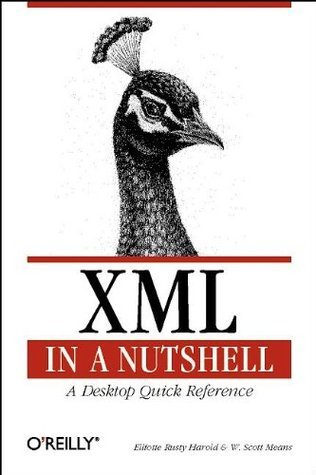
XML in a Nutshell : A Desktop Quick Reference [图书] Goodreads
XML, the Extensible Markup Language, is a W3C endorsed standard for document markup. Because of its ability to deliver portable data, XML is positioned to be a key web application technology.Given the complexity and incredible potential of this powerful markup language, it is clear that every serious developer using XML for data or text formatting and transformation will need a comprehensive, easy-to- access desktop reference in order to take advantage of XML's full potential. XML in a Nutshell will assist developers in formatting files and data structures correctly for use in XML documents.XML defines a basic syntax used to mark up data with simple, human-readable tags, and provides a standard format for computer documents. This format is flexible enough to be customized for transforming data between applications as diverse as web sites, electronic data inter-change, voice mail systems, and wireless devices, to name a few.Developers can either write their own programs that interact with, massage, and manipulate the data in XML documents, or they can use off-the-shelf software like web browsers and text editors to work with XML documents. Either choice gives them access to a wide range of free libraries in a variety of languages that can read and write XML.The XML specification defines the exact syntax this markup must how elements are delimited by tags, what a tag looks like, what names are acceptable for elements, where attributes are placed, and so forth. XML doesn't have a fixed set of tags and elements that are supposed to work for everybody in all areas of interest for all time. It allows developers and writers to define the elements they need as they need them.Although XML is quite flexible in the elements it allows to be defined, it is quite strict in many other respects. XML in a Nutshell covers the fundamental rules that all XML documents and authors must adhere to, detailing the grammar that specifies where tags may be placed, what they must look like, which element names are legal, how attributes attach to elements, and much more.