other title:
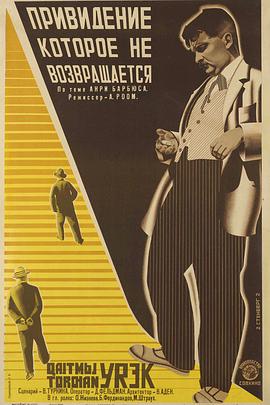
一去不复返的幽灵
/
Привидение, которое не возвращается
…
Like his famous Tretya meshchanskaya/ Bed and Sofa (1927), this 66 minute-long silent film by director Abram Room (1894-1976) is an existential drama disguised as a saga about the proletarian struggle. The Ghost That Never Returns (1929) presents a lonely and insecure individual who is challenged to act more heroically than he is prepared to, but who constantly questions his confidence and loyalties.
The film is set in an unnamed South American country. Jose Real is a labor leader who is sentenced to life in jail. But even though he is safely kept behind bars, the guards are not satisfied and look for an opportunity to get rid of him. So they plot to assassinate him by staging an escape. As someone who has already served ten years, Jose is eligible for a day of liberty in order to visit his family. The prison officials plan to send him on this visit and ensure that he is killed during that day. In order to achieve their goal they send an experienced executor to trail Jose. The rest of the film consists of convoluted series of moves and chases amidst impressively rugged landscapes, at the end of which Jose manages to get back home (in spite all obstacles), to see his little son and his wife, and to reconnect with his fellow-communists who are about to begin a strike. Not a single man who has been sent off to such a day of freedom has ever returned to prison, usually because he would have been killed by the guards. But not Jose — he does not return either, but it is because he turns into a phantom of liberty. Protected by his comrades, he comes to lead the looming strike.
The depiction of South American life and landscape in the film appears convincing. There are some avant garde sets representing the prison, reminiscent of sets used by Fritz Lang in Metropolis (I thought of links to Fritz Lang’s aesthetics of the time more than once while watching the film). The film is based on the writing of Henri Barbusse (1873-1935), a French writer who had moved to Russia in 1918 and who closely sympathized with the Bolsheviks (he also authored biopics on Trotsky and Stalin). There is proficient camera work (by Dmitri Feldman who later on worked primarily in the context of Armenian and Georgian cinema), at moments reminiscent to the visual experiments of Vertov just a few years earlier, using multiplication of the image to create psychologically tense effect. The original music score (by A. Shenshin) is truly impressive.