Tim Wu — 作者 (9)
The Attention Merchants [图书] 豆瓣 谷歌图书
作者: Tim Wu 出版社: Vintage 2017 - 9
From the author of the award-winning The Master Switch, who coined the term "net neutrality”—a revelatory, ambitious and urgent account of how the capture and re-sale of human attention became the defining industry of our time. 

"Dazzling." —Financial Times

Ours is often called an information economy, but at a moment when access to information is virtually unlimited, our attention has become the ultimate commodity. In nearly every moment of our waking lives, we face a barrage of efforts to harvest our attention. This condition is not simply the byproduct of recent technological innovations but the result of more than a century's growth and expansion in the industries that feed on human attention.

Wu’s narrative begins in the nineteenth century, when Benjamin Day discovered he could get rich selling newspapers for a penny. Since then, every new medium—from radio to television to Internet companies such as Google and Facebook—has attained commercial viability and immense riches by turning itself into an advertising platform. Since the early days, the basic business model of “attention merchants” has never changed: free diversion in exchange for a moment of your time, sold in turn to the highest-bidding advertiser.

Full of lively, unexpected storytelling and piercing insight, The Attention Merchants lays bare the true nature of a ubiquitous reality we can no longer afford to accept at face value.
The Master Switch [图书] 豆瓣
作者: Tim Wu 出版社: Knopf 2010 - 11
In this age of an open Internet, it is easy to forget that every American information industry, beginning with the telephone, has eventually been taken captive by some ruthless monopoly or cartel. With all our media now traveling a single network, an unprecedented potential is building for centralized control over what Americans see and hear. Could history repeat itself with the next industrial consolidation? Could the Internet—the entire flow of American information—come to be ruled by one corporate leviathan in possession of “the master switch”? That is the big question of Tim Wu’s pathbreaking book.
As Wu’s sweeping history shows, each of the new media of the twentieth century—radio, telephone, television, and film—was born free and open. Each invited unrestricted use and enterprising experiment until some would-be mogul battled his way to total domination. Here are stories of an uncommon will to power, the power over information: Adolph Zukor, who took a technology once used as commonly as YouTube is today and made it the exclusive prerogative of a kingdom called Hollywood . . . NBC’s founder, David Sarnoff, who, to save his broadcast empire from disruptive visionaries, bullied one inventor (of electronic television) into alcoholic despair and another (this one of FM radio, and his boyhood friend) into suicide . . . And foremost, Theodore Vail, founder of the Bell System, the greatest information empire of all time, and a capitalist whose faith in Soviet-style central planning set the course of every information industry thereafter.
Explaining how invention begets industry and industry begets empire—a progress often blessed by government, typically with stifling consequences for free expression and technical innovation alike—Wu identifies a time-honored pattern in the maneuvers of today’s great information powers: Apple, Google, and an eerily resurgent AT&T. A battle royal looms for the Internet’s future, and with almost every aspect of our lives now dependent on that network, this is one war we dare not tune out.
Part industrial exposé, part meditation on what freedom requires in the information age, The Master Switch is a stirring illumination of a drama that has played out over decades in the shadows of our national life and now culminates with terrifying implications for our future.
The Attention Merchants: The Epic Scramble to Get Inside Our Heads [图书] 豆瓣 Goodreads
作者: Tim Wu 出版社: Knopf 2016 - 10 其它标题: The Attention Merchants
Feeling attention challenged? Even assaulted? American business depends on it. In nearly every moment of our waking lives, we face a barrage of messaging, advertising enticements, branding, sponsored social media, and other efforts to harvest our attention. Few moments or spaces of our day remain uncultivated by the "attention merchants," contributing to the distracted, unfocused tenor of our times.

Tim Wu argues that this condition is not simply the byproduct of recent technological innovations but the result of more than a century's growth and expansion in the industries that feed on human attention. From the pre-Madison Avenue birth of advertising to the explosion of the mobile web; from AOL and the invention of email to the attention monopolies of Google and Facebook; from Ed Sullivan to celebritypower brandslike Oprah Winfrey, Kim Kardashian and Donald Trump, the basic business model of "attention merchants" has never changed: free diversion in exchange for a moment of your consideration, sold in turn to the highest-bidding advertiser. Wu describes the revolts that have risen against the relentless siege of our awareness, from the remote control to the creation of public broadcasting to Apple's ad-blocking OS. But he makes clear that attention merchants are always growing new heads, even as their means of getting inside our heads are changing our very nature--cognitive, social, political and otherwise--in ways unimaginable even a generation ago.
The Curse of Bigness [图书] 豆瓣
作者: Tim Wu 出版社: Columbia Global Reports 2018 - 11
From the man who coined the term "net neutrality," author of The Master Switch and The Attention Merchants, comes a warning about the dangers of excessive corporate and industrial concentration for our economic and political future.
We live in an age of extreme corporate concentration, in which global industries are controlled by just a few giant firms -- big banks, big pharma, and big tech, just to name a few. But concern over what Louis Brandeis called the "curse of bigness" can no longer remain the province of specialist lawyers and economists, for it has spilled over into policy and politics, even threatening democracy itself. History suggests that tolerance of inequality and failing to control excessive corporate power may prompt the rise of populism, nationalism, extremist politicians, and fascist regimes. In short, as Wu warns, we are in grave danger of repeating the signature errors of the twentieth century.
In The Curse of Bigness, Columbia professor Tim Wu tells of how figures like Brandeis and Theodore Roosevelt first confronted the democratic threats posed by the great trusts of the Gilded Age--but the lessons of the Progressive Era were forgotten in the last 40 years. He calls for recovering the lost tenets of the trustbusting age as part of a broader revival of American progressive ideas as we confront the fallout of persistent and extreme economic inequality.
Who Controls the Internet? [图书] 豆瓣
作者: Jack Goldsmith / Tim Wu 出版社: Oxford University Press 2006 - 3
Will cyberanarchy rule the net? And if we do find a way to regulate our cyberlife will national borders dissolve as the Internet becomes the first global state? In this provocative new work, Jack L. Goldsmith and Tim Wu dismiss the fashionable talk of both a 'borderless' net and of a single governing 'code'. Territorial governments can and will, they contend, exercise significant control over all aspects of Internet communications. Examining policy puzzles from e-commerce to privacy, speech and pornography, intellectual property, and cybercrime, Who Controls the Internet demonstrates that individual governments rather than private or global bodies will play that dominant role in regulation. Accessible and controversial, this work is bound to stir comment.
Who Controls the Internet? [图书] 豆瓣
作者: Jack Goldsmith / Tim Wu 出版社: Oxford University Press 2008 - 6
Is the Internet erasing national borders? Will the future of the Net be set by Internet engineers, rogue programmers, the United Nations, or powerful countries? Who's really in control of what's happening on the Net? In this provocative new book, Jack Goldsmith and Tim Wu tell the fascinating story of the Internet's challenge to governmental rule in the 1990s, and the ensuing battles with governments around the world. It's a book about the fate of one idea--that the Internet might liberate us forever from government, borders, and even our physical selves. We learn of Google's struggles with the French government and Yahoo's capitulation to the Chinese regime; of how the European Union sets privacy standards on the Net for the entire world; and of eBay's struggles with fraud and how it slowly learned to trust the FBI. In a decade of events the original vision is uprooted, as governments time and time again assert their power to direct the future of the Internet. The destiny of the Internet over the next decades, argue Goldsmith and Wu, will reflect the interests of powerful nations and the conflicts within and between them.While acknowledging the many attractions of the earliest visions of the Internet, the authors describe the new order, and speaking to both its surprising virtues and unavoidable vices. Far from destroying the Internet, the experience of the last decade has lead to a quiet rediscovery of some of the oldest functions and justifications for territorial government. While territorial governments have unavoidable problems, it has proven hard to replace what legitimacy governments have, and harder yet to replace the system of rule of law that controls the unchecked evils of anarchy. While the Net will change some of the ways that territorial states govern, it will not diminish the oldest and most fundamental roles of government and challenges of governance. Well written and filled with fascinating examples, including colorful portraits of many key players in Internet history, this is a work that is bound to stir heated debate in the cyberspace and globalization communities.
The Master Switch: The Rise and Fall of Information Empires [图书] Goodreads
作者: Tim Wu 出版社: Vintage 2010 - 11
In this age of an open Internet, it is easy to forget that every American information industry, beginning with the telephone, has eventually been taken captive by some ruthless monopoly or cartel. With all our media now traveling a single network, an unprecedented potential is building for centralized control over what Americans see and hear. Could history repeat itself with the next industrial consolidation? Could the Internet—the entire flow of American information—come to be ruled by one corporate leviathan in possession of “the master switch”? That is the big question of Tim Wu’s pathbreaking book.

As Wu’s sweeping history shows, each of the new media of the twentieth century—radio, telephone, television, and film—was born free and open. Each invited unrestricted use and enterprising experiment until some would-be mogul battled his way to total domination. Here are stories of an uncommon will to power, the power over information: Adolph Zukor, who took a technology once used as commonly as YouTube is today and made it the exclusive prerogative of a kingdom called Hollywood . . . NBC’s founder, David Sarnoff, who, to save his broadcast empire from disruptive visionaries, bullied one inventor (of electronic television) into alcoholic despair and another (this one of FM radio, and his boyhood friend) into suicide . . . And foremost, Theodore Vail, founder of the Bell System, the greatest information empire of all time, and a capitalist whose faith in Soviet-style central planning set the course of every information industry thereafter.

Explaining how invention begets industry and industry begets empire—a progress often blessed by government, typically with stifling consequences for free expression and technical innovation alike—Wu identifies a time-honored pattern in the maneuvers of today’s great information powers: Apple, Google, and an eerily resurgent AT&T. A battle royal looms for the Internet’s future, and with almost every aspect of our lives now dependent on that network, this is one war we dare not tune out.

Part industrial exposé, part meditation on what freedom requires in the information age, The Master Switch is a stirring illumination of a drama that has played out over decades in the shadows of our national life and now culminates with terrifying implications for our future.


From the Hardcover edition.
Which Side of History?: How Technology Is Reshaping Democracy and Our Lives [图书] Goodreads
作者: James P. Steyer / Cheri Vandenheuvel 出版社: Chronicle Prism 2020 - 10
'WHICH SIDE OF HISTORY' offers a collection of bold essays on how technology is affecting democracy, society, and our future.

Featuring prominent national voices such as Sacha Baron Cohen, Marc Benioff, Ellen Pao, Ken Auletta, Chelsea Clinton, Tim Wu, Khaled Hosseini, Nicholas Kristof and Sheryl WuDunn, Jaron Lanier, Willow Bay, Sal Khan, Sherry Turkle, Shoshana Zuboff, and many more.

The essays focus on the extraordinary impact of technology on our privacy, kids and families, race and gender roles, democracy, climate change, and mental health.

This groundbreaking audiobook challenges opinion leaders and the broader public to take action to improve technology's effects on our lives.

Featuring notable journalists, engineers, entrepreneurs, novelists, activists, filmmakers, business leaders, scholars, and researchers, including: Thomas Friedman, Kara Swisher, Aaron Sorkin, Jennifer Siebel Newsom, Cameron Kasky, Tristan Harris, and many others.

With the rise of cyberbullying and hate speech online, issues around climate change and technology, and the "move fast and break things" mentality of tech culture, 'WHICH SIDE OF HISTORY?' will urge listeners to draw the line. This audiobook will help shape the conversations we have around technology in our society and our future for years to come.

A smart gift for anyone who approaches tech and the future with a healthy skepticism.

Edited by James Steyer, the CEO and founder of Common Sense Media.

Add it to the shelf with books like 'Ten Arguments for Deleting Your Social Media Accounts Right Now' by Jaron Lanier, 'The Shallows: What the Internet Is Doing to Our Brains' by Nicholas Carr, and 'The Age of Surveillance Capitalism: The Fight for a Human Future at the New Frontier of Power' by Shoshana Zuboff.
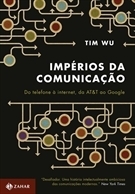
Impérios da Comunicação: Do Telefone à Internet, da AT&T ao Google [图书] Eggplant.place Goodreads
作者: Tim Wu / Claudio Salles Carina 出版社: Zahar 2012 - 8
A indústria da comunicação obedece a um implacável movimento cíclico: a cada inovação corresponde uma abertura, logo seguida pelo fechamento, representado por monopolização, controle e mesmo censura isso até que outra invenção venha forçar nova abertura, e assim sucessivamente.Para provar essa ideia, o eminente professor e escritor norte-americano Tim Wu recupera a história das comunicações no século XX. Nesse livro fundamental, ele nos mostra como os grandes monopólios de telefonia, rádio, cinema, televisão e internet se constituíram, lançando mão de mirabolantes golpes comerciais e jurídicos, envolvendo inventores e altos executivos. Somando considerações de ordem econômica a uma ampla reflexão sobre o significado da liberdade na era da informação, Impérios da comunicação lança uma desafiadora pergunta: estará a internet em parte ainda livre de monopólios e de regulamentação restritiva condenada a seguir o ciclo de abertura e fechamento das outras mídias?