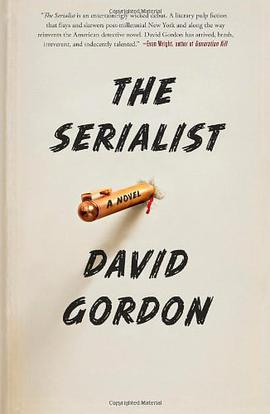
A DARK AND STYLISH PAGE-TURNER FROM A BOLD NEW VOICE IN FICTION
Harry Bloch is a struggling writer who pumps out pulpy serial novels—from vampire books to detective stories—under various pseudonyms. But his life begins to imitate his fiction when he agrees to ghostwrite the memoir of Darian Clay, New York City’s infamous Photo Killer. Soon, three young women turn up dead, each one murdered in the Photo Killer’s gruesome signature style, and Harry must play detective in a real-life murder plot as he struggles to avoid becoming the killer’s next victim.
Witty, irreverent, and original, The Serialist is a love letter to books—from poetry to pornography—and proof that truth really can be stranger than fiction.
Editorial Reviews
From Publishers Weekly
A seedy freelance writer provides the wry narrative voice for Gordon's winning debut, a darkly humorous thriller. New Yorker Harry Bloch, who once had lofty literary ambitions, has spent the past two decades as a hack, mostly as an advice columnist called the Slut Whisperer for Raunchy magazine. Bloch also earns cash by doing homework for affluent private school students, a side business managed by a precocious teenage girl who was the first pupil he was paid to tutor. His boring life takes an unexpected turn after he receives a letter from death-row inmate Darian Clay (aka the Photo Killer), who, as a fan of the Slut Whisperer, thinks Bloch is right for the job of assisting him on his memoirs. In exchange for Clay revealing where he concealed the heads of his female victims, Bloch must seek out women who have written to Clay and write stories about their having sex with the serial killer. A number of plausible plot twists help shift the story from farce to whodunit. (Mar.)
Copyright © Reed Business Information, a division of Reed Elsevier Inc. All rights reserved.
From Booklist
*Starred Review* Harry Bloch is a serialist in spades. He ekes out a living in Queens by writing pseudonymous series novels, all in the pulp style: the Zorg SF series by T. R. L. Pangstrom; the inner-city black Jew detective series by J. Duke Johnson; and the vampire series by Sybilline Lorindo-Gold, Bloch’s mother’s full maiden name. In addition he “tutors” rich high-school kids by writing their term papers. Bloch’s big break comes from a serial killer on death row: 88 days before his execution, Darian Clay offers a chapter of his life story for each piece of pornography Bloch writes based on the torrid letters Clay has received in prison. Bloch’s visits to three letter-writing women have unexpected consequences, raising the possibility of a retrial for Clay; meanwhile, Bloch is suspected of murder and fears for his life. In his debut novel, Gordon sustains the action of an involved plot while sprinkling in chapters from each of Bloch’s three series and his own reflections on reading and writing, with an emphasis on the mystery genre. Seldom has a serial-killer story been as richly textured and laugh-out-loud funny as this one. Sure to be among the most unusual and appealing of this year’s debut thrillers. --Michele Leber
Review
"A killer debut. . . funny, with a satirical edge, and unlike some literary authors who play with genre, Gordon knows how to write a potboiler." --Los Angeles Times
“Seldom has a serial-killer story been as richly textured and laugh-out-loud funny as this one. Sure to be among the most unusual and appealing of this year’s debut thrillers.”
--Booklist (starred review)
"An irreverent and funny twist on the classic whodunit—the kind of pulp-fiction mystery that made the careers of such writers as Jim Thompson, Raymond Chandler, and Dashiell Hammett." -- GQ.com
“Gordon, who lives in New York City, is terrifically talented. . . Not just a good first novel, but an excellent novel, period.” –Winnipeg Free Press
"A tour de force debut." --Kirkus
"The Serialist is a book about many things but above all it's about storytelling -- why and how we tell stories to stay not only sane but also alive. David Gordon writes with style, bite, suspense, humor, and heart. Remember his name. The Serialist is great fun to read and the beginning of a noteworthy career."
--David Ebershoff, author of The 19th Wife and The Danish Girl
"David Gordon has gathered up our cultural trash and made of it something magnificent. In the tradition of Bolano, Chandler, and lots of dime novels that most of us pretend to know nothing about, The Serialist makes high art out of serial murders, pornography, soup dumplings and pulp fiction. I adore this book!"
-Rivka Galchen, author of Atmospheric Disturbances
"The Serialist is an entertainingly wicked debut. A literary pulp fiction that flays and skewers post-Millennial New York and along the way reinvents the American detective novel. David Gordon has arrived, brash, irreverent and indecently talented."
--Evan Wright, author of Generation Kill
"The Serialist is David Gordon’s debut novel, and an auspicious one it is. . .Terrific
characters, a game (if somewhat reluctant) protagonist and clever dialogue make
The Serialist a really excellent debut just itching for a sequel." --Bookpage