China's New Order [Book] Douban
author:
Jane Hui Wang
translator:
Rebecca E. Karl
publishing house:
Harvard University Press
2003
- 11
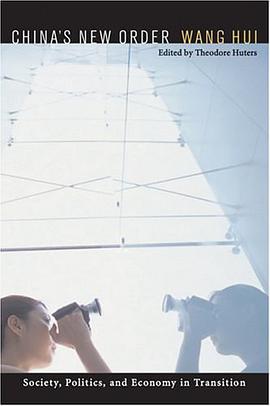
As the world is drawn together with increasing force, our long-standing isolation from--and baffling ignorance of--China is ever more perilous. This book offers a powerful analysis of China and the transformations it has undertaken since 1989.
Wang Hui is unique in China's intellectual world for his ability to synthesize an insider's knowledge of economics, politics, civilization, and Western critical theory. A participant in the Tiananmen Square movement, he is also the editor of the most important intellectual journal in contemporary China. He has a grasp and vision that go beyond contemporary debates to allow him to connect the events of 1989 with a long view of Chinese history. Wang Hui argues that the features of contemporary China are elements of the new global order as a whole in which considerations of economic growth and development have trumped every other concern, particularly those of democracy and social justice. At its heart this book represents an impassioned plea for economic and social justice and an indictment of the corruption caused by the explosion of "market extremism."
As Wang Hui observes, terms like "free" and "unregulated" are largely ideological constructs masking the intervention of highly manipulative, coercive governmental actions on behalf of economic policies that favor a particular scheme of capitalist acquisition--something that must be distinguished from truly free markets. He sees new openings toward social, political, and economic democracy in China as the only agencies by which the unstable conditions thus engendered can be remedied.
Wang Hui is unique in China's intellectual world for his ability to synthesize an insider's knowledge of economics, politics, civilization, and Western critical theory. A participant in the Tiananmen Square movement, he is also the editor of the most important intellectual journal in contemporary China. He has a grasp and vision that go beyond contemporary debates to allow him to connect the events of 1989 with a long view of Chinese history. Wang Hui argues that the features of contemporary China are elements of the new global order as a whole in which considerations of economic growth and development have trumped every other concern, particularly those of democracy and social justice. At its heart this book represents an impassioned plea for economic and social justice and an indictment of the corruption caused by the explosion of "market extremism."
As Wang Hui observes, terms like "free" and "unregulated" are largely ideological constructs masking the intervention of highly manipulative, coercive governmental actions on behalf of economic policies that favor a particular scheme of capitalist acquisition--something that must be distinguished from truly free markets. He sees new openings toward social, political, and economic democracy in China as the only agencies by which the unstable conditions thus engendered can be remedied.