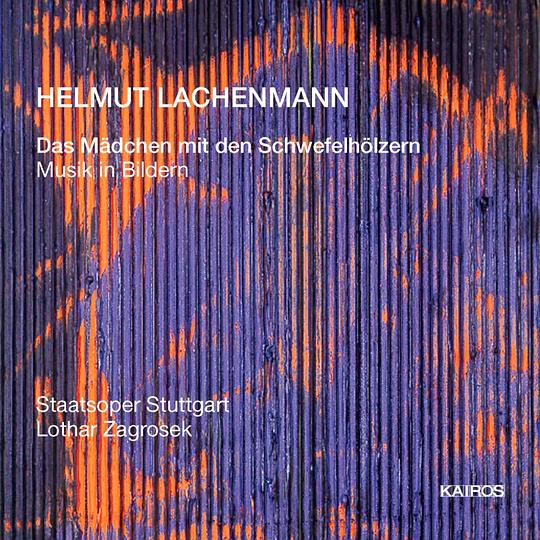
Composer Helmut Lachenmann (1935 - )
Conductor Lothar Zagrosek
Performer Elizabeth Keusch (Soprano)
Sarah Leonard (Soprano)
Salome Kammer (Spoken Vocals)
Mayumi Miyata (Sho)
Genre 20th Century Period / Opera
Date Written 1990-1996
Ensemble Stuttgart State Opera Chorus
Period 20th Century
Language German
Country Germany
Recording Studio
Lachenmann was born in Stuttgart and after the end of the Second World War (when he was 11) started singing in his local church choir. Showing an early aptitude for music, he was already composing in his teens. He studied piano with Jürgen Uhde and composition and theory with Johann Nepomuk David at the Stuttgarter Musikhochschule from 1955 to 1958 and was the first private student of the serialist composer Luigi Nono in Venice from 1958 to 1960. From Nono, he acquired the belief that music should aim to serve a message of social relevance. He also worked briefly at the electronic music studio at the University of Ghent in 1965, but thereafter focused almost exclusively on purely instrumental music.
Lachenmann has referred to his compositions as musique concrète instrumentale, implying a musical language that embraces the entire sound-world made accessible through unconventional playing techniques. According to the composer, this is music "in which the sound events are chosen and organized so that the manner in which they are generated is at least as important as the resultant acoustic qualities themselves. Consequently those qualities, such as timbre, volume, etc., do not produce sounds for their own sake, but describe or denote the concrete situation: listening, you hear the conditions under which a sound- or noise-action is carried out, you hear what materials and energies are involved and what resistance is encountered". His music is therefore primarily derived from the most basic of sounds, which through processes of amplification serve as the bases for extended works. His scores place enormous demands on performers, due to the plethora of techniques that he has invented for wind, brass and string instruments.
His more important works include the music theatre work Das Mädchen mit den Schwefelhölzern (1990-96, after Hans Christian Andersen, Leonardo da Vinci and Gudrun Ensslin), the orchestral pieces Schwankungen am Rand (1974-75, for eight brass, two electric guitars, two pianos, four thunder sheets, and 34 strings), Accanto (1975-76, for clarinet, large orchestra and tape) and NUN (1997-99, for flute, trombone, male chorus, and large orchestra), the ensemble works Mouvement (- vor der Erstarrung) (1982-84, for three ad hoc players and 14 players) and "...zwei Gefühle...", Musik mit Leonardo (1992, an excerpt from Das Mädchen mit den Schwefelhölzern, after Leonardo da Vinci, for two speakers and 22 players) and three string quartets (Gran Torso, 1971, revised 1976, 1988; Reigen seliger Geister, 1989; Grido, 2001), as well as other orchestral, ensemble and chamber works and six piano pieces.
He has regularly lectured at Darmstadt since 1978 and important among his many positions as a teacher was his term as professor of composition at the Stuttgarter Musikhochschule from 1981 to 1999. He is also noted for his many articles, essays and lectures, many of which appear in Musik als existentielle Erfahrung (Music as Existential Experience) (Breitkopf & Härtel, Wiesbaden, 1996).
PLAYERS
Elizabeth Keusch (Soprano (Vocal)), Mayumi Miyata (Sho), Salome Kammer (Speech/Speaker/Speaking Part), Sarah Leonard (Soprano (Vocal)), Staatsorchester Stuttgart (Orchestra), Stuttgart State Opera Chorus (Choir, Chorus), Yukiko Sugawara (Piano)