Mark Wigley — Author (11)
The Appearance of That Which Cannot be Seen [Book] Douban
author:
Ariella Azoulay
/
Bruno Latour
…
publishing house:
Spector Books
2018
- 1
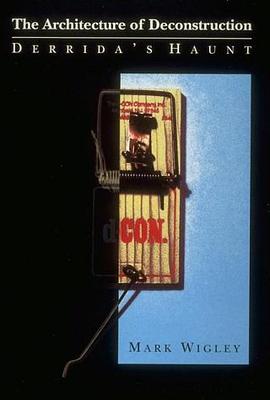
The Architecture of Deconstruction [Book] Douban
Nowhere, Mark Wigley asserts, are the stakes higher for deconstruction than in architecture - architecture is the Achilles' heel of deconstructive discourse, the point of vulnerability upon which all of its arguments -depend. In this book Wigley redefines the question of deconstruction and architecture. By locating the architecture already hidden within deconstructive discourse, he opens up more radical possibilities for both architecture and deconstruction, offering a way of rethinking the institution of architecture while using architecture to rethink deconstructive discourse.Wigley relentlessly tracks the tacit argument about architecture embedded within Jacques Derrida's discourse, a curious line of argument that passes through each of the philosopher's texts. He argues that this seemingly tenuous thread actually binds those texts, acting as their source of strength but also their point of greatest weakness. Derrida's work is seen to render architecture at once more complex, uncanny, pervasive, unstable, brutal, enigmatic, and devious, if not insidious, while needing itself to be subjected to an architectural interrogation.Wigley provocatively turns Derrida's reading strategy back on his texts to expose the architectural dimension of their central notions like law, economy, writing, place, domestication, translation, vomit, spacing, laughter, and dance. Along the way he highlights new aspects of the relationship between Heidegger and Derrida, explores the structural role of ornament and the elusive architecture of haunting, while presenting a fascinating account of the institutional politics of architecture.Mark Wigley is Assistant Professor in the School of Architecture at Princeton University.
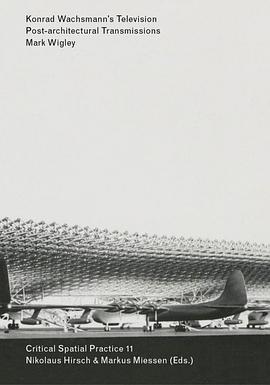
Konrad Wachsmann's Television [Book] Douban
In this provocative intellectual biography, architectural historian Mark Wigley makes the surprising claim that the thinking behind modernist architect Konrad Wachsmann's legendary projects was dominated by the idea of television. Investigating the archives of one of the most influential designers of the twentieth century, Wigley scrutinizes Wachsmann's design, research, and teaching, closely reading a succession of unseen drawings, models, photographs, correspondence, publications, syllabi, reports, and manuscripts to argue that Wachsmann is an anti-architect—a student of some of the most influential designers of the 1920s who dedicated thirty-five post–Second World War years to the disappearance of architecture.
Wachsmann turned architecture against itself. His hypnotic projects for a new kind of space were organized around the thought that television enables a different way of living together. While architecture is typically embarrassed by television, preferring to act as if it never happened, Wachsmann fully embraced it. He dissolved buildings into pulsating mirages that influenced the experimental avant-gardes of the 1960s and 1970s; but Wigley demonstrates that this work was even more extreme than the experiments it inspired. Wigley's forensic analysis of a career shows that Wachsmann developed one of the most compelling manifestos of what architecture would need to become in the age of ubiquitous electronics.
Wachsmann turned architecture against itself. His hypnotic projects for a new kind of space were organized around the thought that television enables a different way of living together. While architecture is typically embarrassed by television, preferring to act as if it never happened, Wachsmann fully embraced it. He dissolved buildings into pulsating mirages that influenced the experimental avant-gardes of the 1960s and 1970s; but Wigley demonstrates that this work was even more extreme than the experiments it inspired. Wigley's forensic analysis of a career shows that Wachsmann developed one of the most compelling manifestos of what architecture would need to become in the age of ubiquitous electronics.
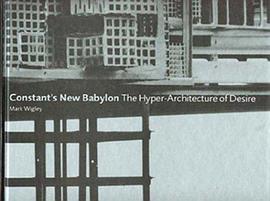
Constant's New Babylon [Book] Douban
The New Babylon Project was a project that consisted of a vast, layered, sheltered structure, supported by pillars and covering the entire earth. Human labor is rendered superfluous. Dwelling, work, recreation and transportation take a back seat to that which drives Homo Ludens, creativity. Constant was proposing an alternate society and along with it, an alternate architecture. Not just for those with architectural concerns, but for anyone who thinks.
Buckminster Fuller Inc. [Book] Douban
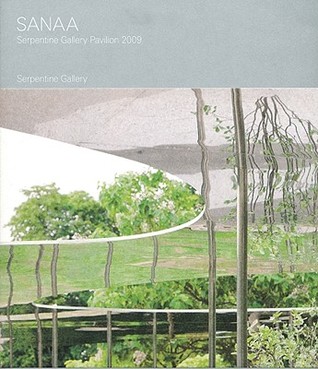
Sanaa: Serpentine Gallery Pavilion 2009 [Book] Goodreads
An ongoing program of temporary structures designed by internationally acclaimed architects, The Serpentine Gallery Pavilion commission was conceived by the institution's director, Julia Peyton-Jones, in 2000, and is unique worldwide. The Pavilion for 2009 was designed by Kazuyo Sejima and Ryue Nishizawa, of the leading Japanese architecture practice SANAA. Sejima and Nishizawa created a stunning structure that resembles a reflective cloud or a pool of water, sitting atop a series of delicate columns. The metal roof varies in height, wrapping itself around the trees in the park and sweeping down almost to the ground in some places. Open and ephemeral in structure, its reflective materials allow it to sit seamlessly within the natural environment, reflecting both the park and sky. "It works as a field of activity with no walls," say Sejima and Nishizawa. This publication documents the conception, construction and life of this impressive temporary structure.
Deconstructivist Architecture [Book] Douban
author:
Philip Johnson
/
Mark Wigley
publishing house:
Museum of Modern Art/Little Brown and Company
1988
- 11
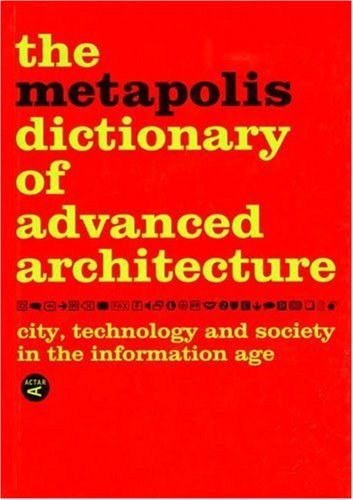
Metapolis Dictionary of Advanced Architecture [Book] Douban
author:
Eduard Bru
/
Jose Alfonso Ballesteros
…
publishing house:
Actar
2003
- 9
A dictionary for a world whose cities are linked by fiber optic cables and whose citizens are virtually global, a world where airports are meeting places and meetings take place via web conference, the Metapolis Dictionary of Advanced Architecture identifies a new architectural will and a new social and cultural panorama. From "abduction" to "zoom," radical definitions abound. Collected together they form a global, cross-disciplinary, multi-voiced vision of new architectural action. They define an architecture that is inscribed in information society, that is influenced by new technologies and new economies, and that concerns itself with the environment and sustainability. Entries have been written by the six main authors--Gausa, Guallart, Mller, Morales, Porras and Soriano--plus dozens of international contributors, including Iiaki Abalos and Juan Herreros, Stan Allen, Cecil Balmond, Ben van Berkel, Aaron Betsky, Eduard Bru, Greg Lynn, Josep Llu's Mateo, Fradaric Migayrou, Marcos Novak, Josa Parez Arroyo, Andreas Ruby, Antonino Saggio, Saskia Sassen, Kelly Shannon, Lars Spuybroek, Roemer van Toorn and Mark Wigley. For the sake of accessibility, the dictionary has been organized according to three distinct systems. The main dictionary is laid out in alphabetical order, with each entry explained via one or various contributors' interpretations, plus a list of related words. Within this larger dictionary are two smaller ones: the ideological dictionary (see "ideological dictionary"), located roughly at the center of the book, offers analogical groups of words related to specific idea; the dictionary of aphorisms (see "synthetical") synthesizes some of the key definitions from the maindictionary in the form of mottos. Finally, please note that this is an illustrated dictionary, with images used to facilitate quick explanations of related terms.
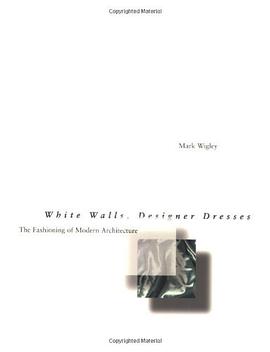
White Walls, Designer Dresses [Book] Douban
Product Description
In a daring revisionist history of modern architecture, Mark Wigley opens up a new understanding of the historical avant-garde. He explores the most obvious, but least discussed, feature of modern architecture: white walls. Although the white wall exemplifies the stripping away of the decorative masquerade costumes worn by nineteenth-century buildings, Wigley argues that modern buildings are not naked. The white wall is itself a form of clothing -- the newly athletic body of the building, like that of its occupants, wears a new kind of garment and these garments are meant to match. Not only did almost all modern architects literally design dresses, Wigley points out, their arguments for a modern architecture were taken from the logic of clothing reform. Architecture was understood as a form of dress design.
Wigley follows the trajectory of this key subtext by closely reading the statements and designs of most of the protagonists, demonstrating that it renders modern architecture's relationship with the psychosexual economy of fashion much more ambiguous than the architects' endlessly repeated rejections of fashion would suggest. Indeed, Wigley asserts, the very intensity of these rejections is a symptom of how deeply they are embedded in the world of clothing. By drawing on arguments about the relationship between clothing and architecture first formulated in the middle of the nineteenth century, modern architects in fact presented a sophisticated theory of the surface, modernizing architecture by transforming the status of the surface.
White Walls, Designer Dresses shows how this seemingly incidental clothing logic actually organizes the detailed design of the modern building, dictating a system of polychromy, understood as a multicolored outfit. The familiar image of modern architecture as white turns out to be the effect of a historiographical tradition that has worked hard to suppress the color of the surfaces of the buildings that it describes. Wigley analyzes this suppression in terms of the sexual logic that invariably accompanies discussions of clothing and color, recovering those sensuously colored surfaces and the extraordinary arguments about clothing that were used to defend them.
In a daring revisionist history of modern architecture, Mark Wigley opens up a new understanding of the historical avant-garde. He explores the most obvious, but least discussed, feature of modern architecture: white walls. Although the white wall exemplifies the stripping away of the decorative masquerade costumes worn by nineteenth-century buildings, Wigley argues that modern buildings are not naked. The white wall is itself a form of clothing -- the newly athletic body of the building, like that of its occupants, wears a new kind of garment and these garments are meant to match. Not only did almost all modern architects literally design dresses, Wigley points out, their arguments for a modern architecture were taken from the logic of clothing reform. Architecture was understood as a form of dress design.
Wigley follows the trajectory of this key subtext by closely reading the statements and designs of most of the protagonists, demonstrating that it renders modern architecture's relationship with the psychosexual economy of fashion much more ambiguous than the architects' endlessly repeated rejections of fashion would suggest. Indeed, Wigley asserts, the very intensity of these rejections is a symptom of how deeply they are embedded in the world of clothing. By drawing on arguments about the relationship between clothing and architecture first formulated in the middle of the nineteenth century, modern architects in fact presented a sophisticated theory of the surface, modernizing architecture by transforming the status of the surface.
White Walls, Designer Dresses shows how this seemingly incidental clothing logic actually organizes the detailed design of the modern building, dictating a system of polychromy, understood as a multicolored outfit. The familiar image of modern architecture as white turns out to be the effect of a historiographical tradition that has worked hard to suppress the color of the surfaces of the buildings that it describes. Wigley analyzes this suppression in terms of the sexual logic that invariably accompanies discussions of clothing and color, recovering those sensuously colored surfaces and the extraordinary arguments about clothing that were used to defend them.
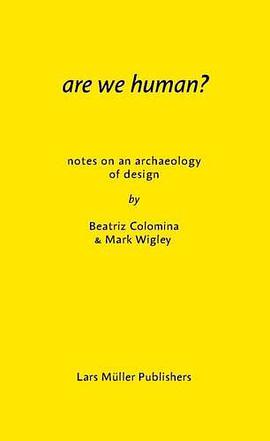
Are We Human? [Book] Douban
The question Are We Human? is both urgent and ancient. Beatriz Colomina and Mark Wigley offer a multi-layered exploration of the intimate relationship between human and design and rethink the philosophy of design in a multi-dimensional exploration from the very first tools and ornaments to the constant buzz of social media. The average day involves the experience of thousands of layers of design that reach to outside space but also reach deep into our bodies and brains. Even the planet itself has been completely encrusted by design as a geological layer. There is no longer an outside to the world of design.
Colomina’s and Wigley’s field notes offer an archaeology of the way design has gone viral and is now bigger than the world. They range across the last few hundred thousand years and the last few seconds to scrutinize the uniquely plastic relation between brain and artifact. A vivid portrait emerges.
Design is what makes the human. It becomes the way humans ask questions and thereby continuously redesign themselves.
Colomina’s and Wigley’s field notes offer an archaeology of the way design has gone viral and is now bigger than the world. They range across the last few hundred thousand years and the last few seconds to scrutinize the uniquely plastic relation between brain and artifact. A vivid portrait emerges.
Design is what makes the human. It becomes the way humans ask questions and thereby continuously redesign themselves.