赫伯特·阿赫滕布施 — 导演 (5)
希特勒们万岁! (1986) [电影] 豆瓣
Heilt Hitler!
其它标题: Heilt Hitler!
Herbert in plaster
In the films of Herbert Achternbusch the plot is more of a space in which the Bavarian filmmaker, poet and painter improvises. For example as artist and soldier Herbert in Heilt Hitler!, which premiered 25 years ago at the Berlinale. At night Herbert sits with his last comrade in the trenches of Stalingrad. While his comrade is writing with his finger one last letter to the Fuehrer into the air, Herbert starts to plaster himself with the last bucket of plaster, so the Russians find only a statue. Suddenly Herbert finds himself in the Munich of the eighties. At the war memorial in Munich's Hofgarten is written "They will rise again". That's the miracle of Stalingrad. Herbert does not know where he is and tries to scrounge cigarettes, in Russian. Maybe the Germans have won the war, have rebuilt Stalingrad after the model of Munich and renamed it Hitlergrad. On the Munich Marienplatz and Lake Starnberg Herbert observes that all Germans are sick. Like Hitler: "No one is healed." Heilt Hitler! is an absurd farce, shot in eleven days in Super-8 and blown-up to 35 mm, a histrionic, avant-garde artist's film with wonderful monologic passages, where Achternbusch's later conversion to Buddhism is already indicated.
Detlef Kuhlbrodt in DIE ZEIT, 7th July 2011
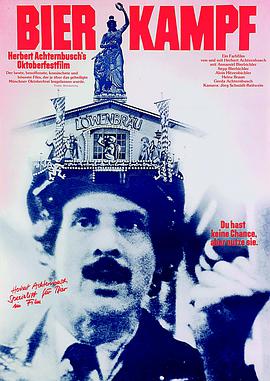
啤酒大战 (1977) [电影] 豆瓣
Bierkampf
其它标题: Bierkampf / Beer Chase
This movie is located at the "Oktoberfest" (bigbig, legendary and well-known drinking fest for dumb white-bread idiots) in Munich/Germany. A man who is dissatisfied with his senseless existence in his family-life and social status steals the uniform of a policeman and then enters the "Oktoberfest". - Now he is somebody, he is important, he can help, people respect him, etc. His wife, other relatives and some friends start to follow him while he gets some new acquaintances. The craziness begins! Full ahead! You cannot really say what the sense of this movie is, maybe it's about senselessness of life in general and about the relativity of common values. Amateur actors philosophize about this and that - most of them unemotional as a stone. But this doesn't ruin the movie - it's quite the contrary and supports the absurdity of the scenes and texts. There's no real storyline, it's more like a collage of sketches and clips. And it's also funny that you never know if the protagonists are actors who know they play for the movie (but I guess they do not know WHAT KIND of movie this is!!) or if they are just visitors of the Oktoberfest who happen to fall victim to a crazy-genius movie-director by chance, you know, like hidden-camera or something. - You never know. - And sometimes people get really angry by being annoyed by our false policeman out of control - and I am very sure that he'd got some punches in the face without this uniform. Many of the mono- and dialogues are really funny as hell and also quite intelligent in a subtle and subversive meaning. This movie and with it it's director was a total find for me, I must recommend this a lot, 10 out of 10!
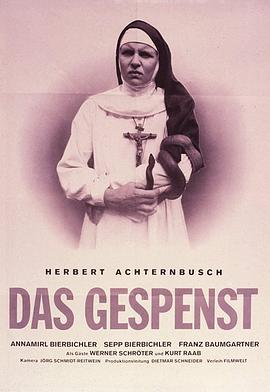
鬼魂 (1982) [电影] 豆瓣
Das Gespenst
导演: Herbert Achternbusch 演员: Herbert Achternbusch / Annamirl Bierbichler
其它标题: Das Gespenst
"The film caused a scandal in Germany in the mid-eighties. The that-time Minister of the Interior Zimmermann, a conservative Roman-Catholic and a Bavarian like director Achternbusch, decided that such a blasphemous movie should not be supported and withdrew state funding which the production already had received. This created more publicity for the movie than, I guess, any other movie Achternbusch had made before. The film is actually quite funny. Jesus (played by the director) returns to present-day Bavaria, walks around Munich in a somewhat dazed manner and strikes up an affair with a nun, arguing that they are married anyway. Therefore, he refers to himself as "Ober" (waiter), obviously the male form of "Oberin" (Mother Superior). He occasionally transforms into a snake when being afraid and is finally carried up into the sky by the nun, who transforms into a bird of prey. Blasphemy? Sure, but in a rather bizarre fashion. The film obviously doesn't take itself too seriously - one particular highlight comes when two policemen try to defecate into two tiny Schnaps glasses. Like in many of his other films, Achternbusch targets Bavaria's everyday culture with his meandering, anarchic, quirky ideas, and like his other films, this has a deliberately amateurish look. The pacing is uneven and can become challenging, but the cinematography is at times quite beautiful. Overall, if you look for edgy, quirky films that deliberately defy standards of slick movie making, this can be some fun." (from imdb.com)
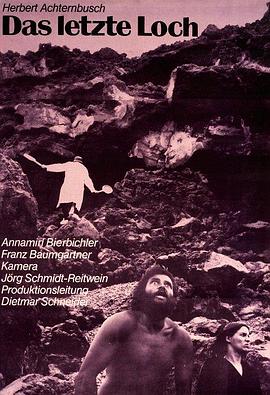
最后的洞 (1981) [电影] 豆瓣
Letzte Loch, Das
其它标题: Letzte Loch, Das
A film of deep sadness and despair, and the director’s first film in black and white, The Last Hole is the mordant tale of a man haunted by the historic guilt of Germany who desperately tries to find redemption. Achternbusch portrays “der Nil” (The Nile), a flycatcher, beer drinker, and private detective from the Bavarian forest. “I am called ‘der Nil’ because I wander through the desert, wander through the desert and evaporate,” says the man who drinks several liters of beer a day in an attempt to forget the murder of six million Jews by the nation to which he belongs. The only thing that drives him forward is the search for the love of his life, who is always—and can only be—called Susan. —

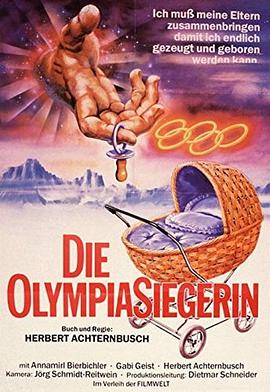
奥运夺金者 (1983) [电影] 豆瓣
Olympiasiegerin, Die
其它标题: Olympiasiegerin, Die
Adi has a dream: While sitting at his regular table and sucessfully chatting up Gabi the waitress, a boy appears. "You have to beget me", says the child to the man. The little boy has also already selected a mother: Ilona, an athlete with the sporting club TSC 1860 Munich. She, too, have her dreams, and they revolve around winning the gold medal at the Olympic Games.