I'm a <a href="/tags/neovim/" rel="tag">#Neovim</a> user but those voices in my head keep trying to persuade me to use <a href="/tags/vim/" rel="tag">#Vim</a> instead. I've spent days reading folks configs and reasons for and against and no I'm not considering Vi, Ed or the church. I've tried Helix too and it's just not suited the back to my roots style. I'm loving <a href="/tags/openbsd/" rel="tag">#OpenBSD</a> with ksh and I don't know why but Vim just keeps calling. Think the only way to resolve this would be to run both side by side ??? I guess I'm just showing my age by going old school. <a href="/tags/runbsd/" rel="tag">#RunBSD</a><br>
neovim
I still cannot believe that I only have one plugin installed in my new <a href="/tags/vim/" rel="tag">#Vim</a> config and yet in my <a href="/tags/neovim/" rel="tag">#Neovim</a> you can see below what I have installed. Yes I know I've not got the same functionality as with all those plugins but I'm trying to see how minimal I can go and still get by. I am enjoying this journey so far and may well stay with team vim. Also I might still add a couple more plugins to my vim config if I need ?<br><br><p>alpha<br>indent-blankline<br>mason<br>nvim-tree<br>vim-illuminate<br>colorizer<br>noice<br>nvim-treesitter<br>whichkey<br>comment<br>lualine-nvim<br>nvim-cmp<br>nvim-web-devicons<br>gruvbox<br>mason-lspconfig<br>nvim-lspconfig<br>telescope<br></p>

<p>❤️ With all the installations on <a href="/tags/gnu/" rel="tag">#GNU</a>/<a href="/tags/linux/" rel="tag">#Linux</a> (servers, vms, desktop, ... ), <a href="/tags/bsd/" rel="tag">#BSD</a> and <a href="/tags/unix/" rel="tag">#Unix</a> systems, <a href="/tags/macos/" rel="tag">#MacOS</a>, <a href="/tags/microsoft/" rel="tag">#Microsoft</a> <a href="/tags/windows/" rel="tag">#Windows</a> and WLS) I feel comfortable to claim there or way more than 1 billion installations of Vi*; often without people knowing about it.❤️</p><p>❤️ Thank you Bram Moolenaar, Christian Brabandt, the whole <a href="/tags/vim/" rel="tag">#Vim</a> community, and all the people from projects like <a href="/tags/neovim/" rel="tag">#NeoVIM</a>, <a href="/tags/nvi/" rel="tag">#Nvi</a>, <a href="/tags/busybox/" rel="tag">#Busybox</a> <a href="/tags/vi/" rel="tag">#Vi</a>, who develop and maintain their <a href="/tags/vim/" rel="tag">#vim</a> flavour. ❤️</p><p><a href="https://k7r.eu/thank-you-for-the-editor-of-the-beast/" rel="nofollow" class="ellipsis" title="k7r.eu/thank-you-for-the-editor-of-the-beast/"><span class="invisible">https://</span><span class="ellipsis">k7r.eu/thank-you-for-the-edito</span><span class="invisible">r-of-the-beast/</span></a> ❤️ <a href="/tags/ilovefs/" rel="tag">#ilovefs</a> ❤️</p>

<p><a href="/tags/neovim/" rel="tag">#neovim</a> is <a href="/tags/slop/" rel="tag">#slop</a> too !</p>

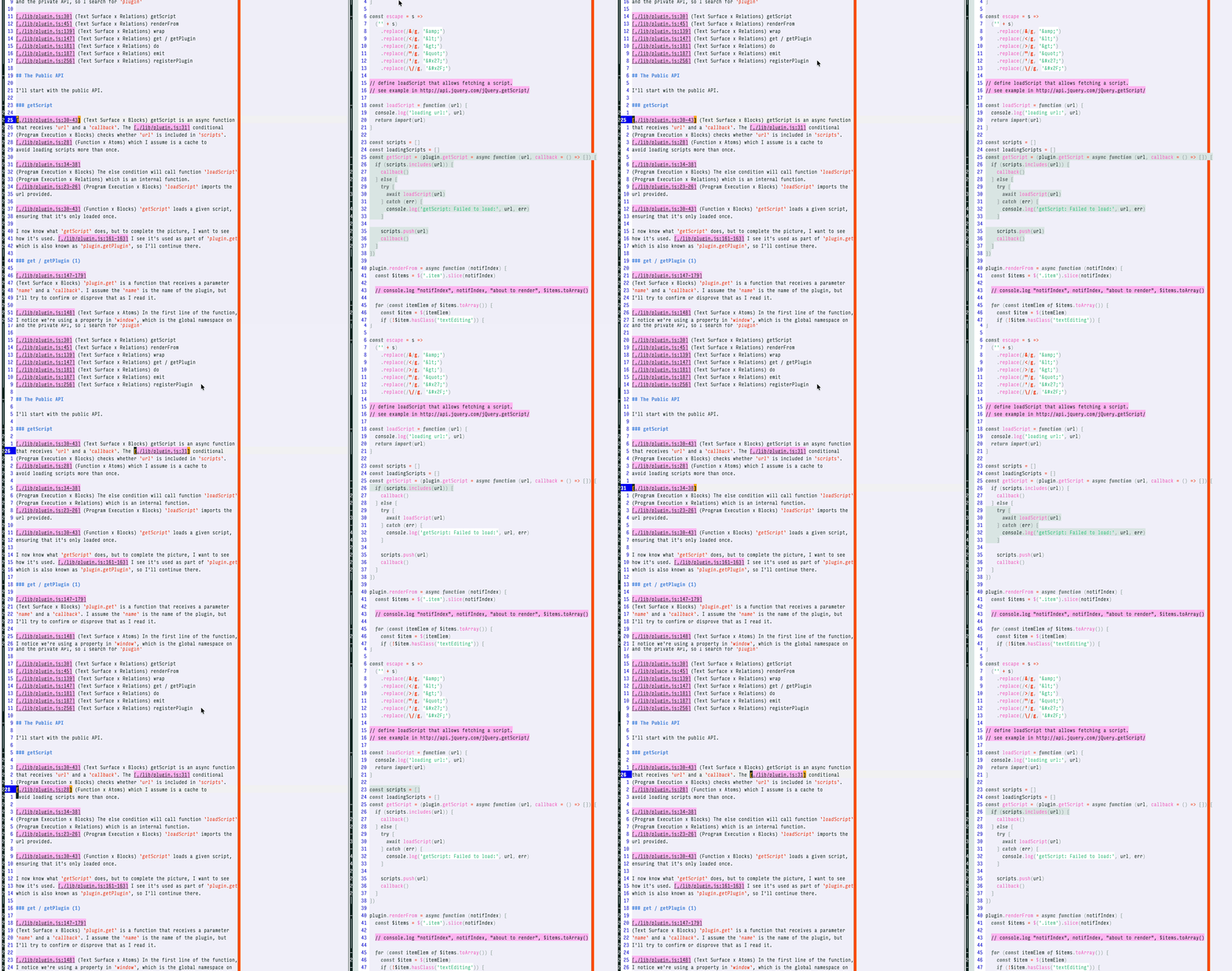
I forgot I had built this <a href="/tags/neovim/" rel="tag">#neovim</a> plugin and never published it.<br><br>It's called marginalie and it lets you write annotations in markdown files that you can then trigger to open the file side by side with the relevant part highlighted.<br><br>⁃ open with <space>m<br>⁃ next marginalia with ]m<br>⁃ previous marginalia with [m<br><br>I've been using it to annotate my explorations of software, and (as in this screenshot), to write annotations that can help people learning how to analyze code.<br><br>Download it here: <a href="https://git.sr.ht/~rbdr/marginalie.nvim/" rel="nofollow" class="ellipsis" title="git.sr.ht/~rbdr/marginalie.nvim/"><span class="invisible">https://</span><span class="ellipsis">git.sr.ht/~rbdr/marginalie.nvi</span><span class="invisible">m/</span></a> (or wherever you get your podcasts)<br>