


NetBSD
netbsd
<p>Better the *daemon* you know than the *devil* you don't<br><img src="https://neodb.social/media/emoji/bsd.cafe/netbsd.png" class="emoji" alt=":netbsd:" title=":netbsd:"> <img src="https://neodb.social/media/emoji/bsd.cafe/freebsd.png" class="emoji" alt=":freebsd:" title=":freebsd:"> <img src="https://neodb.social/media/emoji/bsd.cafe/openbsd.png" class="emoji" alt=":openbsd:" title=":openbsd:"> </p><p><a href="/tags/runbsd/" rel="tag">#runbsd</a> <a href="/tags/netbsd/" rel="tag">#netbsd</a> <a href="/tags/freebsd/" rel="tag">#freebsd</a> <a href="/tags/openbsd/" rel="tag">#openbsd</a></p>
Edited 337d ago
Having toyed around for a while in <a href="/tags/qemu/" rel="tag">#QEMU</a> <a href="/tags/vm/" rel="tag">#VM</a> boxes with <a href="/tags/freebsd/" rel="tag">#FreeBSD</a>, <a href="/tags/openbsd/" rel="tag">#OpenBSD</a> and <a href="/tags/netbsd/" rel="tag">#NetBSD</a> as well. I found that <a href="/tags/gpart/" rel="tag">#gpart</a> in FreeBSD is intuitive and easy to use for disk partition manipulation, followed by gpt in NetBSD. For me, powerful and flexible as fdisk is, it has always been mysteriously difficult and fighting.<br><a href="/tags/usebsd/" rel="tag">#UseBSD</a> <a href="/tags/runbsd/" rel="tag">#RUNBSD</a> <a href="/tags/bsd/" rel="tag">#BSD</a> <a href="/tags/foss/" rel="tag">#FOSS</a> <a href="/tags/unix/" rel="tag">#UNIX</a><br>
And oh boy all terms seem so foreign to me as a long time <a href="/tags/linux/" rel="tag">#Linux</a> user. The same disk is called ada0 with a partition like ada0p2 in <a href="/tags/freebsd/" rel="tag">#FreeBSD</a>, will be called something like sd0 with sd0h in <a href="/tags/openbsd/" rel="tag">#OpenBSD</a>, ld0 and dk2 in <a href="/tags/netbsd/" rel="tag">#NetBSD</a> . Then to experiment, all the <a href="/tags/dkctl/" rel="tag">#dkctl</a>, <a href="/tags/disklabel/" rel="tag">#disklabel</a> and <a href="/tags/fdisk/" rel="tag">#fdisk</a> commands are like blue and red wires on a dynamite you have to get rid of 😱. Linux distros nowadays seem to be going to the <a href="/tags/gdisk/" rel="tag">#gdisk</a> way which feels very much like <a href="/tags/gpart/" rel="tag">#gpart</a> in FreeBSD.<br><a href="/tags/usebsd/" rel="tag">#UseBSD</a> <a href="/tags/runbsd/" rel="tag">#RUNBSD</a> <a href="/tags/bsd/" rel="tag">#BSD</a> <a href="/tags/foss/" rel="tag">#FOSS</a> <a href="/tags/unix/" rel="tag">#UNIX</a> <a href="/tags/linux/" rel="tag">#Linux</a><br>
Edited 137d ago
<p>Advertisement: We are happy to welcome our new sponsor at <a href="/tags/boxybsd/" rel="tag">#BoxyBSD</a>: ST-Hosting.com </p><p>ST-Hosting.com stands for performance, stability, and pragmatic solutions and hosting like:</p><p>- LXC & KVM servers on AMD EPYC, Ryzen, Intel Xeon systems<br>- Fair pricing and direct support from Germany<br>- Hosting made in Germany</p><p>We’re excited to have <a href="https://st-hosting.com" rel="nofollow"><span class="invisible">https://</span>st-hosting.com</a> on board! You can immediately start to provision your BSD based boxes (like <a href="/tags/freebsd/" rel="tag">#FreeBSD</a>, <a href="/tags/openbsd/" rel="tag">#OpenBSD</a>, <a href="/tags/netbsd/" rel="tag">#NetBSD</a>,...) at BoxyBSD in our new location in Germany, Nuremberg. Also, stay tuned for <a href="/tags/fosdem/" rel="tag">#Fosdem</a> ;) Thanks a lot!</p><p>cc: <a href="https://gyptazy.com/fedi/gyptazy" rel="nofollow">@gyptazy</a> <br><a href="/tags/runbsd/" rel="tag">#RUNBSD</a> <a href="/tags/bsd/" rel="tag">#BSD</a> <a href="/tags/opensource/" rel="tag">#OpenSource</a> <a href="/tags/hosting/" rel="tag">#Hosting</a></p>
<p>Static Web Hosting on the Intel N150: FreeBSD, SmartOS, NetBSD, OpenBSD and Linux Compared</p><p>Update: This post has been updated to include Docker benchmarks and a comparison of container overhead versus FreeBSD Jails and illumos Zones.</p><p><a href="https://it-notes.dragas.net/2025/11/19/static-web-hosting-intel-n150-freebsd-smartos-netbsd-openbsd-linux/" rel="nofollow" class="ellipsis" title="it-notes.dragas.net/2025/11/19/static-web-hosting-intel-n150-freebsd-smartos-netbsd-openbsd-linux/"><span class="invisible">https://</span><span class="ellipsis">it-notes.dragas.net/2025/11/19</span><span class="invisible">/static-web-hosting-intel-n150-freebsd-smartos-netbsd-openbsd-linux/</span></a></p><p><a href="/tags/itnotes/" rel="tag">#ITNotes</a> <a href="/tags/freebsd/" rel="tag">#freebsd</a> <a href="/tags/illumos/" rel="tag">#illumos</a> <a href="/tags/jail/" rel="tag">#jail</a> <a href="/tags/linux/" rel="tag">#linux</a> <a href="/tags/netbsd/" rel="tag">#netbsd</a> <a href="/tags/openbsd/" rel="tag">#openbsd</a> <a href="/tags/ownyourdata/" rel="tag">#ownyourdata</a> <a href="/tags/server/" rel="tag">#server</a> <a href="/tags/smartos/" rel="tag">#smartos</a> <a href="/tags/sysadmin/" rel="tag">#sysadmin</a> <a href="/tags/zoneshosting/" rel="tag">#zoneshosting</a></p>
Edited 137d ago
Another thing is, in <a href="/tags/freebsd/" rel="tag">#FreeBSD</a> and also <a href="/tags/linux/" rel="tag">#Linux</a>, using <a href="/tags/efibootmgr/" rel="tag">#efibootmgr</a> to change <a href="/tags/uefi/" rel="tag">#UEFI</a> boot entries is quite handy. But it is not available for <a href="/tags/openbsd/" rel="tag">#OpenBSD</a> and <a href="/tags/netbsd/" rel="tag">#NetBSD</a> . However seems NetBSD has got something cooking already in -current and it is called efi.<br><a href="/tags/usebsd/" rel="tag">#UseBSD</a> <a href="/tags/runbsd/" rel="tag">#RUNBSD</a> <a href="/tags/bsd/" rel="tag">#BSD</a> <a href="/tags/foss/" rel="tag">#FOSS</a> <a href="/tags/unix/" rel="tag">#UNIX</a><br>
<p>The slides, the video, and the text behind my presentation at EuroBSDCon 2024 - 'Why and how we're migrating many of our servers from Linux to the BSDs.'</p><p><a href="https://it-notes.dragas.net/2024/10/03/i-solve-problems-eurobsdcon/" rel="nofollow" class="ellipsis" title="it-notes.dragas.net/2024/10/03/i-solve-problems-eurobsdcon/"><span class="invisible">https://</span><span class="ellipsis">it-notes.dragas.net/2024/10/03</span><span class="invisible">/i-solve-problems-eurobsdcon/</span></a></p><p><a href="/tags/itnotes/" rel="tag">#ITNotes</a> <a href="/tags/freebsd/" rel="tag">#FreeBSD</a> <a href="/tags/openbsd/" rel="tag">#OpenBSD</a> <a href="/tags/netbsd/" rel="tag">#NetBSD</a> <a href="/tags/runbsd/" rel="tag">#RunBSD</a> <a href="/tags/it/" rel="tag">#IT</a> <a href="/tags/sysadmin/" rel="tag">#SysAdmin</a> <a href="/tags/eurobsdcon/" rel="tag">#EuroBSDCon</a> <a href="/tags/ebc24/" rel="tag">#EBC24</a> <a href="/tags/eurobsdcon24/" rel="tag">#EuroBSDCon24</a> <a href="/tags/eurobsdcon2024/" rel="tag">#EuroBSDCon2024</a> <a href="/tags/notehub/" rel="tag">#NoteHUB</a></p>
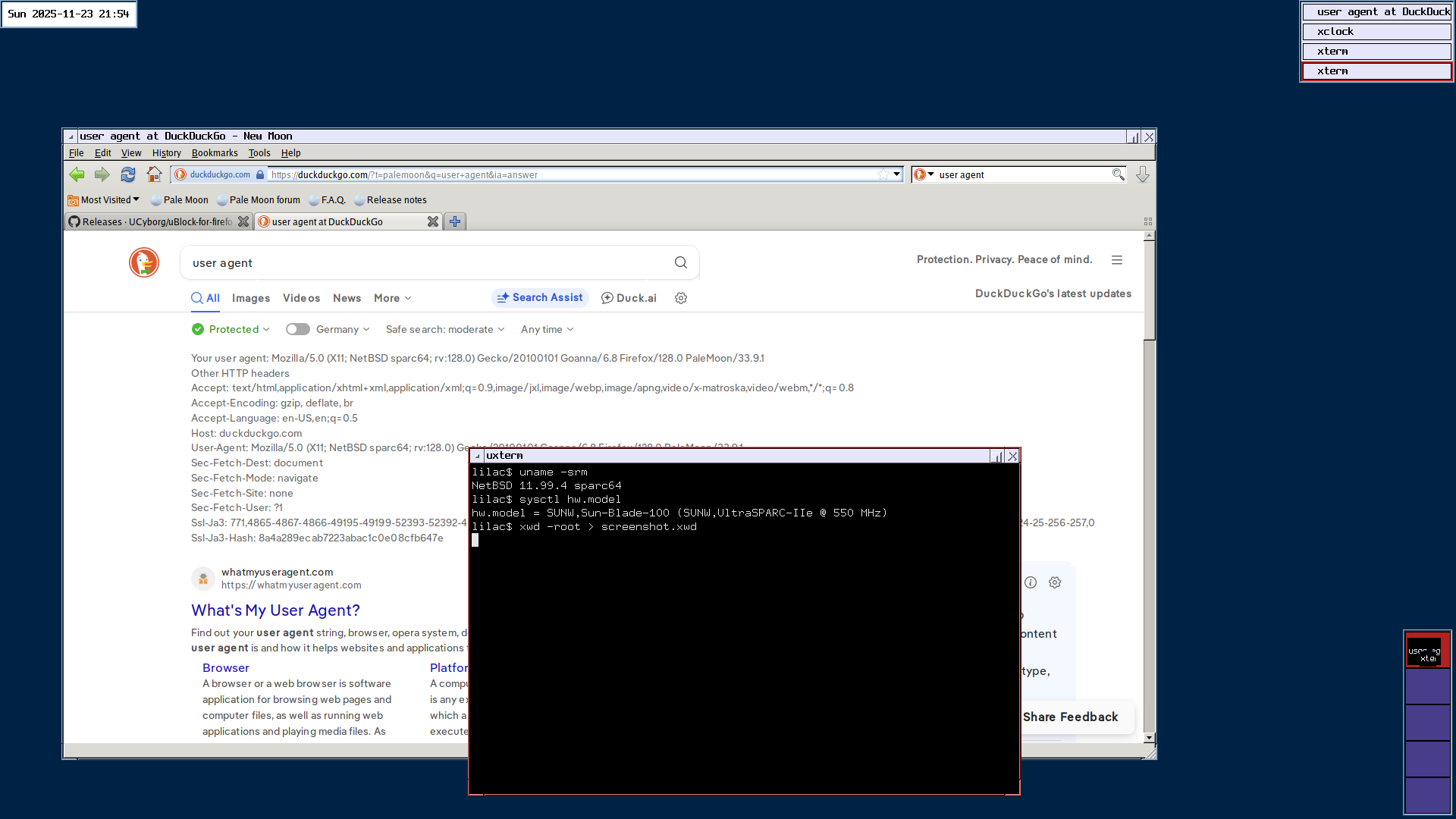
<p>Just another honest weekend's work keeping an up-to-date browser working... On the other hand, the most trackable user agent in the world. <a href="/tags/netbsd/" rel="tag">#netbsd</a> <a href="/tags/sparc64/" rel="tag">#sparc64</a> <a href="/tags/palemoon/" rel="tag">#palemoon</a></p>
Damn I like the whole css-or-bust approach to styling that <a href="/tags/snac/" rel="tag">#snac</a> has. I mean I know many (most?) others do a bit of the same but this is just delightful.<br><br>So..TLS aside, what is the most lightweight reverse proxy I can use instead of nginx in front of this thing? You know, in case I would like to move the instance from this beefy PPro to, say, a <a href="/tags/486/" rel="tag">#486</a> or a <a href="/tags/nintendo/" rel="tag">#Nintendo</a> Wii running <a href="/tags/netbsd/" rel="tag">#NetBSD</a>? :)<br><br><a href="/tags/retrocomputing/" rel="tag">#retrocomputing</a> <a href="/tags/bsd/" rel="tag">#BSD</a> <a href="/tags/stupididea/" rel="tag">#stupididea</a><br><br>
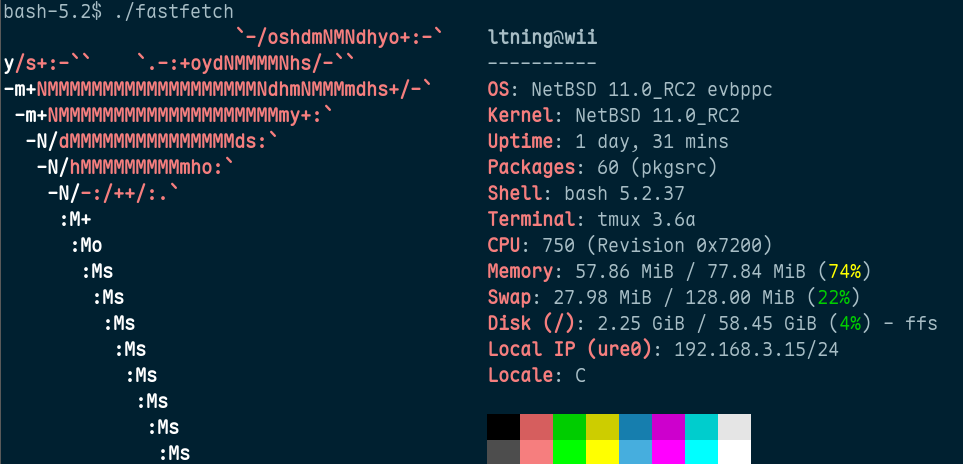
<p>My favourite experience regarding Wii homebrew so far has to be NetBSD. I wanted to use my Wii as a computer for a while now, and NetBSD being available as an operating system you can install and get going on an SD card and a Wii with the HBC is definitely the highlights of my Wii homebrew experience. I don't use my Wii much at the moment, as I don't even have a monitor I can use for my Wii yet, but I have used it for a while on a TV and it was nice.</p><p>Networking is a bit hard, at least on the Wii however. I tried to get WiFi included in as a Wii image of NetBSD to burn, this was during my time on FreeBSD, and I just couldn't compile it. I was doing something weird where I would alternate between GCC and clang but that would have been a waste of time once it got to booting.</p><p>Other than that, it was nice writing a fetch program entirely written in C using vi and man pages to get by. It was a nice break from writing things without an LSP to help, although I still love using modern features many editors provide, obviously excluding AI, so I will stick with that. I also found that Lua existed on it which definitely helped whenever I didn't want to write C.</p><p>First *BSD post in a while, as I forgot to talk about the time I used NetBSD. I'll probably talk about Linux more at some point but I wanted to talk about *BSD a little again. Try NetBSD if you get the chance!</p><p><a href="/tags/netbsd/" rel="tag">#netbsd</a> <a href="/tags/homebrew/" rel="tag">#homebrew</a> <a href="/tags/wii/" rel="tag">#wii</a> <a href="/tags/tech/" rel="tag">#tech</a> <a href="/tags/computers/" rel="tag">#computers</a> <a href="/tags/programming/" rel="tag">#programming</a></p>
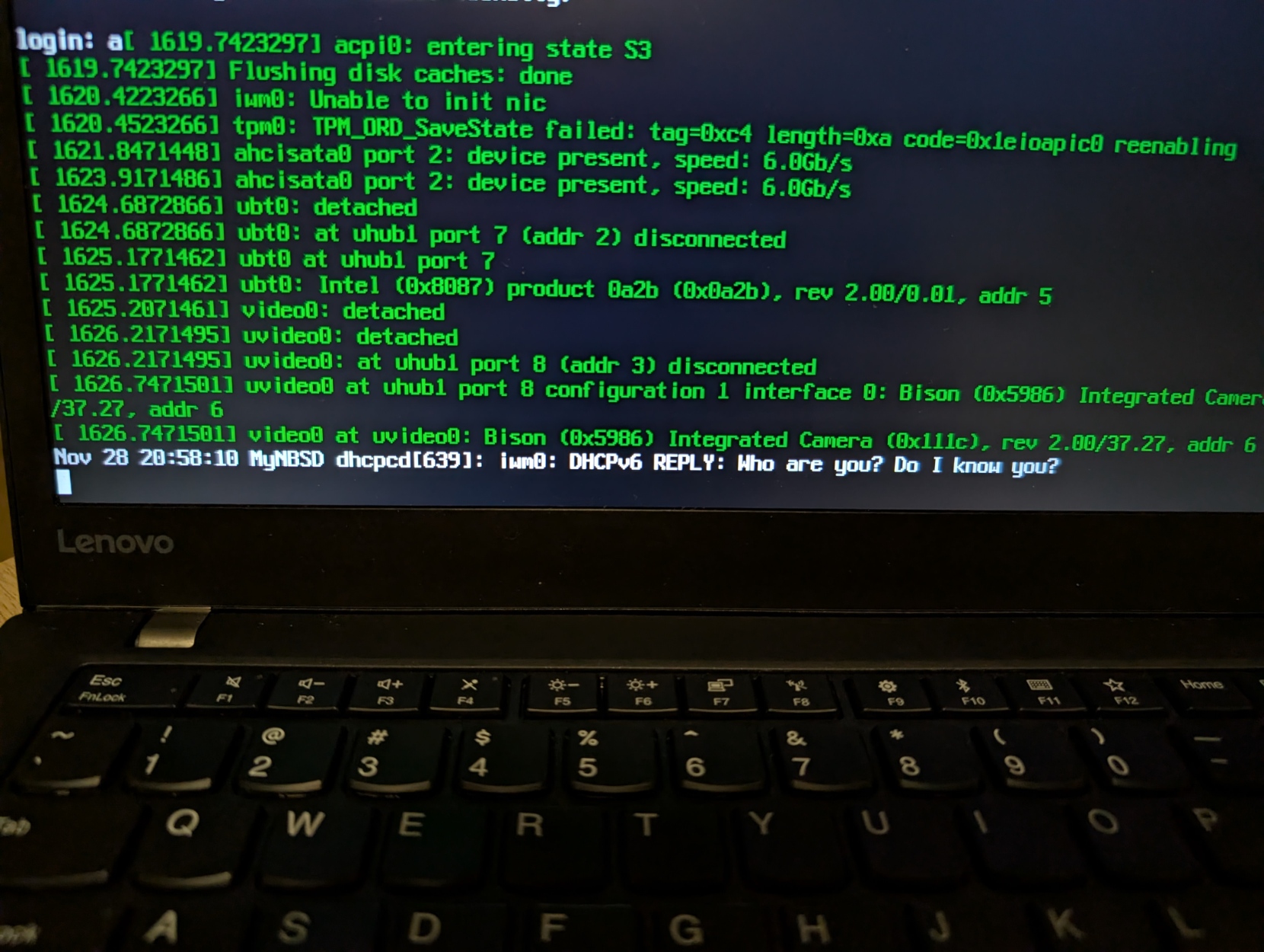
Finally tried <a href="/tags/netbsd/" rel="tag">#NetBSD</a> 10.1 RELEASE baremetal on my <a href="/tags/thinkpad/" rel="tag">#ThinkPad</a> <a href="/tags/t470s/" rel="tag">#T470s</a>. Good news is most things seem to work out of box: WiFi, touchpad, i915 drived video card. Bad news is, suspend/wakeup (S3) not working. It appears suspend worked well since after issuing sysctl -w hw.acpi.sleep.state=3 the laptop went to sleep with blinking power led, fan stops. However, at wakeup keyboard just stops responding, even swtiching tty with Ctrl-Alt-Fn keys. WiFi usually wakes up just fine since I gain ssh session back shortly after wakeups. I will conclude a major issue for a system if suspend/wakeup won't work for a laptop. I simply cannot imagine having to poweroff a laptop every day before going to bed. It is kinda a sueprise to me since I assume ThinkPad laptops usually get along well with <a href="/tags/bsd/" rel="tag">#BSD</a> and <a href="/tags/linux/" rel="tag">#Linux</a> systems.<br><br>FYI, S3 suspend/wakeup works flawlessly with <a href="/tags/freebsd/" rel="tag">#FreeBSD</a> and <a href="/tags/openbsd/" rel="tag">#OpenBSD</a> on this laptop without any hack.<br><br><a href="/tags/bsd/" rel="tag">#BSD</a> <a href="/tags/runbsd/" rel="tag">#RunBSD</a> <a href="/tags/unix/" rel="tag">#Unix</a> <a href="/tags/foss/" rel="tag">#FOSS</a><br>
Feels like my laptop is trying to talk to me here!<br><br><a href="/tags/netbsd/" rel="tag">#NetBSD</a> <a href="/tags/bsd/" rel="tag">#BSD</a> <a href="/tags/runbsd/" rel="tag">#RUNBSD</a> <a href="/tags/unix/" rel="tag">#UNIX</a> <a href="/tags/foss/" rel="tag">#FOSS</a><br>
<p>I want this on hardware with network support and modern sleep for laptops. I know "Of course it runs NetBSD", but.....does it work well enough on a laptop?</p><p><a href="/tags/netbsd10/" rel="tag">#netbsd10</a> <a href="/tags/netbsd/" rel="tag">#netbsd</a> <a href="/tags/laptop/" rel="tag">#laptop</a> <a href="/tags/runbsd/" rel="tag">#runbsd</a> <a href="/tags/unix/" rel="tag">#unix</a></p>
<p>People who use NetBSD on their desktop, where do they live? What do they eat?<br>Don't miss the shocking revelations today at 06:66 on OSreporter!</p><p><a href="/tags/netbsd/" rel="tag">#NetBSD</a> <a href="/tags/runbsd/" rel="tag">#RunBSD</a></p>
<p>Wondering if I wanna keep the ancient HP as an upgrade test bed for FreeBSD since we've already done 2 upgrades, or use it to try out <a href="/tags/netbsd/" rel="tag">#NetBSD</a> or <a href="/tags/openbsd/" rel="tag">#OpenBSD</a>? What do you all think?</p>
<p>Dear friends of the BSD Cafe,</p><p>This idea has been in my mind since the very beginning of this adventure, almost two years ago. Over time, several people have suggested it. But until recently, I felt the timing just wasn’t right - for many reasons. Today, I believe it finally is.</p><p>So I’m happy to announce a new service: <br>The BSD Cafe Journal - <a href="https://journal.bsd.cafe" rel="nofollow"><span class="invisible">https://</span>journal.bsd.cafe</a></p><p>At first, I thought I’d use BSSG for it (I even added multi-author support with this in mind), but in the end, it didn’t feel like the right tool for the job.</p><p>The idea is to create a multi-author space, with content published on a fairly regular basis. A reference point for news, updates, tutorials, technical articles - a place to inform and connect.<br>Just like people in Italy used to stop by cafes to read the newspaper and chat about the day’s news, the BSD Cafe Journal aims to be a space for reading, sharing, and staying informed - all in the spirit of the BSD Cafe.</p><p>What it’s not:<br>It’s not here to replace personal blogs, or excellent newsletters like <span class="h-card"><a href="https://mastodon.bsd.cafe/@vermaden" class="u-url mention" rel="nofollow noopener noreferrer" target="_blank">@<span>vermaden</span></a></span> 's. And it’s not an aggregator.</p><p>What it is:<br>A place where authors can write original content, share links to posts on their own blogs or elsewhere, publish guides, offer insights, or dive into technical explanations. </p><p>The guiding principles are the same as always: positivity, constructive discussion, promoting BSDs and open source in general. No hype (sharing a cool new service is fine, posting non-stop about the latest trend is not), no drama, no politics. The goal is to bring people together, not divide them. To inform, not inflame.<br>Respect, tolerance, and inclusivity are key. Everyone should feel welcome reading the BSD Cafe Journal - never judged, offended, or excluded.</p><p>The platform I’ve chosen is WordPress, for several reasons: it’s portable (runs well on all BSDs), has great built-in role management (contributors, authors, etc.), and - last but not least - supports ActivityPub.<br>This means every author will have their own identity in the Fediverse (like: <span class="h-card"><a href="https://journal.bsd.cafe/author/stefano/" class="u-url mention" rel="nofollow noopener noreferrer" target="_blank">@<span>stefano</span></a></span> ) and can be followed directly, and it’ll also be possible to follow the whole Journal.</p><p>Original and educational content is encouraged, but it’s also perfectly fine to link to existing articles elsewhere. Personally, I’ll link my technical posts from ITNotes whenever I publish them there.</p><p>The goal is simple: a news-oriented site, rich in content, ad-free, respectful of privacy - all under the BSD Cafe umbrella.</p><p>Content coordination will happen in a dedicated Matrix room for authors. There’ll also be a public room for discussing ideas, giving feedback, and sharing suggestions.</p><p>Of course, I can’t do this alone. A journal with no content is just an empty shell.<br>So here’s my call for action:<br>Who’s ready to lend a hand? If you enjoy writing, explaining, sharing your knowledge - the Journal is waiting for you.</p><p><a href="/tags/bsdcafe/" rel="tag">#BSDCafe</a> <a href="/tags/bsdcafeservices/" rel="tag">#BSDCafeServices</a> <a href="/tags/bsdcafeupdates/" rel="tag">#BSDCafeUpdates</a> <a href="/tags/bsdcafeannouncements/" rel="tag">#BSDCafeAnnouncements</a> <a href="/tags/runbsd/" rel="tag">#RunBSD</a> <a href="/tags/freebsd/" rel="tag">#FreeBSD</a> <a href="/tags/netbsd/" rel="tag">#NetBSD</a> <a href="/tags/openbsd/" rel="tag">#OpenBSD</a> <a href="/tags/illumos/" rel="tag">#illumos</a> <a href="/tags/linux/" rel="tag">#Linux</a> <a href="/tags/oss/" rel="tag">#OSS</a> <a href="/tags/opensource/" rel="tag">#OpenSource</a> <a href="/tags/bcjournal/" rel="tag">#BCJournal</a> <a href="/tags/bsdcafejournal/" rel="tag">#BSDCafeJournal</a></p>
Edited 266d ago
@[email protected] <span class="h-card"><a href="https://snac.smithies.me.uk/justine" class="u-url mention" rel="nofollow noopener noreferrer" target="_blank">@<span>justine</span></a></span> With apologies to Pokémon, I think the slogan with the BSDs should be,<br>"Gotta try 'em all!" XD<br><br>I've spent some quality time in <a href="/tags/openbsd/" rel="tag">#OpenBSD</a> and now <a href="/tags/freebsd/" rel="tag">#FreeBSD</a>, I'd like to try <a href="/tags/netbsd/" rel="tag">#NetBSD</a> and <a href="/tags/dragonflybsd/" rel="tag">#DragonflyBSD</a> next.<br><br>(This is regarding <a href="https://mastodon.bsd.cafe/users/gumnos/statuses/115695846629134863" rel="nofollow" class="ellipsis" title="mastodon.bsd.cafe/users/gumnos/statuses/115695846629134863"><span class="invisible">https://</span><span class="ellipsis">mastodon.bsd.cafe/users/gumnos</span><span class="invisible">/statuses/115695846629134863</span></a>. Not sure why the context got lost XD)<br>
Edited 117d ago
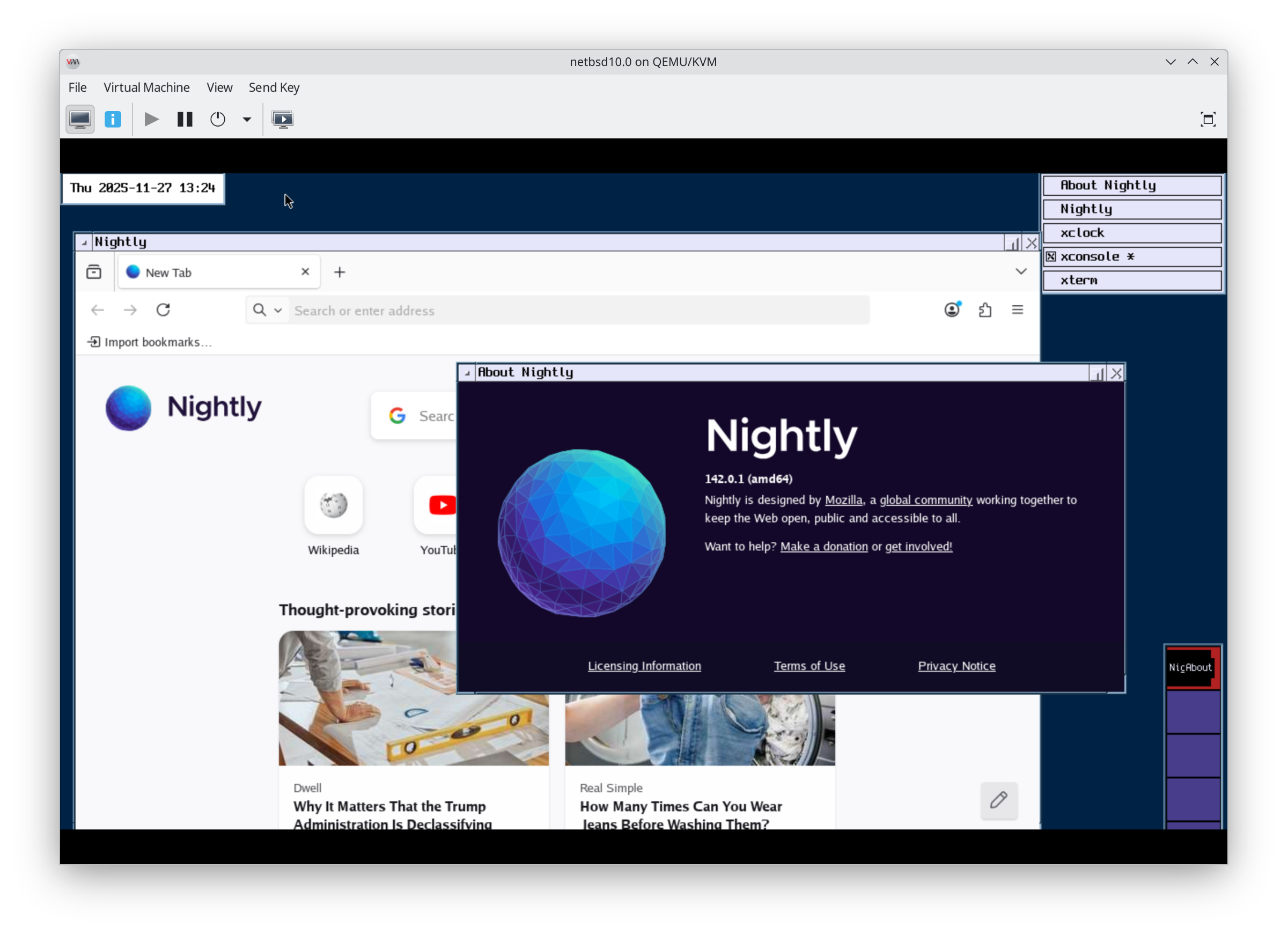
Since <a href="/tags/netbsd/" rel="tag">#NetBSD</a> comes with a nicely configured <a href="/tags/ctwm/" rel="tag">#CTWM</a>. I copied their config files to <a href="/tags/freebsd/" rel="tag">#FreeBSD</a> and with a few small changes, mainly command path differences between the two, and now CTWM seems much better!<br><br><a href="/tags/runbsd/" rel="tag">#RunBSD</a> <a href="/tags/bsd/" rel="tag">#BSD</a> <a href="/tags/unix/" rel="tag">#Unix</a> <a href="/tags/foss/" rel="tag">#FOSS</a><br>
Welcome to the Wii Cafe!<br><br>This instance is running <a href="/tags/snac2/" rel="tag">#snac2</a> under <a href="/tags/netbsd/" rel="tag">#NetBSD</a> on a Nintendo Wii. My DMs are open, let me know if you'd like an account here.<br>
Are you in <a href="/tags/tech/" rel="tag">#tech</a> and running your own <a href="/tags/fediverse/" rel="tag">#Fediverse</a> instance? You might want to join an Activity Pub relay instance!<br><br>My relay at <a href="https://fedi-relay.gyptazy.com" rel="nofollow"><span class="invisible">https://</span>fedi-relay.gyptazy.com</a> has currently 139 instances connected, mostly tech related sharing the same mindset and interests like <a href="/tags/linux/" rel="tag">#Linux</a>, <a href="/tags/bsd/" rel="tag">#BSD</a>, <a href="/tags/ansible/" rel="tag">#Ansible</a>, <a href="/tags/proxmox/" rel="tag">#Proxmox</a>, <a href="/tags/coding/" rel="tag">#Coding</a>, and many more! You can easily join from your instance when using <a href="/tags/pleroma/" rel="tag">#Pleroma</a>, <a href="/tags/snac/" rel="tag">#snac</a> (<a href="/tags/snac2/" rel="tag">#snac2</a>), <a href="/tags/mastodon/" rel="tag">#Mastodon</a> and its forks 🙂<br><br><a href="/tags/fedi/" rel="tag">#fedi</a> <a href="/tags/fediworld/" rel="tag">#fediworld</a> <a href="/tags/fedicommunity/" rel="tag">#fedicommunity</a> <a href="/tags/community/" rel="tag">#community</a> <a href="/tags/freebsd/" rel="tag">#FreeBSD</a> <a href="/tags/openbsd/" rel="tag">#OpenBSD</a> <a href="/tags/netbsd/" rel="tag">#NetBSD</a> <a href="/tags/homelab/" rel="tag">#homelab</a> <a href="/tags/python/" rel="tag">#Python</a> <a href="/tags/debian/" rel="tag">#Debian</a> <a href="/tags/rockylinux/" rel="tag">#RockyLinux</a> <a href="/tags/feditips/" rel="tag">#Feditips</a><br>
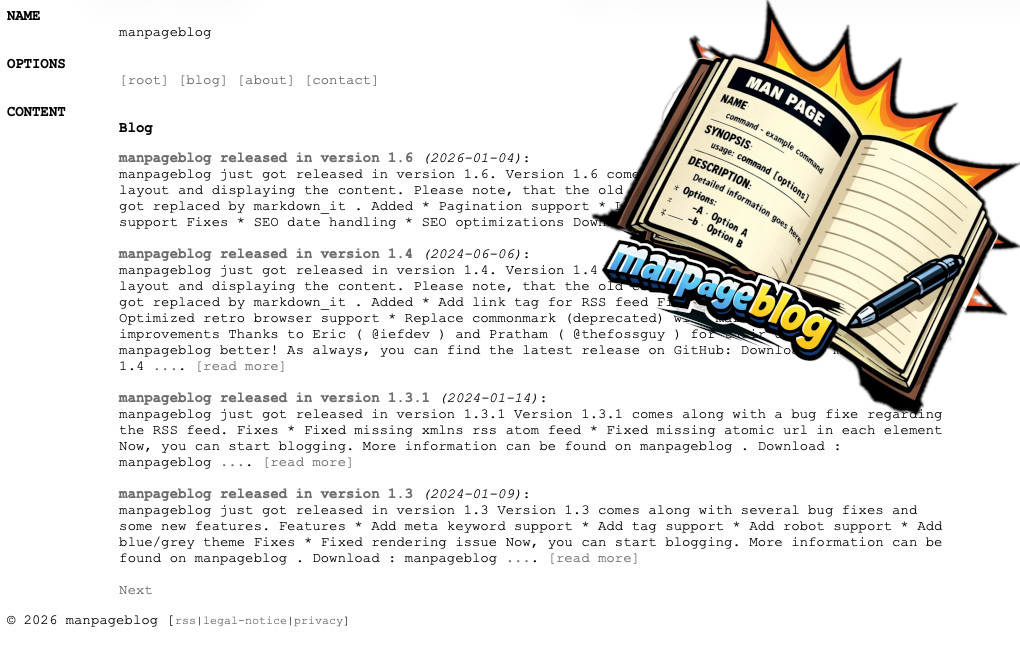
manpageblog v1.6 just got released. It is a static blog engine concept that treats written content like classic Unix man pages. It puts content first without sacrificing style and delivers a clean, elegant reading experience free from JavaScript, infinite scrolling, and other distracting clutter. The result is a fast, focused, and genuinely enjoyable way to consume high-quality content which can easily be served on very low power systems and follows the pure minimalism concept.<br><br>manpageblog is written in Python and available for many systems, including <a href="/tags/freebsd/" rel="tag">#FreeBSD</a>, <a href="/tags/openbsd/" rel="tag">#OpenBSD</a>, <a href="/tags/netbsd/" rel="tag">#NetBSD</a> or <a href="/tags/solaris/" rel="tag">#Solaris</a> based ones like <a href="/tags/illumos/" rel="tag">#Illumos</a> but also on <a href="/tags/linux/" rel="tag">#Linux</a> like <a href="/tags/debian/" rel="tag">#Debian</a> or <a href="/tags/ubuntu/" rel="tag">#Ubuntu</a>.<br><br>Changelog v1.6:<br><p>Pagination support added<br>Sitemap support added<br>SEO optimized<br>LD+JSON support added</p>manpageblog was initially crafted by me to match the minimalism on FreeBSD and you can directly start with it from the ports:
<a href="https://www.freshports.org/www/manpageblog/" rel="nofollow" class="ellipsis" title="www.freshports.org/www/manpageblog/"><span class="invisible">https://</span><span class="ellipsis">www.freshports.org/www/manpage</span><span class="invisible">blog/</span></a><br><br>The project source is available on GitHub at:
<a href="https://github.com/gyptazy/manpageblog" rel="nofollow"><span class="invisible">https://</span>github.com/gyptazy/manpageblog</a><br>You can find a real-life demo on my website at <a href="https://gyptazy.com" rel="nofollow"><span class="invisible">https://</span>gyptazy.com</a><br><br><a href="/tags/opensource/" rel="tag">#opensource</a> <a href="/tags/devops/" rel="tag">#devops</a> <a href="/tags/minimalism/" rel="tag">#minimalism</a> <a href="/tags/purism/" rel="tag">#purism</a> <a href="/tags/web/" rel="tag">#web</a> <a href="/tags/blog/" rel="tag">#blog</a> <a href="/tags/blogengine/" rel="tag">#blogengine</a> <a href="/tags/blogging/" rel="tag">#blogging</a> <a href="/tags/coding/" rel="tag">#coding</a> <a href="/tags/python/" rel="tag">#python</a> <a href="/tags/website/" rel="tag">#website</a> <a href="/tags/manpageblog/" rel="tag">#manpageblog</a><br>
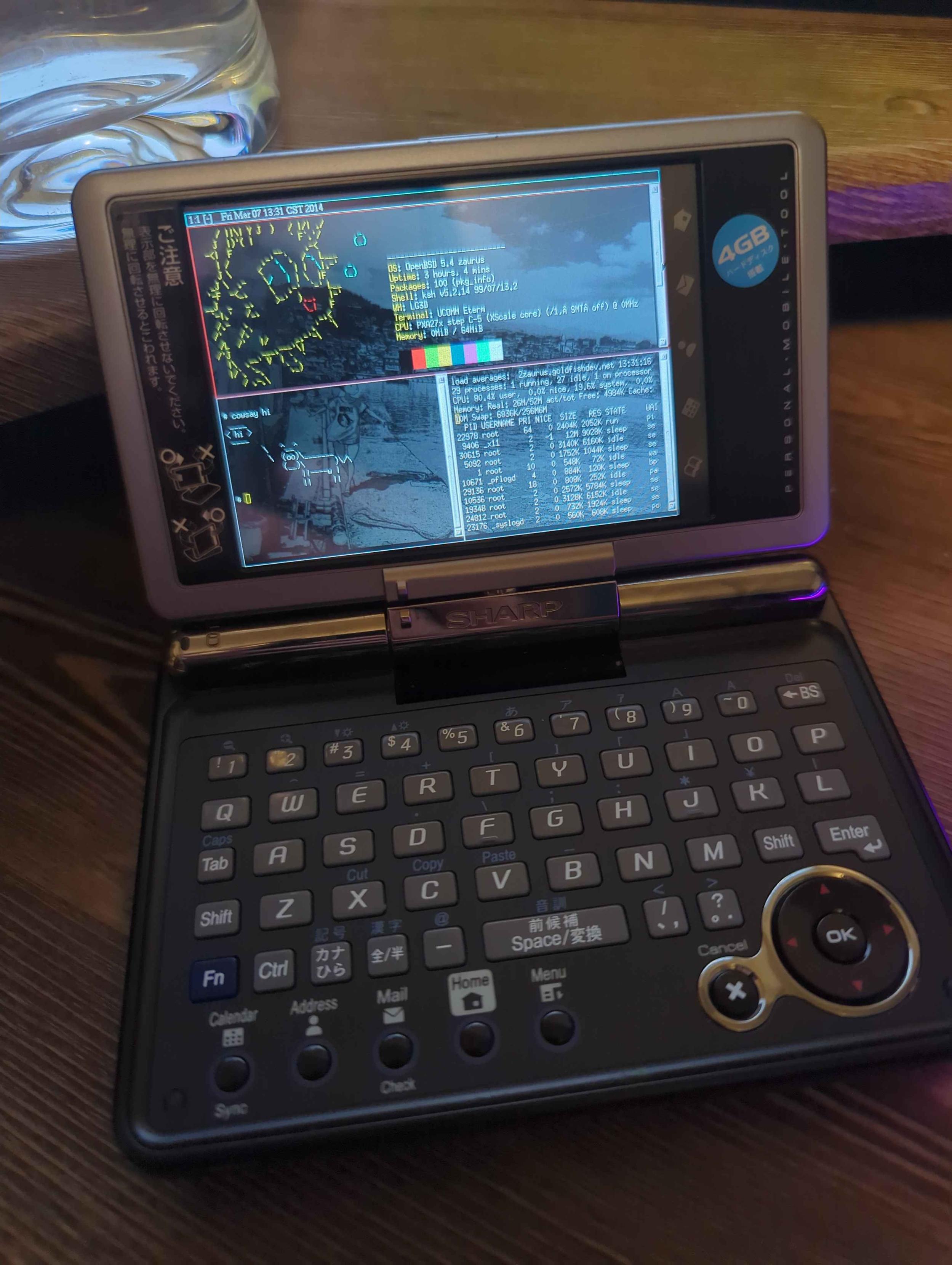
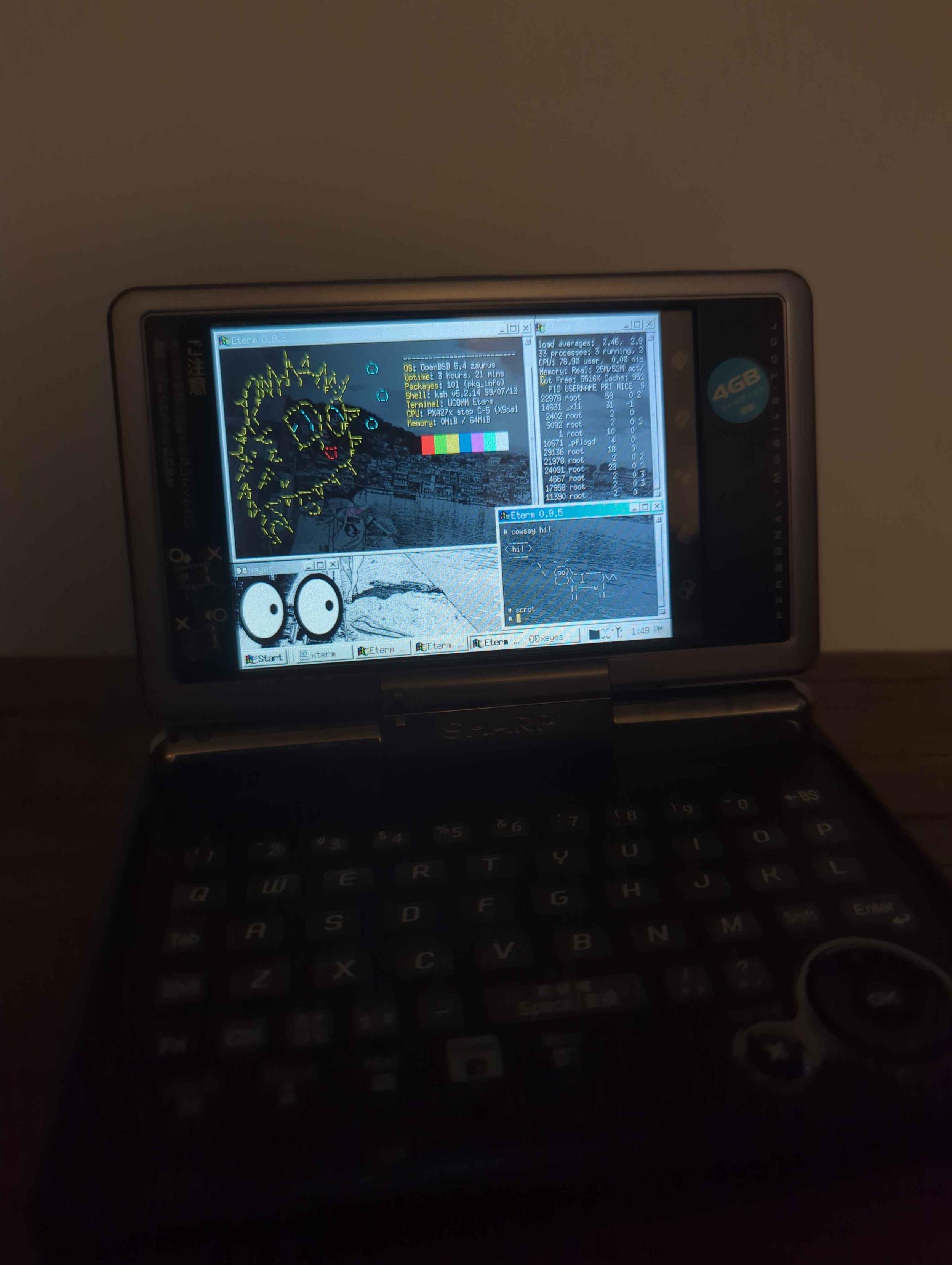
<p><a href="/tags/openbsd/" rel="tag">#OpenBSD</a> 5.4 on a Sharp Zaurus SL-C3100. <br>While 6.0 was the last version to support Zaurus, X breaks in 5.5. I don't have a working network card yet, but hopefully will soon. <br><a href="/tags/netbsd/" rel="tag">#NetBSD</a> still supports the Zaurus, but I wasn't able to install it.</p>
Right I'm not interested in starting a flame war but I am interested to see how many folk in 2026 use <a href="/tags/wayland/" rel="tag">#Wayland</a> or <a href="/tags/wayback/" rel="tag">#Wayback</a> and how many use <a href="/tags/x11/" rel="tag">#X11</a> or even <a href="/tags/xlibre/" rel="tag">#Xlibre</a> . Feel free if you wish to say what OS/Distribution you use and which window manager or desktop environment below. <a href="/tags/linux/" rel="tag">#Linux</a> <a href="/tags/freebsd/" rel="tag">#FreeBSD</a> <a href="/tags/openbsd/" rel="tag">#OpenBSD</a> <a href="/tags/netbsd/" rel="tag">#NetBSD</a><br>Please boost and thanks in advance.<br>
<div class="poll">
<h3 style="display: none;">Options: <small>(choose one)</small></h3>
<ul>
<li>
<label class="poll-option">
<input style="display:none" name="vote-options" type="radio" value="0">
<span class="poll-number" title="280 votes">61%</span>
<span class="poll-option-text">Wayland</span>
</label>
</li>
<li>
<label class="poll-option">
<input style="display:none" name="vote-options" type="radio" value="0">
<span class="poll-number" title="2 votes">0%</span>
<span class="poll-option-text">Wayback</span>
</label>
</li>
<li>
<label class="poll-option">
<input style="display:none" name="vote-options" type="radio" value="0">
<span class="poll-number" title="167 votes">37%</span>
<span class="poll-option-text">X11</span>
</label>
</li>
<li>
<label class="poll-option">
<input style="display:none" name="vote-options" type="radio" value="0">
<span class="poll-number" title="7 votes">2%</span>
<span class="poll-option-text">Xlibre</span>
</label>
</li>
</ul>
<div class="poll-footer">
<span class="vote-total">456 votes</span>
—
<span class="vote-end">Ended 77d ago</span>
<span class="todo">Polls are currently display only</span>
</div>
</div>
<p>It has been so long since I ran a <a href="/tags/bsd/" rel="tag">#BSD</a> that I don't even remember which BSD it was. (I could probably dig up that info...)</p><p>Circa 20 years ago I used to run BSD gateway/router machines.</p><p>I think I'd like to do this again, for a variety of reasons.</p><p>But which BSD should I run for this kind of network gateway. It won't host any applications, it won't be a NAS, it'll purely be network/gateway... it'll have the telco router on one side, internal network on another, and one or two DMZ/separate type networks (one for hosting external facing things like Mastodon, the other for untrusted IoT stuff.) It'll run dhcp, dns, and probably be a VPN endpoint.</p><p>I do not want to run some specialist gateway adapted customised thing with dashboards etc, just want a plain vanilla OS. (And no bullcrap like containers, docker, etc. Just an OS running on a physical box.)</p><p>So, what OS should I run on my network gateway: <a href="/tags/openbsd/" rel="tag">#OpenBSD</a>, <a href="/tags/freebsd/" rel="tag">#FreeBSD</a>, <a href="/tags/netbsd/" rel="tag">#NetBSD</a></p>
<div class="poll">
<h3 style="display: none;">Options: <small>(choose one)</small></h3>
<ul>
<li>
<label class="poll-option">
<input style="display:none" name="vote-options" type="radio" value="0">
<span class="poll-number" title="12 votes">67%</span>
<span class="poll-option-text">OpenBSD</span>
</label>
</li>
<li>
<label class="poll-option">
<input style="display:none" name="vote-options" type="radio" value="0">
<span class="poll-number" title="2 votes">11%</span>
<span class="poll-option-text">FreeBSD</span>
</label>
</li>
<li>
<label class="poll-option">
<input style="display:none" name="vote-options" type="radio" value="0">
<span class="poll-number" title="2 votes">11%</span>
<span class="poll-option-text">NetBSD</span>
</label>
</li>
<li>
<label class="poll-option">
<input style="display:none" name="vote-options" type="radio" value="0">
<span class="poll-number" title="2 votes">11%</span>
<span class="poll-option-text">Stick with Linux you bozo</span>
</label>
</li>
<li>
<label class="poll-option">
<input style="display:none" name="vote-options" type="radio" value="0">
<span class="poll-number" title="0 votes">0%</span>
<span class="poll-option-text">Something else... (say what below)</span>
</label>
</li>
</ul>
<div class="poll-footer">
<span class="vote-total">18 votes</span>
—
<span class="vote-end">Ended 61d ago</span>
<span class="todo">Polls are currently display only</span>
</div>
</div>