A blog post about compiling a bunch of Atom/RSS feeds into an HTML frameset. Contains HTML that may again break your Akkoma
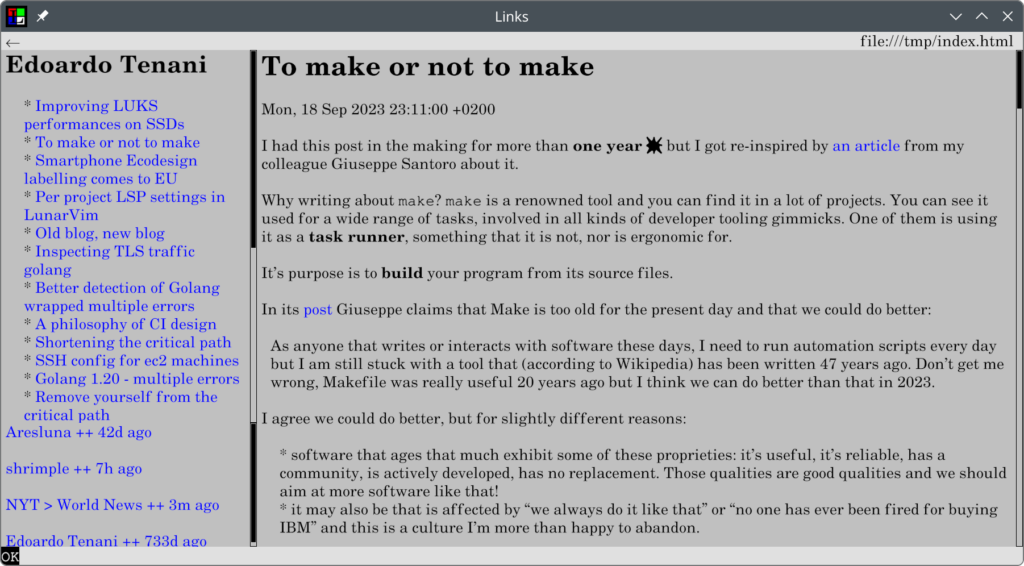
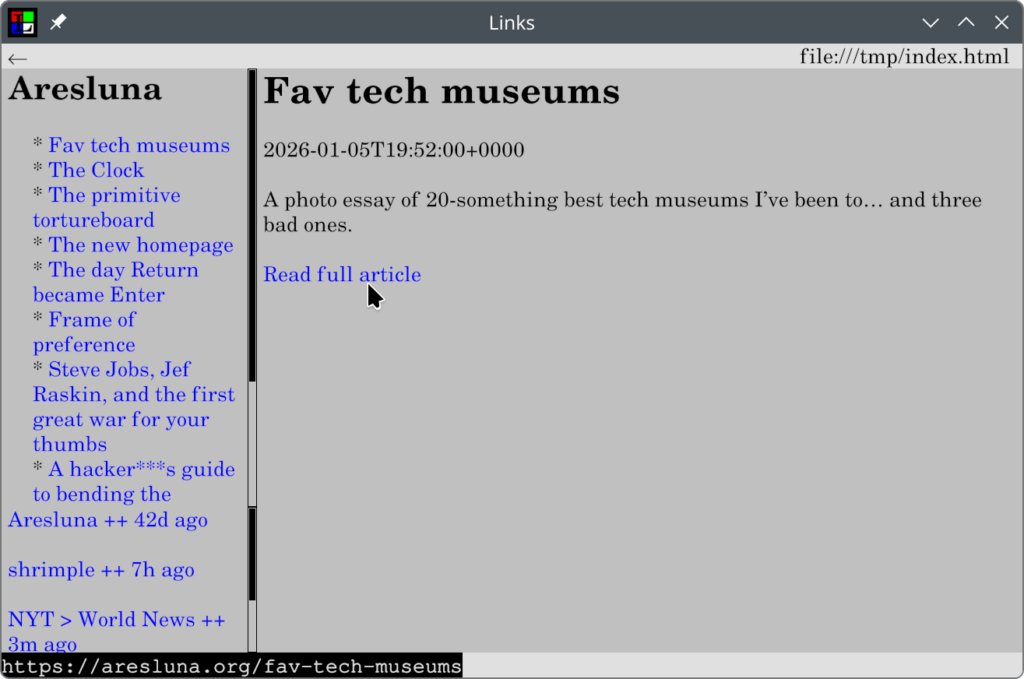
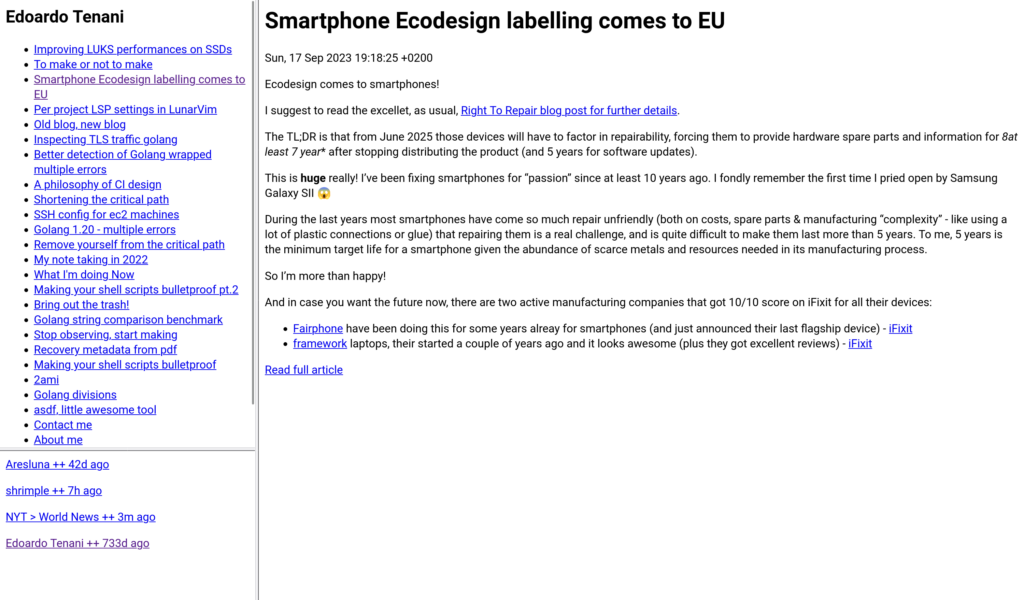
<p>Just seeing what time was the last update to an RSS feed should be enough for most. And the RSS feeds already have titles, so one might not need a full OPML, but nothing more than a list of URLs as a flat file.</p><p>Although what follows has some room for improvement, feed reading can look like this</p>Feeds with text content layed out into a frameset by this script will be comfortable to read in graphical mode of Links browser. Framesets are great for sidebar UI. In the bottom part of the sidebar you have the selection of feeds. The script can embed you the original date string in the article view, and a time-units-since suffix into the feed selection document. It can be seen that a Unicode emoji is displayed by Links as a “blast” character at least in this compilation.Some blogs will only provide a snippet into the feed, and thus the script renders that as a “Read full article” link, that leads directly to the article, right in the browser. You can navigate back from it when you’re done reading. It can be seen that a Unicode apostrophe in a link is rendered by Links as three asterisks at least in this compilation.Framesets are also still supported by modern browsers, so this is a neat option for usual users as well. You fetch the feeds once and then you are in just a bunch of local static HTML files that happen to be a frameset.<p>My idea consists of two programs, for potential composability and to not bother with any kind of PATH:</p><p>one gets spawned in a directory and lays out the articles from the feed XML passed to it on standard input,<br>and one gets passed a list of feed URLs on standard input, and an argument with the path to the former script (it is not hardcoded to be composed with just that first one, although expects from the provided one not just the nav.html that it will link but also a title.txt and a date.txt in the directory after its execution) — and it creates the index.html with the frameset (constant content) and a feeds.html with the list of feeds and when were they last updated</p><p>
#!/usr/bin/env perl
use v5.36;
use strict;
use warnings;
use XML::LibXML;
use File::Path qw(make_path);
my $dom = XML::LibXML->load_xml(IO => \*STDIN);
my $xc = XML::LibXML::XPathContext->new($dom);
$xc->registerNs(atom => '<a href="http://www.w3.org/2005/Atom');" rel="nofollow"><span class="invisible">http://</span>www.w3.org/2005/Atom');</a>
sub safe_id ($id, $fallback) {
my $base = ($id && $id =~ /\S/) ? $id : $fallback;
$base =~ s/[^A-Za-z0-9._-]/_/g;
return $base;
}
sub text_of ($node, $xpath) {
my ($n) = $xc->findnodes($xpath, $node);
return defined $n ? $n->textContent : undef;
}
sub write_file ($path, $content) {
open my $fh, '>:encoding(UTF-8)', $path
or die "Cannot write $path: $!";
print $fh $content;
close $fh;
}
# ---
my @entries;
if ($xc->exists('/rss/channel/item')) {
@entries = $xc->findnodes('/rss/channel/item');
}
else {
@entries = $xc->findnodes('/atom:feed/atom:entry');
}
my $feed_title =
text_of($dom, '/rss/channel/title')
// text_of($dom, '/atom:feed/atom:title')
// 'Feed';
my $feed_date =
text_of($dom, '/rss/channel/lastBuildDate')
// text_of($dom, '/atom:feed/atom:updated');
write_file('title.txt', $feed_title);
write_file('date.txt', $feed_date);
# ---
my $nav = "<html><head><title>$feed_title</title></head><body>";
$nav .= "<h2>$feed_title</h2><ul>";
for my $i (0 .. $<a href="/tags/entries/" rel="tag">#entries</a>) {
my $e = $entries[$i];
my $raw_id =
text_of($e, './guid')
// text_of($e, './atom:id');
my $id = safe_id($raw_id, "entry-" . ($i + 1));
my $title =
text_of($e, './title')
// text_of($e, './atom:title')
// 'Untitled';
$nav .= qq{<li><a target="main" href="$id.html">$title</a></li>};
}
$nav .= "</ul></body></html>";
write_file('nav.html', $nav);
# ---
for my $i (0 .. $<a href="/tags/entries/" rel="tag">#entries</a>) {
my $e = $entries[$i];
my $raw_id =
text_of($e, './guid')
// text_of($e, './atom:id');
my $id = safe_id($raw_id, "entry-" . ($i + 1));
my $title =
text_of($e, './title')
// text_of($e, './atom:title')
// 'Untitled';
my $date =
text_of($e, './pubDate')
// text_of($e, './atom:updated')
// text_of($e, './atom:published')
// '';
my $body =
text_of($e, './description')
// text_of($e, './atom:summary')
// text_of($e, './atom:content')
// '';
my $url =
text_of($e, './link')
// text_of($e, './atom:link[@rel="alternate"]/@href')
// text_of($e, './atom:link[1]/@href');
my $html = <<"HTML";
<html>
<head><title>$title</title></head>
<body>
<h1>$title</h1>
<p>$date</p>
<p>$body</p>
HTML
if ($url) {
$html .= qq{<p><a target="_top" href="$url">Read full article</a></p>};
}
$html .= "</body></html>";
write_file("$id.html", $html);
}
say "Done.";
</p><p>
#!/usr/bin/env perl
use v5.36;
use strict;
use warnings;
use String::Util 'trim';
use File::Path qw(make_path);
use IPC::Run qw(start);
sub write_file ($path, $content) {
open my $fh, '>:encoding(UTF-8)', $path
or die "Cannot write $path: $!";
print $fh $content;
close $fh;
}
write_file('index.html', <<"HTML");
<html>
<frameset cols="25%,75%">
<frameset rows="75%,25%">
<frame name="nav"/>
<frame src="feeds.html" name="feeds"/>
</frameset>
<frame name="main"/>
</frameset>
</html>
HTML
use Cwd 'abs_path';
my $workprog = abs_path $ARGV[0];
my @jobs;
my @urls;
while (<STDIN>) {
chomp;
my $dir = $_;
$dir =~ s/[^A-Za-z0-9._-]/_/g;
make_path($dir);
push @urls, $_;
push @jobs, start(
[ qw/curl -sL/, $_ ],
"|",
[ $workprog ],
init => sub { chdir $dir });
}
use Time::Piece;
use Time::Seconds;
sub parse_date ($s) {
for (
"%Y-%m-%dT%H:%M:%S%z",
"%a, %d %b %Y %H:%M:%S %z",
"%Y-%m-%dT%H:%M%z",
) {
$s =~ s/([+-]\d\d):(\d\d)/$1$2/;
my $t = eval { Time::Piece->strptime($s, $_) };
return $t if $t;
}
return;
}
sub human ($t) {
my $d = gmtime() - $t;
$d < ONE_HOUR ? int($d->minutes)."m ago" :
$d < ONE_DAY ? int($d->hours)."h ago" :
int($d->days)."d ago";
}
open my $fh, '>:encoding(UTF-8)', 'feeds.html'
or die "cannot write feeds.html: $!";
use Path::Tiny;
for (@jobs) {
$_->finish;
$_ = shift @urls;
s/[^A-Za-z0-9._-]/_/g;
my $title = path("$_/title.txt")->slurp_utf8;
$title =~ s/[\p{Cf}\p{Mn}\p{So}\p{Sk}]//g;
$title = substr($title, 0, 20);
$title = trim $title;
my $date = path("$_/date.txt")->slurp_utf8;
$date = parse_date $date;
$date = human $date;
print {$fh} <<"HTML";
<p><a href="$_/nav.html" target=nav>$title ++ $date</a>
HTML
}
close $fh;</p><p>You execute them by running the second one with the path to the first one as an argument (~/feeds_many.pl ~/feeds_one.pl < ~/feeds), and redirect a list of bare URLs as lines to it — it creates you the directory structure and the HTML files; you then navigate with your browser to the index.html, which you of course can do all in a single shell command line.</p><p>Run once, read some, run once the next day again.</p><p>So, I hope to use it from now on 🙂 and read feeds at last.</p><p>In my simplistic ideas, I nonetheless may have been influenced by the approach of Offpunk browser. <a href="https://offpunk.net" rel="nofollow"><span class="invisible">https://</span>offpunk.net</a></p>
<small class="notice" x-post-type-data="type='Article' attributed_to=None">
Takahe has limited support for this type: <a href="https://www.shrimple.pl/2026/02/feeds-into-framesets/">See Original Article</a>
</small>