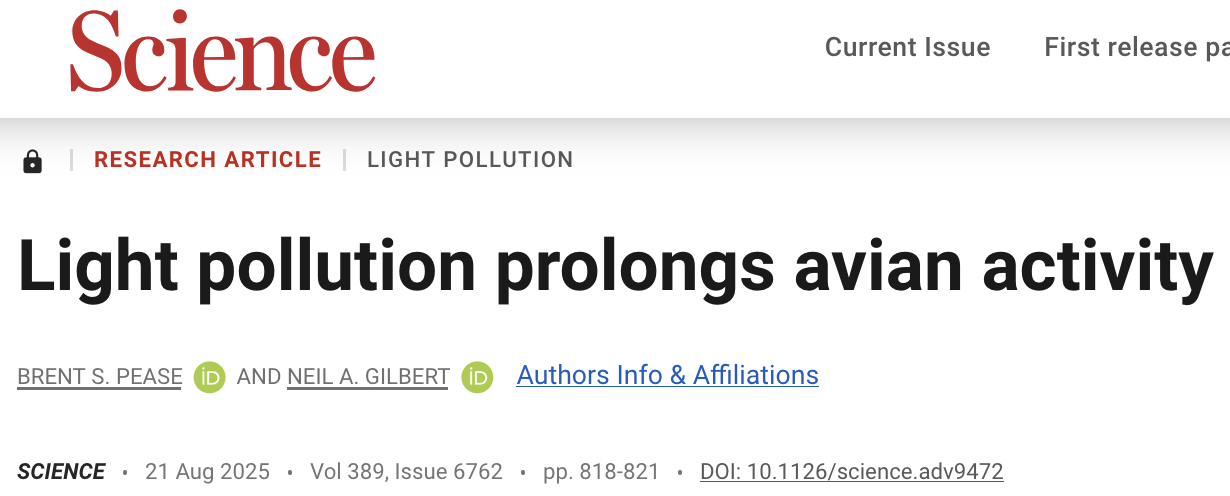
<p>A really interesting paper just came out in Science a few weeks ago: <a href="https://www.science.org/doi/10.1126/science.adv9472" rel="nofollow" class="ellipsis" title="www.science.org/doi/10.1126/science.adv9472"><span class="invisible">https://</span><span class="ellipsis">www.science.org/doi/10.1126/sc</span><span class="invisible">ience.adv9472</span></a></p><p>The authors compared satellite measurements of <a href="/tags/lightpollution/" rel="tag">#LightPollution</a> from <a href="/tags/viirs_dnb/" rel="tag">#VIIRS_DNB</a> to 2.6 million bird calls recorded at 7,824 locations around the world. They show not only that birds sing longer at both morning and night in areas that are brighter, but that the response is different for different species.</p><p>For example, species with larger eyes are more strongly affected, and species that nest in cavities (protected from light exposure) are less affected.</p><p>Very cool work!</p><p><a href="/tags/remotesensing/" rel="tag">#RemoteSensing</a> <a href="/tags/globalenvironmentalchange/" rel="tag">#GlobalEnvironmentalChange</a> <a href="/tags/birds/" rel="tag">#Birds</a> <a href="/tags/science/" rel="tag">#Science</a></p>
remotesensing




<p>🛰️ New Imagery Press Release 🛰️</p><p>The NISAR (NASA-ISRO Synthetic Aperture Radar) satellite sends "first light" images. </p><p><a href="https://www.jpl.nasa.gov/news/nasa-isro-satellite-sends-first-radar-images-of-earths-surface/" rel="nofollow" class="ellipsis" title="www.jpl.nasa.gov/news/nasa-isro-satellite-sends-first-radar-images-of-earths-surface/"><span class="invisible">https://</span><span class="ellipsis">www.jpl.nasa.gov/news/nasa-isr</span><span class="invisible">o-satellite-sends-first-radar-images-of-earths-surface/</span></a></p><p><a href="/tags/nisar/" rel="tag">#NISAR</a> <a href="/tags/nasa/" rel="tag">#NASA</a> <a href="/tags/isro/" rel="tag">#ISRO</a> <a href="/tags/remotesensing/" rel="tag">#remotesensing</a> <a href="/tags/gischat/" rel="tag">#gischat</a> <a href="/tags/gis/" rel="tag">#gis</a> <a href="/tags/satellite/" rel="tag">#satellite</a> <a href="/tags/satellites/" rel="tag">#satellites</a> <a href="/tags/sar/" rel="tag">#SAR</a> <a href="/tags/jpl/" rel="tag">#JPL</a></p>

Edited 192d ago
<p>🛰️ ICYMI New Imagery Press Release 🛰️</p><p>EUMETSAT has released the first Earth images from its METimage instrument on board the recently launched Metop Second Generation A1 (Metop-SGA1) satellite.</p><p><a href="https://www.eumetsat.int/metimage-delivers-spectacular-first-images" rel="nofollow" class="ellipsis" title="www.eumetsat.int/metimage-delivers-spectacular-first-images"><span class="invisible">https://</span><span class="ellipsis">www.eumetsat.int/metimage-deli</span><span class="invisible">vers-spectacular-first-images</span></a> </p><p>HT to <span class="h-card"><a href="https://fediscience.org/@niklasjordan" class="u-url mention" rel="nofollow noopener noreferrer" target="_blank">@<span>niklasjordan</span></a></span> who runs <span class="h-card"><a href="https://niklas.social/@eumbot" class="u-url mention" rel="nofollow noopener noreferrer" target="_blank">@<span>eumbot</span></a></span> which posts live natural color composites of EUMETSATs Meteosat satellites at 15-minute intervals. </p><p><a href="/tags/remotesensing/" rel="tag">#remotesensing</a> <a href="/tags/satellite/" rel="tag">#satellite</a> <a href="/tags/satellites/" rel="tag">#satellites</a> <a href="/tags/eumetsat/" rel="tag">#eumetsat</a> <a href="/tags/eumetsat/" rel="tag">#eumetsat</a> <a href="/tags/earthobservation/" rel="tag">#earthobservation</a> <a href="/tags/gis/" rel="tag">#gis</a> <a href="/tags/gischat/" rel="tag">#gischat</a></p>

Edited 157d ago
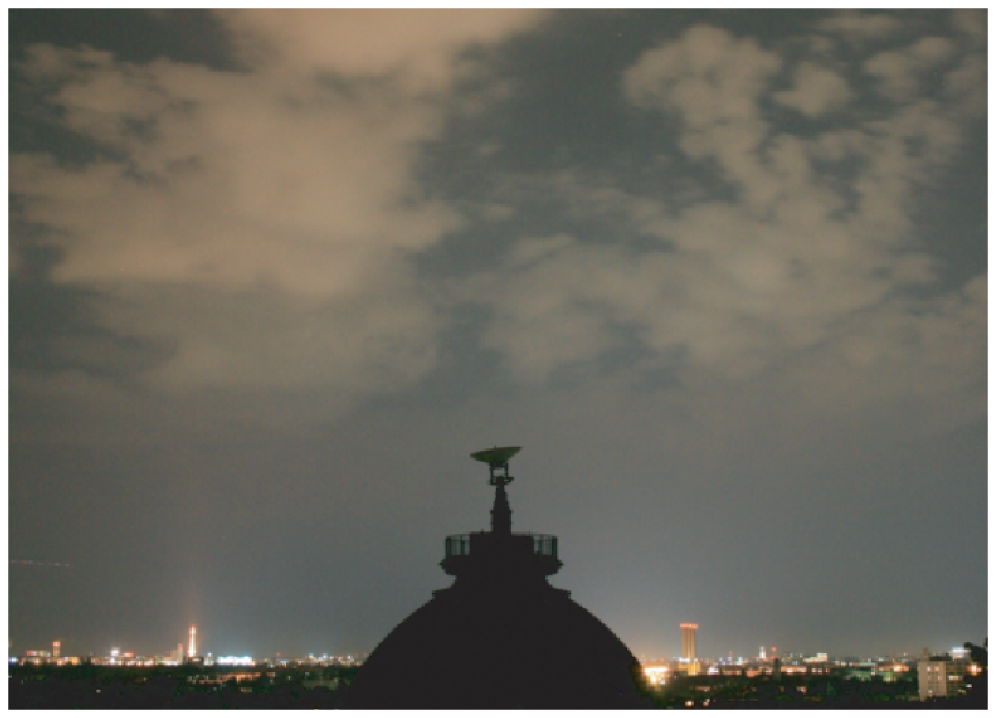
<p>15 years ago, I co-authored my first paper in the field of <a href="/tags/lightpollution/" rel="tag">#LightPollution</a> studies: <a href="https://doi.org/10.1371/journal.pone.0017307" rel="nofollow" class="ellipsis" title="doi.org/10.1371/journal.pone.0017307"><span class="invisible">https://</span><span class="ellipsis">doi.org/10.1371/journal.pone.0</span><span class="invisible">017307</span></a></p><p>Up to that point, work on artificial brightening of the sky had been done almost entirely by astronomers, who (for obvious reasons) weren't really interested in cloudy nights. But because I was involved closely with ecologists from the Leibniz Institute of Freshwater Ecology and Inland Fisheries <span class="h-card"><a href="https://wisskomm.social/@LeibnizIGB" class="u-url mention" rel="nofollow noopener noreferrer" target="_blank">@<span>LeibnizIGB</span></a></span>, we realized that it's also important to measure the extent to which overcast and clear nights differ.</p><p>Through a bunch of twists and turns I now work on <a href="/tags/remotesensing/" rel="tag">#RemoteSensing</a> using nighttime light, but that was the paper that launched me into this direction.</p>