日本


Drowning Love (2016)
溺れるナイフ WikiData IMDb TMDB Douban
other title:
물에 빠진 나이프
/
溺れるナイフ
…
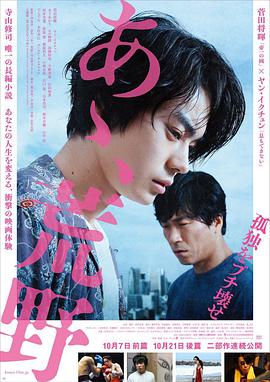
Natsume Mochizuki works as a teen model in Tokyo, but she learns that she has to move to her father's hometown of Ukigumo. She is in a desperate situation because she can't do the things she wants to do in Ukigumo. One day, she meets Koichiro Hasegawa. He is the successor of the Hasegawa family. His family is wealthy and is respected in the area. Natsume Mochizuki and Koichiro Hasegawa become attracted to each other, but something changes their fate.


Love Letter (1995)
Love Letter WikiData IMDb TMDB Douban Bangumi +2
other title:
Letters of Love
/
When I Close My Eyes
…
日本神户某个飘雪的冬日,渡边博子(中山美穗)在前未婚夫藤井树的两周年祭日上又一次悲痛到不能自已。正因为无法抑制住对已逝恋人的思念,渡边博子在其中学同学录里发现“藤井树” 在小樽市读书时的地址时,依循着寄发了一封本以为是发往天国的情书。
不想不久渡边博子竟然收到署名为“藤井树(酒井美纪)”的回信,经过进一步了解,她知晓此藤井树是一个同她年纪相仿的女孩,且还是男友藤井树(柏原崇)少年时代的同班同学。为了多了解一些昔日恋人在中学时代的情况,渡边博子开始与女性藤井树书信往来。而藤井树在不断的回忆中,渐渐发现少年时代与她同名同姓的那个藤井树曾对自己藏了一腔柔情。
The Sensualist (1991)
井原西鶴 好色一代男 IMDb TMDB Douban
other title:
好色一代男
/
Koushoku Ichidai Otoko
…
In the 54 years from his sexual awakening at the age of 7 until the age of 61, Yonosuke had relations with 3740 women and 725 men.
So we learn about the protagonist of Ihara Saikaku's 17th century novel The Sensualist in this animated adaptation, which is directed by erstwhile art director Yukio Abe, best known as the art director of the great Sanrio films of the 70s and early 80s, and scripted by erstwhile director Eiichi Yamamoto, best known for directing the experimental adult epic Belladonna.
Armed with those stats, Yonosuke makes Casanova look like the 30-year-old virgin. The 18th century Venetian and patron saint of latter-day Venutian artists such as Neil Strauss proclaims in his autobiography to have had relations with a mere 200 or so women during his lifetime. Yawn. But Casanova's autobiography is an engrossing and ethnographically invaluable piece of writing, and Yonosuke is a fictional character, so we'll call it even.
Better known as The Life of an Amorous Man, the novel was the first in a series of tracts that Ihara Saikaku published in the 1680s recounting the amorous escapades of the denizens of his Edo-period merchant class demimonde, who were apparently quite the libertines. I'm sure there are some juicy parallels waiting to be drawn between 17th century Japan and 18th century Venice by an enterprising student of comparative cultural studies.
Edo-period Japan was one of the most enlightened and liberal societies the world has ever known when it comes to sexual matters, with its sophisticated amalgamation of sexual openness and artistic expression. Rather than clients visiting prostitutes in dingy dives for a slam-bam-thank-you-mam exchange of fluids, Japan's geisha were government-sanctioned master artists who engaged clients in a classy, ritualized form of intellectual foreplay involving conversation, music and poetry.
The crème de la crème of geisha was the tayuu, and it's one of these creatures that is the object of the chase in this film. The Sensualist tells the story of a fumbling young man who seeks Yonosuke's assistance in getting with a renowned Edo tayuu. Flashbacks weave in and out of the narrative thread, filling us in on Yonosuke's respectable history of romantic dalliances.
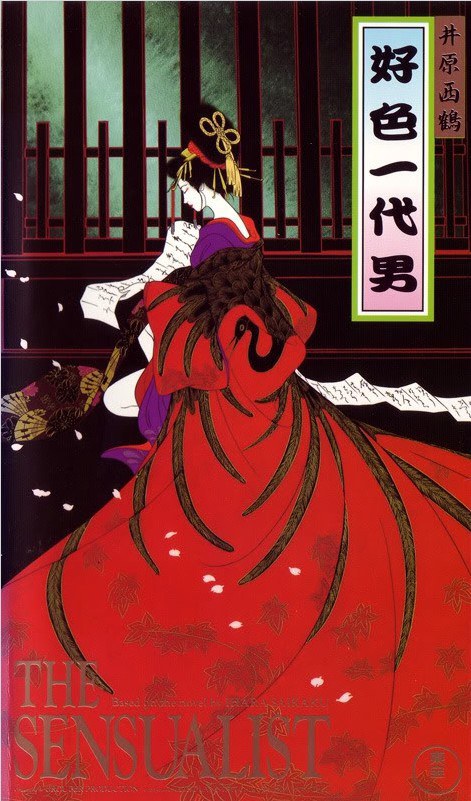
The visuals of the film are exquisite, creating a sumptuous homage to the art of the Edo period. The characters are modeled after the style of Edo hanga, and are animated with great care under the supervision of the late great FX animator Mikiharu Akabori. Quite simply, the film is a feast for the eyes. Abe Yukio was first and foremost an art director, and the focus on the film is understandably on creating a sequence of beautiful images, which it does marvelously. There are few anime films as beautiful as this one out there. The film feels like a moving hanga.
Rather than gliding through a crude naturalistic approximation of Edo Japan, the characters inhabit the actual art and expressive symbols of the era. The ocean undulates like an ink painting, white lines on a black background. Naked bodies entwined in an embrace float through fields of lotuses. Shadows of long-eared rabbits hop across folding screens painted with stormy waves. Prints of Edo beauties or landscapes by the great masters pan across the screen, creating a heady and intoxicating atmosphere in which art, sex and life intermingle, rather than simply telling a story.
Although this is definitely a film for adults, and there is a good deal of nudity, a bit of rubbing, and a whole lot of bobbing, none of it is explicit. Actual shunga from the same period as this novel are far more explicit. Instead, symbols like the turtle and the camellia that were used back then to hint at sexual matters are used in a similar spirit during lovemaking scenes. The only time the film borders on funny is when they use the same strategy as 1001 Nights and Cleopatra and suddenly coyly shift from a shot of the couple embracing to a shot of abstract animation showing a suggestively shaped flame, or a clap of lightning that sends birds flying off of a tree. But for the most part, these shots of abstract animation are subtle and creative, and they feel like a modern extension of the traditional Japanese symbolic tradition.
Originally released in Japan around 1990, this 54-minute film was presumably a direct-to-video release. Gone were the days when a film like Belladonna, this film's only real analogue in anime, could be released in the theaters. It appears to have disappeared into obscurity fairly quickly, and it's hard to find almost any information about it anymore. Needless to say, it has not been re-released on DVD.
This film deserves a better fate. If ever a film qualified as a buried gem, this is it. There is quality work here. This was an ambitious project that was clearly a labor of love. Director Yukio Abe masterfully handles a complex narrative that flows between the present, the past and the abstract, making every image count. Mikiharu Akabori's character animation is subtle but nuanced, authentically reproducing the complex dress of the era and the styles of physical representation of Edo-era prints. And Eiichi Yamamoto deserves a lot of credit for penning an excellent script tangled with poetry, authentic inflection and subtle wit. Together, they did a good job of visualizing some pretty difficult material in a way that remained true to its explicit nature without teetering too much into the realm of bad taste.
More importantly, they fully utilized all the means available in animation to create a thematically and visually consistent interpretation of the spirit of the novel. They channel the actual art of that period into the modern means of animation, achieving a sense of artistic unity that could not be achieved in a live-action adaptation.
Despite being an erotic film, it's not meant to be titillating. The film has a sense of spiritual and literary depth that goes beyond mere sexual exploitation. It reminds me of the themes invoked in 1001 Nights, the first Animerama film, which was also directed by Eiichi Yamamoto: Ambition, lust, curiosity. The desire to push yourself to be the best YOU you can be, to go higher and higher, just to see if you can do it. That is one running themes that seems to occupy Eiichi Yamamoto in the three characters of Yonosuke, Belladonna and Aldin. 1001 Nights was intended as a film for adults addressing complex adult themes, not as erotica, and I find that that's the case with this one, although the erotic element is unmistakably more dominant here. The film feels like an homage not only to the art of Edo Japan but to the erotic sensibility of that era.
And lest all this make the film sound like a stuffy art film, it's clear that they don't take themselves too seriously. It's entertaining to watch the protagonist, a bumbling stand-in for every ordinary loser out there who isn't a Don Juan like Yonosuke, fumble his way into the arms of this goddess.
Alongside Belladonna, The Sensualist is one of the rare attempts to do tasteful and artistic adult fare in animation. The studio that produced this ambitious film might come as a surprise: It was Grouper Production, a short-lived studio that was co-founded in 1986 by Masami Hata, the director of many of the very same Sanrio productions on which Yukio Abe acted as the art director. Hata directed several of Grouper's productions, including the Hobberdy Dick TV series, the Super Mario Brothers: Princess Peach movie, and the Ping Pong Club TV series. As far as I know, this is the only film that Yukio Abe directed. Since then, he has returned to art directing, most recently working again under Masami Hata on the Stitch TV series produced by Madhouse.
How did this project come about? It seems so out of character with everything else done by the studio as well as the director. Was it a project he had always wanted the chance to direct? So many questions. Grouper continued operating for several years after this film was released, so at the very least, it didn't put them out of business, which is a relief. Belladonna was produced 20 years earlier. Films like this only seem to come around in 20 year increments. Hopefully that means we'll be getting a new one soon. It's understandable that most studios don't have the daring to try their hand at something a little more ambitious like this, but it's still a shame. The talent is out there to make a new adult epic. It only makes me all the more grateful for the occasional aw-the-hell-with-it moments of indulgence like The Sensualist
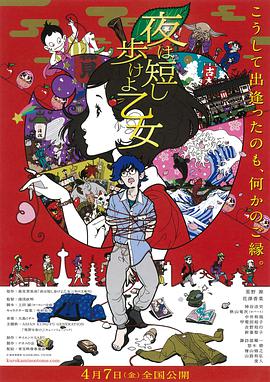
The Night is Short, Walk on Girl (2017)
夜は短し歩けよ乙女 WikiData IMDb TMDB Douban Bangumi AniList MyAnimeList TheTVDB +5
Masaaki Yuasa
/
汤浅政明
actor:
星野源
/
花泽香菜
…
other title:
春宵苦短,少女前进吧!
/
夜は短し歩けよ乙女
…
A black haired girl is walking around the streets of Kyoto, from the night scene of Pontocho to a second-hand book fair in Shimogamo, then off to a college fair. The main character that has a romantic feeling for her secretly follows her around and looks for the opportunities to run into her in a manner that seems like a coincidence. Unfortunately for him, she is not interested in love yet, so she does not notice his feelings. What awaits these two characters are a series of crazy incidents caused by bizarre individuals, such as a person who introduces himself as Tengu, the god of second-hand books, or a money lender, who collects young men's underwear and lives on a three story barge.
(Source: Sugoi Japan, edited)