
Psychosexual dramas 2
2262 movies 68 tv shows


Dogra Magra (1988) [Movie] Douban TMDB IMDb
ドグラ・マグラ
The Sensualist (1991) [Movie] Douban TMDB IMDb
井原西鶴 好色一代男
other title:
好色一代男
/
Koushoku Ichidai Otoko
…
In the 54 years from his sexual awakening at the age of 7 until the age of 61, Yonosuke had relations with 3740 women and 725 men.
So we learn about the protagonist of Ihara Saikaku's 17th century novel The Sensualist in this animated adaptation, which is directed by erstwhile art director Yukio Abe, best known as the art director of the great Sanrio films of the 70s and early 80s, and scripted by erstwhile director Eiichi Yamamoto, best known for directing the experimental adult epic Belladonna.
Armed with those stats, Yonosuke makes Casanova look like the 30-year-old virgin. The 18th century Venetian and patron saint of latter-day Venutian artists such as Neil Strauss proclaims in his autobiography to have had relations with a mere 200 or so women during his lifetime. Yawn. But Casanova's autobiography is an engrossing and ethnographically invaluable piece of writing, and Yonosuke is a fictional character, so we'll call it even.
Better known as The Life of an Amorous Man, the novel was the first in a series of tracts that Ihara Saikaku published in the 1680s recounting the amorous escapades of the denizens of his Edo-period merchant class demimonde, who were apparently quite the libertines. I'm sure there are some juicy parallels waiting to be drawn between 17th century Japan and 18th century Venice by an enterprising student of comparative cultural studies.
Edo-period Japan was one of the most enlightened and liberal societies the world has ever known when it comes to sexual matters, with its sophisticated amalgamation of sexual openness and artistic expression. Rather than clients visiting prostitutes in dingy dives for a slam-bam-thank-you-mam exchange of fluids, Japan's geisha were government-sanctioned master artists who engaged clients in a classy, ritualized form of intellectual foreplay involving conversation, music and poetry.
The crème de la crème of geisha was the tayuu, and it's one of these creatures that is the object of the chase in this film. The Sensualist tells the story of a fumbling young man who seeks Yonosuke's assistance in getting with a renowned Edo tayuu. Flashbacks weave in and out of the narrative thread, filling us in on Yonosuke's respectable history of romantic dalliances.
The visuals of the film are exquisite, creating a sumptuous homage to the art of the Edo period. The characters are modeled after the style of Edo hanga, and are animated with great care under the supervision of the late great FX animator Mikiharu Akabori. Quite simply, the film is a feast for the eyes. Abe Yukio was first and foremost an art director, and the focus on the film is understandably on creating a sequence of beautiful images, which it does marvelously. There are few anime films as beautiful as this one out there. The film feels like a moving hanga.
Rather than gliding through a crude naturalistic approximation of Edo Japan, the characters inhabit the actual art and expressive symbols of the era. The ocean undulates like an ink painting, white lines on a black background. Naked bodies entwined in an embrace float through fields of lotuses. Shadows of long-eared rabbits hop across folding screens painted with stormy waves. Prints of Edo beauties or landscapes by the great masters pan across the screen, creating a heady and intoxicating atmosphere in which art, sex and life intermingle, rather than simply telling a story.
Although this is definitely a film for adults, and there is a good deal of nudity, a bit of rubbing, and a whole lot of bobbing, none of it is explicit. Actual shunga from the same period as this novel are far more explicit. Instead, symbols like the turtle and the camellia that were used back then to hint at sexual matters are used in a similar spirit during lovemaking scenes. The only time the film borders on funny is when they use the same strategy as 1001 Nights and Cleopatra and suddenly coyly shift from a shot of the couple embracing to a shot of abstract animation showing a suggestively shaped flame, or a clap of lightning that sends birds flying off of a tree. But for the most part, these shots of abstract animation are subtle and creative, and they feel like a modern extension of the traditional Japanese symbolic tradition.
Originally released in Japan around 1990, this 54-minute film was presumably a direct-to-video release. Gone were the days when a film like Belladonna, this film's only real analogue in anime, could be released in the theaters. It appears to have disappeared into obscurity fairly quickly, and it's hard to find almost any information about it anymore. Needless to say, it has not been re-released on DVD.
This film deserves a better fate. If ever a film qualified as a buried gem, this is it. There is quality work here. This was an ambitious project that was clearly a labor of love. Director Yukio Abe masterfully handles a complex narrative that flows between the present, the past and the abstract, making every image count. Mikiharu Akabori's character animation is subtle but nuanced, authentically reproducing the complex dress of the era and the styles of physical representation of Edo-era prints. And Eiichi Yamamoto deserves a lot of credit for penning an excellent script tangled with poetry, authentic inflection and subtle wit. Together, they did a good job of visualizing some pretty difficult material in a way that remained true to its explicit nature without teetering too much into the realm of bad taste.
More importantly, they fully utilized all the means available in animation to create a thematically and visually consistent interpretation of the spirit of the novel. They channel the actual art of that period into the modern means of animation, achieving a sense of artistic unity that could not be achieved in a live-action adaptation.
Despite being an erotic film, it's not meant to be titillating. The film has a sense of spiritual and literary depth that goes beyond mere sexual exploitation. It reminds me of the themes invoked in 1001 Nights, the first Animerama film, which was also directed by Eiichi Yamamoto: Ambition, lust, curiosity. The desire to push yourself to be the best YOU you can be, to go higher and higher, just to see if you can do it. That is one running themes that seems to occupy Eiichi Yamamoto in the three characters of Yonosuke, Belladonna and Aldin. 1001 Nights was intended as a film for adults addressing complex adult themes, not as erotica, and I find that that's the case with this one, although the erotic element is unmistakably more dominant here. The film feels like an homage not only to the art of Edo Japan but to the erotic sensibility of that era.
And lest all this make the film sound like a stuffy art film, it's clear that they don't take themselves too seriously. It's entertaining to watch the protagonist, a bumbling stand-in for every ordinary loser out there who isn't a Don Juan like Yonosuke, fumble his way into the arms of this goddess.
Alongside Belladonna, The Sensualist is one of the rare attempts to do tasteful and artistic adult fare in animation. The studio that produced this ambitious film might come as a surprise: It was Grouper Production, a short-lived studio that was co-founded in 1986 by Masami Hata, the director of many of the very same Sanrio productions on which Yukio Abe acted as the art director. Hata directed several of Grouper's productions, including the Hobberdy Dick TV series, the Super Mario Brothers: Princess Peach movie, and the Ping Pong Club TV series. As far as I know, this is the only film that Yukio Abe directed. Since then, he has returned to art directing, most recently working again under Masami Hata on the Stitch TV series produced by Madhouse.
How did this project come about? It seems so out of character with everything else done by the studio as well as the director. Was it a project he had always wanted the chance to direct? So many questions. Grouper continued operating for several years after this film was released, so at the very least, it didn't put them out of business, which is a relief. Belladonna was produced 20 years earlier. Films like this only seem to come around in 20 year increments. Hopefully that means we'll be getting a new one soon. It's understandable that most studios don't have the daring to try their hand at something a little more ambitious like this, but it's still a shame. The talent is out there to make a new adult epic. It only makes me all the more grateful for the occasional aw-the-hell-with-it moments of indulgence like The Sensualist
So we learn about the protagonist of Ihara Saikaku's 17th century novel The Sensualist in this animated adaptation, which is directed by erstwhile art director Yukio Abe, best known as the art director of the great Sanrio films of the 70s and early 80s, and scripted by erstwhile director Eiichi Yamamoto, best known for directing the experimental adult epic Belladonna.
Armed with those stats, Yonosuke makes Casanova look like the 30-year-old virgin. The 18th century Venetian and patron saint of latter-day Venutian artists such as Neil Strauss proclaims in his autobiography to have had relations with a mere 200 or so women during his lifetime. Yawn. But Casanova's autobiography is an engrossing and ethnographically invaluable piece of writing, and Yonosuke is a fictional character, so we'll call it even.
Better known as The Life of an Amorous Man, the novel was the first in a series of tracts that Ihara Saikaku published in the 1680s recounting the amorous escapades of the denizens of his Edo-period merchant class demimonde, who were apparently quite the libertines. I'm sure there are some juicy parallels waiting to be drawn between 17th century Japan and 18th century Venice by an enterprising student of comparative cultural studies.
Edo-period Japan was one of the most enlightened and liberal societies the world has ever known when it comes to sexual matters, with its sophisticated amalgamation of sexual openness and artistic expression. Rather than clients visiting prostitutes in dingy dives for a slam-bam-thank-you-mam exchange of fluids, Japan's geisha were government-sanctioned master artists who engaged clients in a classy, ritualized form of intellectual foreplay involving conversation, music and poetry.
The crème de la crème of geisha was the tayuu, and it's one of these creatures that is the object of the chase in this film. The Sensualist tells the story of a fumbling young man who seeks Yonosuke's assistance in getting with a renowned Edo tayuu. Flashbacks weave in and out of the narrative thread, filling us in on Yonosuke's respectable history of romantic dalliances.
The visuals of the film are exquisite, creating a sumptuous homage to the art of the Edo period. The characters are modeled after the style of Edo hanga, and are animated with great care under the supervision of the late great FX animator Mikiharu Akabori. Quite simply, the film is a feast for the eyes. Abe Yukio was first and foremost an art director, and the focus on the film is understandably on creating a sequence of beautiful images, which it does marvelously. There are few anime films as beautiful as this one out there. The film feels like a moving hanga.
Rather than gliding through a crude naturalistic approximation of Edo Japan, the characters inhabit the actual art and expressive symbols of the era. The ocean undulates like an ink painting, white lines on a black background. Naked bodies entwined in an embrace float through fields of lotuses. Shadows of long-eared rabbits hop across folding screens painted with stormy waves. Prints of Edo beauties or landscapes by the great masters pan across the screen, creating a heady and intoxicating atmosphere in which art, sex and life intermingle, rather than simply telling a story.
Although this is definitely a film for adults, and there is a good deal of nudity, a bit of rubbing, and a whole lot of bobbing, none of it is explicit. Actual shunga from the same period as this novel are far more explicit. Instead, symbols like the turtle and the camellia that were used back then to hint at sexual matters are used in a similar spirit during lovemaking scenes. The only time the film borders on funny is when they use the same strategy as 1001 Nights and Cleopatra and suddenly coyly shift from a shot of the couple embracing to a shot of abstract animation showing a suggestively shaped flame, or a clap of lightning that sends birds flying off of a tree. But for the most part, these shots of abstract animation are subtle and creative, and they feel like a modern extension of the traditional Japanese symbolic tradition.
Originally released in Japan around 1990, this 54-minute film was presumably a direct-to-video release. Gone were the days when a film like Belladonna, this film's only real analogue in anime, could be released in the theaters. It appears to have disappeared into obscurity fairly quickly, and it's hard to find almost any information about it anymore. Needless to say, it has not been re-released on DVD.
This film deserves a better fate. If ever a film qualified as a buried gem, this is it. There is quality work here. This was an ambitious project that was clearly a labor of love. Director Yukio Abe masterfully handles a complex narrative that flows between the present, the past and the abstract, making every image count. Mikiharu Akabori's character animation is subtle but nuanced, authentically reproducing the complex dress of the era and the styles of physical representation of Edo-era prints. And Eiichi Yamamoto deserves a lot of credit for penning an excellent script tangled with poetry, authentic inflection and subtle wit. Together, they did a good job of visualizing some pretty difficult material in a way that remained true to its explicit nature without teetering too much into the realm of bad taste.
More importantly, they fully utilized all the means available in animation to create a thematically and visually consistent interpretation of the spirit of the novel. They channel the actual art of that period into the modern means of animation, achieving a sense of artistic unity that could not be achieved in a live-action adaptation.
Despite being an erotic film, it's not meant to be titillating. The film has a sense of spiritual and literary depth that goes beyond mere sexual exploitation. It reminds me of the themes invoked in 1001 Nights, the first Animerama film, which was also directed by Eiichi Yamamoto: Ambition, lust, curiosity. The desire to push yourself to be the best YOU you can be, to go higher and higher, just to see if you can do it. That is one running themes that seems to occupy Eiichi Yamamoto in the three characters of Yonosuke, Belladonna and Aldin. 1001 Nights was intended as a film for adults addressing complex adult themes, not as erotica, and I find that that's the case with this one, although the erotic element is unmistakably more dominant here. The film feels like an homage not only to the art of Edo Japan but to the erotic sensibility of that era.
And lest all this make the film sound like a stuffy art film, it's clear that they don't take themselves too seriously. It's entertaining to watch the protagonist, a bumbling stand-in for every ordinary loser out there who isn't a Don Juan like Yonosuke, fumble his way into the arms of this goddess.
Alongside Belladonna, The Sensualist is one of the rare attempts to do tasteful and artistic adult fare in animation. The studio that produced this ambitious film might come as a surprise: It was Grouper Production, a short-lived studio that was co-founded in 1986 by Masami Hata, the director of many of the very same Sanrio productions on which Yukio Abe acted as the art director. Hata directed several of Grouper's productions, including the Hobberdy Dick TV series, the Super Mario Brothers: Princess Peach movie, and the Ping Pong Club TV series. As far as I know, this is the only film that Yukio Abe directed. Since then, he has returned to art directing, most recently working again under Masami Hata on the Stitch TV series produced by Madhouse.
How did this project come about? It seems so out of character with everything else done by the studio as well as the director. Was it a project he had always wanted the chance to direct? So many questions. Grouper continued operating for several years after this film was released, so at the very least, it didn't put them out of business, which is a relief. Belladonna was produced 20 years earlier. Films like this only seem to come around in 20 year increments. Hopefully that means we'll be getting a new one soon. It's understandable that most studios don't have the daring to try their hand at something a little more ambitious like this, but it's still a shame. The talent is out there to make a new adult epic. It only makes me all the more grateful for the occasional aw-the-hell-with-it moments of indulgence like The Sensualist


Dream Demon (1988) [Movie] TMDB Douban IMDb WikiData
Dream Demon
director:
Harley Cokeliss
actor:
Jemma Redgrave
/
Kathleen Wilhoite
…
other title:
梦魔
/
Los sueños del demonio
…
A young woman about to be married begins having terrifying dreams about demons. When she wakes, however, the demons are real and begin to commit gruesome murders.
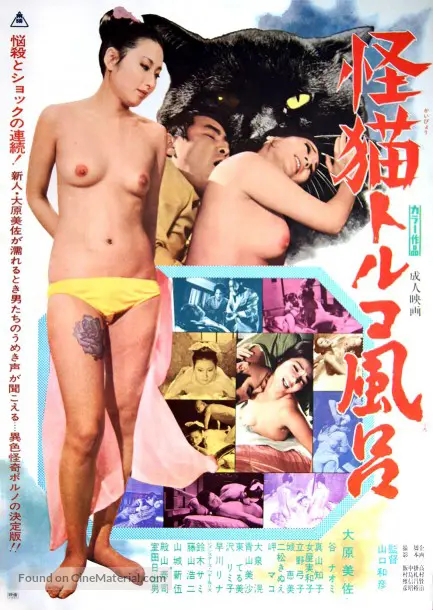
A Haunted Turkish Bathhouse (1975) [Movie] Douban IMDb WikiData TMDB
怪猫トルコ風呂
director:
山口和彦
actor:
谷奈绪美
/
大原美佐
…
other title:
怪猫土耳其浴场
/
怪猫トルコ風呂
由于《防止卖春法》自昭和三十三年四月一日起施行,吉原游廓“后宫”的老板弦造开设了泡泡浴店“舞姬”,决定让店里的姑娘们以风俗女的身份工作。然而雪乃拒绝了这一提议,与情人鹿内勇三住到了一起。鹿内却打算靠雪乃吃软饭,便以欠债为由,迫使雪乃在“舞姬”工作。那时,雪乃的妹妹真弓高中毕业后从乡下来到东京,搬进了雪乃家,雪乃一直对真弓隐瞒了自己在风俗业的事。几天后,鹿内又以偿还债务为由,让雪乃在“舞姬”住店工作,并与他在夜总会结识的弦造的继妻歌江两人分得了雪乃的“拘束费”。随后,在公寓里,当真弓正在洗澡时,鹿内强奸了她。真弓逃离了公寓,成为了一名酒吧女招待。几个月后,得知雪乃怀孕的鹿内和歌江杀死了雪乃,并将她的尸体埋进了“舞姬”地下室的墙壁里。看到“舞姬”招揽风俗女郎广告的真弓,顺利通过了试用,开始在那里工作。凭借丰满的身材和娴熟的技巧,真弓很快便成为了头号红娘。另一方面,鹿内也在歌江的推荐下在“舞姬”工作。某天,雪乃曾疼爱的那只黑猫将真弓引到了体弱多病的弦造的女儿夏代身边,真弓由此得知雪乃已经失踪。鹿内与歌江两人策划接管“舞姬”,并请求弦造允许他与夏代结婚。然而,由于遭到弦造的拒绝,鹿内杀死了弦造,并强暴了夏代。次日,夏代自杀了。当鹿内和歌江正在庆祝计划成功时,那只曾咬断弦造手腕的黑猫正注视着两人。两人下到地下室确认尸体。真弓紧随其后。弦造的尸体从木桶中显现出来,而藏在旁边的黑猫突然袭击了鹿内。激战持续,黑猫身上喷涌出鲜血,血迹溅到了埋着雪乃的墙壁上。突然,伴随着巨大的轰鸣声,墙壁碎裂,雪乃的怨灵现身了。美丽的雪乃的面容逐渐变成了怪猫。最终,真弓得知了杀害雪乃的真相,而雪乃的怨灵也完成了复仇。

Flower & Snake (1974) [Movie] Douban WikiData IMDb TMDB
花と蛇
other title:
꽃과 뱀
/
花と蛇
…
Shizuka is the aristocratic wife of the president of a large company. When she wants to divorce her domineering husband, he orders his employee Yoshi, the son of an adult toy store owner, to train his wife to become sexually submissive.

Wife to Be Sacrificed (1974) [Movie] Douban IMDb WikiData TMDB
生贄夫人
other title:
供品夫人
/
生贄夫人
…
1974 film by Masaru Konuma

Fairy in a Cage (1977) [Movie] Douban IMDb WikiData TMDB
檻の中の妖精
director:
小原宏裕
actor:
谷奈绪美
other title:
牢笼中的妖精
/
檻の中の妖精
…
During World War II a moral corrupt judge uses the military police to falsely accuse and imprison a high class business woman who captures his eye at a party. In his personal underground dungeon he subjects her to various humiliations and sexual abuse.

Ecstasy of the Black Rose (1975) [Movie] Douban IMDb TMDB
黒薔薇昇天

Campus Swingers (1972) [Movie] WikiData IMDb Douban TMDB
Schulmädchen-Report 4. Teil: Was Eltern oft verzweifeln läßt
director:
Ernst Hofbauer
actor:
Puppa Armbruster
/
Marina Blümel
…
other title:
Schulmädchen-Report 4. Teil: Was Eltern oft verzweifeln läßt
/
Bacchanales Erotiques
…
A fake documentary about the sex lives of teenage girls.

Four Rooms (1995) [Movie] Douban IMDb TMDB WikiData
Four Rooms
other title:
四个房间
/
疯狂终结者
…
It's Ted the Bellhop's first night on the job...and the hotel's very unusual guests are about to place him in some outrageous predicaments. It seems that this evening's room service is serving up one unbelievable happening after another.

The Kingdom II (1997) [Movie] WikiData TMDB
Riget II
director:
拉斯·冯·提尔
/
Morten Arnfred
actor:
Ernst-Hugo Järegård
/
Kirsten Rolffes
…
other title:
킹덤 2
/
O Reino 2
…
Set in the neurosurgical ward of Copenhagen's Rigshospitalet, the city and country's main hospital, nicknamed "Riget", "Riget" means "the realm" or "the kingdom" and leads one to think of "dødsriget", the realm of the dead.

Heart of Midnight (1988) [Movie] IMDb WikiData TMDB
Heart of Midnight
director:
Matthew Chapman
actor:
詹妮弗·杰森·李
/
布伦达·瓦卡罗
…
other title:
여인숙의 악령
/
Heart of Midnight - Im Herzen der Nacht
…
A young woman who is getting back on her feet after a mental breakdown, Carol Rivers discovers that her late uncle has left her a rundown nightclub. Carol decides to renovate the venue, but, in the process, uncovers dark secrets about the club and her dead relative. After a series of disturbing events, Carol becomes increasingly unstable, but she finds some measure of comfort in Sharpe, an enigmatic older detective.

The Last of England (1987) [Movie] Douban IMDb TMDB WikiData
The Last of England