Delphine Seyrig — Actor (42)
I Sent a Letter to My Love (1980) [Movie] IMDb Douban
Chère inconnue
director: 莫什·米扎西 actor: 西蒙·西涅莱 / 让·罗什福尔
other title: Chère inconnue / 致爱人的信
A middle-aged disabled man unknowingly begins a lonely hearts correspondence with his own unmarried sister, who takes care of him. As he writes more and more to her, he begins to fall in love, and she, knowing that it is her brother who is writing, discovers a new, tender side to him. But trouble looms when he asks to meet her in person.
The Garden That Tilts (1975) [Movie] Douban TMDB IMDb WikiData
Le jardin qui bascule
director: Guy Gilles actor: Delphine Seyrig / 萨米·弗雷
other title: 倾斜的花园 / Le jardin qui bascule
Karl, a young killer is to kill Kate, an adventurous lady living in a mansion by a lake. He approaches her but fails to kill her. Instead, he falls in love and becomes her lover ...
The Beast of the Jungle (1988) [Movie] Douban
La bête dans la jungle
director: 伯努瓦·雅克 actor: Sami Frey / Delphine Seyrig
other title: 丛林野兽 / La bête dans la jungle
Story of an unacknowledged love in Victorian England. A man spends his life, alongside a woman who is dear to him, waiting for the momentous event that should change his destiny.
Diary of a Suicide (1973) [Movie] Douban
Le journal d'un suicidé
director: 斯坦尼斯拉夫·斯坦诺耶维奇 actor: 德菲因·塞里格 / 萨米·弗雷
other title: 自杀者日记 / Le journal d'un suicidé
In his interview on Facet Video's DVD of Diary of a Suicide (Le journal d'un suicidé), Serbian director Stanislav Stanojevic mentions a French arts body that dispenses funds for creative filmmaking, and remarks that Luis Buñuel received more money than he did! This early 70s art film depends for its reputation on a quote by François Truffaut, who may have not seen the film, but had high praise for its screenplay.
Diary of a Suicide plays very much like a brief episode in a Buñuel film, but padded to feature length and communicating little beyond a vague nihilism. Busy actor Sami Frey is a handsome young man on a pleasure cruise on the east coast of Spain. He flirts with an attractive fellow passenger (Delphine Seyrig). Neither is given a name. No matter how much the man coaxes, the woman refuses to remove her sunglasses. They visit a church in Barcelona but mostly talk on board ship while watching seagulls.
The smiling woman encourages the young man to entertain her with a beautiful story. He responds with several morbid, interlinked anecdotes. A man (Bernard Haller) stands before a mirror, unable to make himself smile. Another man faces a firing squad. Anarchist lovers (Marie-France Pisier & Roland Bertin) fail to carry out an assassination. Wounded, she wants to die but is given a life sentence. Her jailer (Sacha Pitoëff) cannot sleep because he was brain-damaged in a war. That infirmity allows him to watch his prisoner around the clock. The jailer explains that his mind holds only one memory, of a beautiful woman he once knew. Should he forget her as well, the jailer reasons, his life will no longer have a purpose.
The female cruise passenger seems pleased by the young man's efforts to seduce her, but she has withheld a wicked surprise.
Unfortunately, Diary of a Suicide is a weak and uninvolving slice of mannered filmmaking. Scenes with the two main actors seem arbitrary and haphazard. Many of their encounters are staged against blank walls, and some dialogue scenes avoid showing lips, as in the cheapest of post-dubbed low-budget productions. Except for a few color inserts, all of the shipboard scenes are in B&W. Some of the young man's stories are tinted in various hues. The compositions are rarely framed wider than a medium shot, producing a feeling of claustrophobia.
With its nameless lovers and stories within stories, director Stanojevic's puzzle picture is more than a little reminiscent of Alan Resnais' Last Year at Marienbad, minus that film's elegance and compelling dreamlike surface. Little tension develops between the shipboard reality and the man's bizarre stories. A melancholy singer performing aboard the ship appears to represent the mystery woman of the jailer's tale. The singer's actor-husband dresses similarly to the jailer, and carries out the jailer's suicide as part of his act. With the exception of Sacha Pitoëff's morose jailer, none of the story characters connect with the audience. The gaunt, sad jailer truly looks like a man haunted by his loss of memory.
Stanislav Stanojevic's main coup for his first film is the gathering of an impressive cast. He's secured the services of Seyrig and Pitoëff, two of the stars of Last Year at Marienbad. Sami Frey and Marie-France Pisier have appeared in films by Agnès Varda, Georges Franju, William Klein, Jean-Luc Godard, H.G. Clouzot, François Truffaut, Alain Robbe-Grillet, Luis Buñuel and Jacques Rivette.
Director Stanojevic made two more features blending political themes with aspects of the fantastic. 1979's Subversion is about a country ruled by a paralyzed, blind president and his corrupt daughter. Diary of a Suicide has images of soldiers used as cannon fodder and anarchists dedicated to an assassination, but makes no real political statement. Its final twist is indeed a surprise, but an almost pointless one.
Facets Video's DVD of Diary of a Suicide is an acceptable flat transfer with English subtitles. For an extra we're given a lengthy video interview with the director. Stanojevic doesn't discuss Diary at length, preferring to give an unfocused talk about film funding and filmmaking in general.
Window Shopping (1986) [Movie] IMDb Douban TMDB WikiData
Golden Eighties
8.0 (16 ratings) director: 香特尔·阿克曼 actor: 德菲因·塞里格 / 米丽娅姆·博耶
other title: 金色80年代 / Golden Eighties
Three young women at a hair salon all like the son of the clothing store proprietors across the mall. Although Robby is selfish and shallow, he's appealing to Lili, the salon's manager, who's trendy and also the salon-owner's moll; to Mado, who's innocent and sweet; and to Pascale, who's intelligent but passive and downcast. Robby's dad tells him to grow up and see beyond the mercurial Lili, so he proposes suddenly to Mado. She's delighted, but the day before the wedding, Lili returns to give Robby another look. In the background, a Yank who was a soldier in France in World War II returns to Paris and tries to recapture the love of his wartime sweetheart, Robby's mom.
Seven Women, Seven Sins (1986) [Movie] Douban IMDb WikiData TMDB
Seven Women, Seven Sins
other title: 七个女人七宗罪 / Superbia 傲慢
Seven Women, Seven Sins (1986) represents a quintessential moment in film history. The women filmmakers invited to direct for the seven sins were amongst the world's most renown: Helke Sander (Gluttony), Bette Gordon (Greed), Maxi Cohen (Anger), Chantal Akerman (Sloth), Valie Export (Lust), Laurence Gavron (Envy), and Ulrike Ottinger (Pride). Each filmmaker had the liberty of choosing a sin to interpret as they wished. The final film reflected this diversity, including traditional narrative fiction, experimental video, a musical, a radical documentary, and was delivered in multiple formats from 16, super 16, video and 35mm.
Location Hunting (1977) [Movie] Douban
director: Michel Soutter actor: 让-路易·特兰蒂尼昂 / 德菲因·塞里格
other title: Repérages
In the story of Reperages, Victor (Jean-Louis Trintignant) is a film director who has arranged to shoot a version of Anton Chekhov's play The Three Sisters. Casting her in the lead will enable his troubled wife, who has separated from him, to earn some money and receive some much-needed emotional support. Julie (Delphine Seyrig), his wife, has a drug problem, but Cecilia (Lea Massari), her co-star, happily approaches her with just the right kind of off-camera friendship to keep her going...
The Image of Dorian Gray in the Yellow Press (1984) [Movie] Douban IMDb WikiData TMDB
Dorian Gray im Spiegel der Boulevardpresse
director: Ulrike Ottinger actor: 范若施卡·冯·兰朵夫 / 德菲因·塞里格
other title: 八卦小报图片中的多里安·格雷 / Dorian Gray im Spiegel der Boulevardpresse
The final installment in Ulrike Ottinger’s Berlin Trilogy (following TICKET OF NO RETURN and FREAK ORLANDO) casts Delphine Seyrig as the nefarious Fritz Lang supervillain Dr. Mabuse, here the head of a powerful media empire that seeks to create headlines by manufacturing (and then publicly destroying) its own celebrity: the wealthy, handsome playboy Dorian Gray.
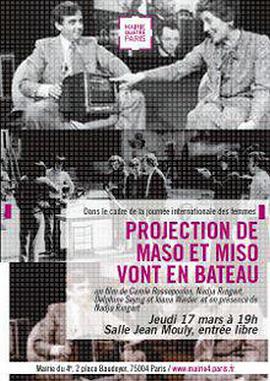
Maso and Miso Go Boating (1975) [Movie] Douban TMDB IMDb WikiData
Maso et Miso vont en bateau
director: Nadja Ringart / 卡罗尔·罗索普洛斯 actor: José Artur / Simone de Beauvoir
other title: 马索和米索出航记 / Maso et Miso vont en bateau
1975年,随着联合国“国际妇女年”的临近,法国电视台播放了一个名为“妇女年:感谢上帝”的节目。“一切都结束了,”这本书汇集了法国男性的各种可疑言论,当时唯一的女性客人,当时的女国务卿弗兰·奥伊丝·基洛德应该对此作出回应。Maso和Miso Vont en Bateau是女权主义者视频活动家“Les Insoumuses”(卡罗尔·罗索普洛斯、德尔芬·塞里格、纳贾林加特和IO安娜·维德尔)对今晚的回应:他们愤怒而机智地从编辑桌上插手,不仅曝光了节目,而且还揭露了吉洛德作为父权主义者的滑稽行为的办公室。社会。“没有电视图像能代表我们;我们将借助视频讲述我们自己的故事。”
这个集体的另一个作品是《S.C.U.M.宣言》,该宣言分阶段阅读同名的1967年作品。当男性主导的世界事件的新闻图像在电视屏幕上闪烁时,Delphine Seyrig传播了Valerie Solanas关于男性的论文——根据宣言,男性在生物学上是不完整的,并且受到阴道嫉妒的驱使。
As the UN’s “International Year of the Woman” came to a close in 1975, French TV ran a programme called “The Year of the Woman: Thank God! It’s Over,” which assembled various questionable statements by French men to which the only female guest, then State Secretary for Women, Françoise Giroud, was supposed to respond. Maso et Miso vont en bateau is how the feminist video activists “Les Insoumuses” – Carole Roussopoulos, Delphine Seyrig, Nadja Ringart, and Ioana Wieder – responded to this evening: with fury and ample wit, they intervene from the editing table to expose not only the show, but also Giroud’s very office as being the farce of a patriarchal society. “No television image can represent us; we’ll tell our own stories with the help of video.”
Another of the collective’s works is S.C.U.M. Manifesto, which stages a reading of the eponymous 1967 work. As news images of male-dominated world events flicker across the television screen, Delphine Seyrig disseminates Valerie Solanas’s theses on men – who, according to the manifesto, are both biologically incomplete and driven by vagina envy.
Conversation about India Song (1984) [Movie] Douban
La couleur des mots
director: 杰罗米·博若尔 / Jean Mascolo actor: 玛格丽特·杜拉斯 / Dominique Noguez
other title: 词语的颜色 / La couleur des mots
访谈杜拉斯,关于《印度之歌》