Nigel Thomas — Author (22)
The German Navy 1935–45 [Book] Douban Google Books Goodreads
author: Nigel Thomas / Nigel Thomas publishing house: Osprey Publishing 2025 - 2
An illustrated study of the uniforms and personal equipment worn by the personnel of the Kriegsmarine, the German Navy of the Third Reich, from 1935–45.
Founded in defiance of the Treaty of Versailles, the Kriegsmarine was established in 1935 and reached a peak strength of more than 800,000 personnel in 1944. Its original aim of amassing a surface fleet on parity with Great Britain's Royal Navy shifted with the outbreak of World War II, after which focus moved to submarine warfare, with the Kriegsmarine's U-boats exacting a heavy toll on Allied shipping across the globe. Meanwhile, several of its formidable capital ships – notably the Graf Spee, Bismarck, Tirpitz, Scharnhorst and Gneisenau – saw widespread action as Nazi Germany strove to defeat the Allies at sea.
In this new study, Nigel Thomas examines the evolving organization, uniforms and equipment used by the Kriegsmarine during its ten-year existence, spanning its pre-war beginnings, the invasion of Norway in 1940, and through to the deployment of Kriegsmarine personnel as grounds troops from 1943–45. The different gear worn by its various branches of service is described in detail and illustrated with newly commissioned colour artwork and an array of specially selected photographs.
The German Army in World War I (1) [Book] Google Books Goodreads Douban
author: Nigel Thomas / Nigel Thomas publishing house: Osprey Publishing 2003 - 8
In August 1914 the mobilization of Imperial Germany's 800,000-strong army ushered in the first great war of the modern age - a war which still stands as the greatest slaughter of soldiers in history. That German Army is also the best example of a particular period of military thought, when virtually the whole manpower of the European nations was integrated into mass conscript armies, supported by several age categories of reservists and by dedicated industrial and transport systems. In this first of three volumes the author offers an extraordinary mass of information, in text and tables, illustrated by photographs and colour plates.
Czechoslovak Armies 1939–45 [Book] Douban Google Books Goodreads
author: Nigel Thomas / Nigel Thomas publishing house: Osprey Publishing 2024 - 1
Featuring rare photos, detailed colour illustrations and insignia tables, this study explores the contribution made by Czech and Slovak troops fighting alongside Allied forces during World War II.

Following the Anglo-French failure at the Munich Conference in March 1938 to prevent a Nazi take-over of Bohemia-Moravia (modern Czech Republic/Czechia), many frustrated Czech and Slovak soldiers sided with Allied forces and fought alongside their armies – first in Poland, then in France, and finally from Britain.

Using depictions of relevant uniforms and equipment plus photos of the troops in action, military uniformology expert Nigel Thomas explains how the Czech Army was organized and how it fought alongside Allied forces in the Middle East and at Normandy. He describes the involvement of free Czech agents operating from Britain in Operation Anthropoid, the assassination of Nazi governor Reinhard Heydrich in occupied Bohemia-Moravia, and the part Czech soldiers played in mutinies in both Italy and Prague against German occupation which ultimately helped to secure a final Allied victory.
Hitler’s Russian & Cossack Allies 1941–45 [Book] Google Books Douban Goodreads
author: Nigel Thomas / Nigel Thomas publishing house: Osprey Publishing 2015 - 10
Given the merciless way in which the war on the Eastern Front of World War II was conducted, it is difficult to imagine soldiers changing allegiance from one side to another. Yet after the German invasion of Russia in Operation Barbarossa, well over 400,000 former Soviet Citizens went on to fight for Nazi Germany in some capacity. These included not only the 'legions' recruited from non-Russian ethnic groups eager for freedom from Stalin's dictatorship, but also some 100,000 Russians and Cossacks. What began as small local security units of 'Ostruppen', enrolled for the ongoing campaigns against Soviet partisans, were later reorganized, given special systems of uniform and insignia, amalgamated into larger formations, and eventually committed to the front line. This book offers up an essential guide to the appearance, formation and equipment of the myriad Russian and Soviet units that fought for the Germans. It uses rare photographs and revealing color illustrations to create a peerless visual reference to the troops who switched from one ruthless superpower to another and met with a horrific fate when the fighting was over.
World War II Soviet Armed Forces (3) [Book] Google Books Goodreads Douban
author: Nigel Thomas / Nigel Thomas publishing house: Osprey Publishing 2012 - 11
This book presents a detailed analysis of the Soviet armed forces during the final days of the war, covering the soldiers that successfully turned the tide against the Nazi onslaught and pushed it back into Germany itself. This final part of the series documents the Red Army's push through Germany to Berlin, which eventually culminated in the surrender of the German forces to the Allies in 1945. It also offers a detailed breakdown of all the armed forces that conducted the offensive campaigns on the Eastern Front, including the army, air force, paratroopers, navy and NKVD troops. It also reveals in colourful illustrations the uniforms and organizations of the Russian forces serving against Japan until the eventual surrender of all Japanese Imperial forces in August 1945.
World War II Soviet Armed Forces (2) [Book] Douban Goodreads
author: Nigel Thomas / Nigel Thomas publishing house: Osprey Publishing 2011 - 7
In this second volume of a three-part series on the Soviet Armed Forces in World War II (1939-1945), author Nigel Thomas turns his attention to the mid-war period. Focusing on the uniforms and organization of Soviet troops during the campaigns of the Caucasus, Stalingrad and Kursk, this book offers a detailed breakdown of all the armed forces which conducted the valiant defensive campaigns, including the army, air force, paratroopers, navy and NKVD troops. It also covers equipment and insignia and the changes brought about by the new regulations of 1943. An invaluable resource for those curious about the war effort on the Eastern front.
World War II Soviet Armed Forces (1) [Book] Goodreads Douban
author: Nigel Thomas / Nigel Thomas publishing house: Osprey Publishing 2010 - 10
This would be a detailed analysis of the Soviet Army at the outbreak of World War II, including the Red Army's campaigns against Japan on the Manchurian plains as well as in Finland. It would also cover the Red Army's first operations during Operation Barbarossa when the Red Army was forced to defend Mother Russia against the German onslaught. This book would offer a breakdown of all the armed forces including the army, air force, paratroopers, navy and NKVD troops. In particular, it will cover the evolution of uniforms, equipment and insignia with the introduction of new regulations in 1935 and 1940.
Axis Forces in Yugoslavia 1941-45 [Book] Douban Google Books Goodreads
author: Nigel Thomas / Nigel Thomas publishing house: Osprey Publishing 1995 - 3
On 6 April, the German 2nd and 12th Armies, Italian 2nd and 9th Armies, and the Hungarian 4th, 5th and Mobile Corps invaded Yugoslavia from Italy, Germany, Rumania, Bulgaria and Albania. Few of the Royal Yugoslav Army's 30 divisions actively resisted, and after 11 days the Yugoslav High Command surrendered. In Croatia, a puppet state was installed. Axis forces quickly occupied the principal towns and patrolled the main road and rail links, but in the villages, countryside and mountains a vicious and complex guerrilla war was brewing. This title takes a close look at the German, Italian, Croatian, Serbian, Montenegrin, Bulgarian, Macedonian, and Slovenian units that fought for the Axis powers in Yugoslavia.
Wehrmacht Auxiliary Forces [Book] Douban Goodreads Google Books
author: Nigel Thomas / Nigel Thomas publishing house: Osprey Publishing 1992 - 11
Though the 'Wehrmachtsgefolge' (Armed Forces Auxiliaries) were generally inferior to their armed forces equivalents, their contribution to the German war-effort was far from negligible. Auxiliaries including the NSKK, Transportkorps Speer, Reichsarbeitsdienst and Organization Todt supported the Wehrmacht in their duties. In 1944, the strength of these organizations peaked at 3,800,000-40% of the size of the armed forces. As they became increasingly aware of their importance, the Auxiliaries introduced uniform and insignia modifications which made them virtually indistinguishable from their comrades in the armed forces. This book examines the organization, uniforms and history of the various Wehrmacht auxiliary forces of World War II.
Yugoslav Armies 1941–45 [Book] Goodreads Google Books Douban
author: Nigel Thomas / Nigel Thomas publishing house: Osprey Publishing 2022 - 1
In March 1941, an anti-German coup in the Kingdom of Yugoslavia prompted Hitler to order an invasion using allied Italian, Hungarian, Bulgarian and Romanian forces. Operation Marita was an invasion of Yugoslavia and simultaneously Greece. At the same time, the constituent region of Croatia broke away from Yugoslavia and joined the Axis powers. Royal Yugoslav armed forces, despite advancing against the Italians in Albania were forced to surrender after 11 days' fighting and some 1,000 soldiers, airmen and sailors escaped to British-occupied Egypt to form Free Yugoslav units. From there, guerrilla resistance to the Axis occupiers broke out and continued with increasing strength until the end of the war under Mihailovic's royalist 'Chetniks' and Tito's Communist 'Partisans' (both supported by Britain). However, hostilities between the two movements eventually led to the Chetniks entering into local agreements with Italian occupation forces and Britain switching its support entirely to the Partisans. The advance of the Red Army increased Partisan strength and, during 1944-45, they created what could be described as a lightly equipped conventional army.
Using meticulously-drawn illustrations of different insignia, uniforms and equipment from each faction to bring the conflict alive, this volume describes, in detail, both the political and military implications of the war and how it was fought, setting the scene for the subsequent rise of Tito to power within Yugoslavia
The German Army in World War I (3) [Book] Goodreads Douban
author: Nigel Thomas / Nigel Thomas publishing house: Osprey Publishing 2004 - 11
This third volume of a mini-series covering the German forces in World War I examines the troops that fought during the climax of the war on all fronts: the last great battles of attrition in the West (Arras, Messines, 3rd Ypres - Passchendaele/Langemarck - and Cambrai, 1917) and the collapse of Russia in the East. The 'Kaiserschlacht' campaign is covered, as are the German operations in Italy, the Balkans, and in support of Turkey in the Middle East. Uniform changes during this period reflected the introduction of new tactics and weapons and new types of troops, such as tanks and assault battalions.
The German Army in World War I (2) [Book] Douban Goodreads
author: Nigel Thomas / Nigel Thomas publishing house: Osprey Publishing 2004 - 4
The years 1915–17 of World War I saw the Imperial German Army forced to adapt to the new realities of static trench warfare. Prewar uniforms and equipment had to be modified, for both utility and economy; on battlefields ruled by machine guns and artillery the steel helmet reappeared, as well as masks to protect against poison gas. The fashionable cavalry regiments soon proved irrelevant on the Western Front; many were dismounted to join the infantry, while new types of unit usurped their prestige – assault battalions, and the air corps. This second volume in a three-part sequence offers a mass of detail on organisation, uniforms and insignia, illustrated with rare photographs and meticulous colour artwork.
Germany's Eastern Front Allies (2) [Book] Goodreads Douban Google Books
author: Nigel Thomas / Nigel Thomas publishing house: Osprey Publishing 2012 - 5
The Baltic nations Estonia, Latvia and Lithuania enjoyed a brief independence between the World Wars before being annexed by the USSR in 1940. The grim experience of Soviet occupation made it inevitable that after the German invasion of Russia in 1941 they would fight beside the Wehrmacht as allies against the Red Army while always hoping for restored independence. That hope was crushed again in 1944-45; yet 'Forest Brother' guerrillas continued to fight against hopeless odds for years after the second Soviet occupation. This extraordinary story is illustrated here with rare photos, insignia charts, tables of units and detailed uniform plates.
NATO Armies 1949–87 [Book] Goodreads Douban Google Books
author: Nigel Thomas publishing house: Osprey Publishing 1988 - 2
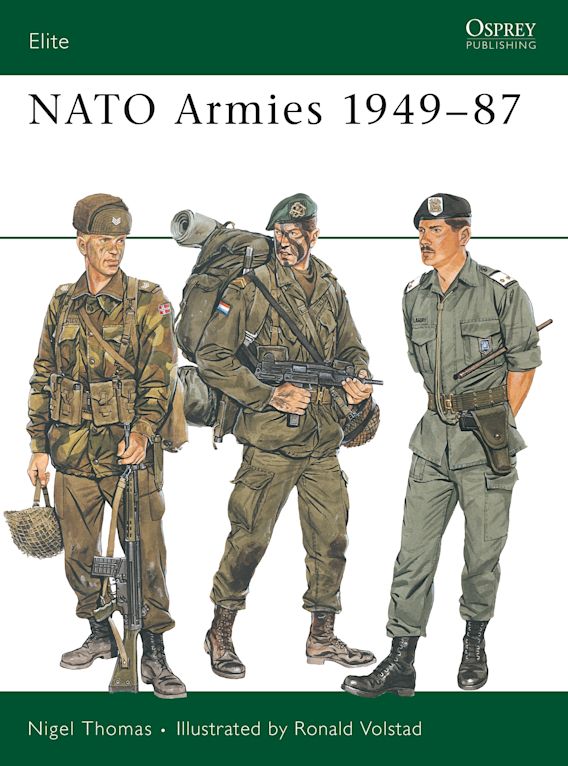
Osprey's study of NATO armies of the post-World War II period. The defeat of Hitler on 8 May 1945 left Western Europe militarily vulnerable and economically exhausted. The Soviet Union, however, had since 1940 annexed 180,000 square miles of Eastern Europe, occupied a further 390,000 square miles, and now seemed poised to advance still further westwards with its six-million strong forces. The increasing Soviet threat brought forth demands for a permanent Western Military alliance, and on 4 April 1949, the North Atlantic Treaty was signed in Washington DC. This book explores the history, organization and uniforms of NATO armies - excluding the United States and Great Britain - as they were in the late 1980s.
The German Army 1939–45 (1) [Book] Douban Google Books
author: Nigel Thomas / Nigel Thomas publishing house: Osprey Publishing 2012 - 9
On 1 September 1939, when Germany attacked Poland, the Wehrmacht numbered 3,180,000 men. It eventually expanded to 9,500,000, and on 8-9 May 1945, the date of its unconditional surrender on the Western and Eastern Fronts, it still numbered 7,800,000. The Blitzkrieg period, from 1 September 1939 to 25 June 1940, was 10 months of almost total triumph for the Wehrmacht, as it defeated every country, except Great Britain, that took the field against it. In this first of five volumes examining the German Army of World War Two, Nigel Thomas examines the uniforms and insignia of Hitler's Blitzkrieg forces, including an overview of the Blitzkrieg campaign itself. Men-at-Arms 311, 316, 326, 330 and 336 are also available in a single volume special edition titled 'German Army in World War II'.
The German Army 1939-45 (2) [Book] Douban
author: Nigel Thomas / Nigel Thomas publishing house: Osprey Publishing 1998 - 4
Hitler first considered an invasion of Great Britain in autumn 1940, then scheduled Operation Barbarossa, the conquest of the European part of the Soviet Union, for May 1941. Anxious to emulate Hitler's successes, the Italian dictator Mussolini embarked upon unnecessary military adventures in North Africa and the Balkans, which forced Hitler's intervention, diverting and depleting precious German resources, and a six-week postponement of Barbarossa. In this second of four volumes [Men-at-Arms 311, 316, 326 & 330] on the German Army of the Second World War, Nigel Thomas examines the uniforms and insignia of the forces involved in North Africa and the Balkans. Men-at-Arms 311, 316, 326, 330 and 336 are also available in a single volume special edition titled 'German Army in World War II'.
The German Army 1939–45 (4) [Book] Douban
author: Nigel Thomas / Nigel Thomas publishing house: Osprey Publishing 1999
In early 1943, the annihilation of the 6th Army at Stalingrad marked the irreversible turning-point of World War II (1939-1945) in the East. Despite occasional local successes gained in the face of great odds - testimony to the Wehrmacht's extraordinary resilience - from now on Germany was on the defensive. Despite Hitler's damaging interference the quality of German field leadership, and of new weapons, remained high; but each new Soviet offensive pushed the front line closer to - and finally, across - the borders of the Reich. In this fourth title of their sequence author and artist describe and illustrate the developments in unit organization, uniforms and equipment during 1943-45, including information on European and Eastern volunteer units; text and illustrations are supported by detailed tables.
The German Army 1939-45 (5) [Book] Douban
author: Nigel Thomas / Nigel Thomas publishing house: Osprey Publishing 2000 - 1
This book covers the high command, the developments in unit organisation, the campaigns and the uniforms and equipment of the German Army in the last two years of the war in North-West Europe and Italy. Despite the huge pressure of fighting on three fronts, ever-worsening shortages of manpower and equipment, and Allied command of the skies, Germany's decimated divisions fought on with impressive skill and determination. This period of World War II (1939-1945) also saw a fascinating mixture of obsolescent, newly designed, and field-made combat clothing which gave the German soldier a radically different appearance from his predecessor of just five years before.
Hitler's Eastern Legions 1942–45 [Book] Douban
author: Nigel Thomas / Nigel Thomas publishing house: Osprey Publishing 2020 - 8
Between 1941-45, the Germans recruited around 175,000 men from a number of minorities in the USSR, distinguishing between 'Turkomans' (predominantly Muslims) and 'Caucasians' (predominantly Orthodox Christians). Of these, many formed rear-area auxiliary units, but at least 55,000 were combat troops. The first recruits formed two battalions in the 444th Security Division raised as early as November 1941; during 1942-43 seven legions were formed, each of several battalions, eventually totalling some 53 battalions (equivalent to about 6 full divisions). However, with one exception (162nd Turkoman Division), they were not deployed as whole formations; after training in Poland, individual battalions were posted to fill out German regiments in the front lines, at first in Army Group South but later in all three Army Groups fighting on the Eastern Front. Units were also sent to Yugoslavia, Italy and the Western Front.
This fully illustrated history of the Eastern legions details the organization, battle orders, combat history, uniforms and insignia of these unique units, combining contemporary photographs and full-colour illustrations with expert research from military historian Dr Nigel Thomas.
The German Army 1939-45 (3) [Book] Douban
author: Nigel Thomas / Nigel Thomas publishing house: Osprey Publishing 1999 - 3
Operation Barbarossa, the attack on the Soviet Union, commenced on 22 June 1941. It became the biggest conflict in military history, with some three million German troops and about 900,000 allies facing almost 4.7 million Soviet troops. The effects would colour postwar European history for the next 50 years. This title examines the history of the conflict, and the organisation, uniforms and insignia of the German Army on the Eastern Front from 1941-43. The book contains numerous illustrations and photographs throughout, incuding eight fine full-page colour plates by Stephen Andrew. Men-at-Arms 311, 316, 326, 330 and 336 are also available in a single volume special edition titled `German Army in World War II'.