Jacques Rivette — Director (34)
The Story of Marie and Julien (2003) [Movie] Douban WikiData IMDb TMDB
Histoire de Marie et Julien
director: 雅克·里维特 actor: 艾曼纽·贝阿 / 耶日·拉齐维沃维奇
other title: 幻爱钟情 / Histoire de Marie et Julien
Julien is a clockmaker with destructive impulses who decides to blackmail Madame X, a rich, attractive woman who traffics in stolen antiques. What he doesn’t know is that she has an even more dangerous secret that leads him to Marie, with whom he had fallen in love a year earlier.
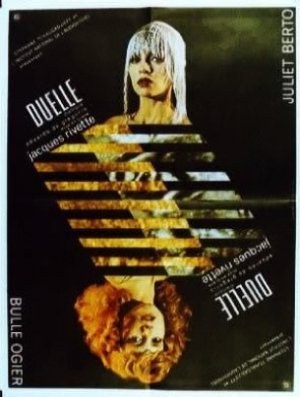
Duelle (1976) [Movie] Douban WikiData IMDb TMDB
Duelle (une quarantaine)
7.1 (8 ratings) director: 雅克·里维特 actor: Juliet Berto / 布鲁·欧吉尔
other title: 决斗 / Duelle (une quarantaine)
Rivette is relatively precise in his dealings with meaning. He is the most atavistically ceremonious of the Vague, in the sense that his abstraction as a journey leading inwards is always attended by signs and codas that affirm our passage. The transcendent rite of passage, in more ways than one, is about the symbolic enactment that paves the way. The transcendence itself is left to our sphere of experience, but we're at least brought to the doorstep.
Oh, there's the improvisational flow that seems to throw people off, that things seem to be randomly bubbling up from nothing without significant plan or substance. The chance encounters in a world that we may recognize, the geography vaguely familiar whose nature is yet ultimately insoluble. There's a lot of that here. As in Celine, it is the breathing space that conducts our preparation to step beyond the mechanisms of reason. We don't reason with it, rather trust its intuitive flow. Like the dream world, it is only the figment of the known world spontaneously arisen as a stage or blank slate for the atavistic portents and divinations of the subconscious mind to be writ.
But the rite of passage matters, in spite of the seemingly aimless wandering. Here it is about human effort to bypass the 'wall of paradise' constituted by the coincidence of apparent opposites (good and evil, light and dark, being and non-being). A barrier that obscures vision and traps in a world of names and forms that is only an apparent reality.
Rendered in the film as twin goddesses of sun and moon, vying for a precious stone that enables their descend into the human world. The human characters are mere pawns to their schemes; to be seduced, tricked, threatened, or ultimately destroyed. Twin femme fatales, weaving spells in an inverse noir universe magnified into a macrocosmic struggle.
The ill-prepared man who chances to steal a glimpse of them in their true form, like in the myth of Actaion who steals upon the Greek goddess Artemis bathing naked in a pool, has his consciousness shattered by the revelation. His mirrored image (the soul, the reflected half) is cracked.
The woman who finally shatters the illusionary duality that quarantines human consciousness into meaningless dilemmas, does so by a sacrifice of blood.
And this is the problem of the film. So much of it is a stridently symbolic enactment, a matter of ceremony. The sacrifice is, quite literally, a matter of spilling blood upon the symbolic stone and does not flow from anything - it is simply the schematic end of the spiritual myth. Although valuable as insight, the meaning of the film is trapped inside the rituals performed to signify it. Having cracked the outer shell to absorb it, the film seizes to resonate.
Le Pont du Nord (1981) [Movie] WikiData IMDb Douban TMDB
Le Pont du nord
8.2 (16 ratings) director: 雅克·里维特 actor: 布鲁·欧吉尔 / 帕斯卡·欧吉尔
other title: 北方的桥 / Le Pont du nord
In this unreal walk through the streets of Paris, Marie (Bulle Ogier), a woman convicted of robbing a bank is just out from prison when she runs into Baptiste (Pascale Ogier) a young paranoid needing companionship, and the two team up for awhile. Marie's former boyfriend (Pierre Clementi) supplies them with a strange map of the city, suspicious because he keeps files on political figures that may be somehow linked to the map. A gangster nicknamed "Max" begins to track Marie and the already paranoid Baptiste, causing Marie to examine the map as though it held the clue to which sides of the city were "safe" and which were not. As the two women attempt to outsmart Max and unknown gangsters, they try to figure out the map - a task made all the more difficult by Baptiste's tendency to violent rushes of adrenaline and Marie's overworked imagination (a dragon at the North Bridge is a threat until Baptiste screams him down). Between the dragon and their own demons, Marie and Baptiste face frightening odds against coming out of this misadventure intact. ~ Eleanor Mannikka, Rovi
Va Savoir (Who Knows?) (2001) [Movie] Douban WikiData IMDb TMDB
Va savoir
9.0 (6 ratings) director: 雅克·里维特 actor: 让娜·巴利巴尔 / 玛丽安娜·巴斯莱
other title: 去了解 / Va savoir
After finding love and success in Italy, French actress Camille returns to Paris, the city she fled three years ago. She secretly dreads confronting her ex-boyfriend Pierre. Her new lover Ugo also has a secret, as he’s meeting with the intriguing Dominique while on his quest for an unpublished manuscript.
Up, Down, Fragile (1995) [Movie] TMDB IMDb Douban WikiData
Haut bas fragile
8.5 (27 ratings) director: 雅克·里维特 actor: 玛丽安娜·德尼库尔 / 娜塔莉·理查德
other title: 高、低与脆弱之间 / Haut bas fragile
The film follows the story of three girls in contemporary Paris. One searches for her lost mother since she knows she's adopted. The other has come out of a coma and needs to have a love relationship aside from his mysterious father. The third one is a crook who redeems herself through love. The action is commented by songs and dance routines.