亚历山大·索科洛夫 — Director (58)


Taurus (2001) [Movie] Douban WikiData IMDb TMDB
Телец
other title:
遗忘列宁
/
Телец
…
Unfolding over two days in 1924, the film depicts the dying Lenin, world revolutionary and father of the USSR, now powerless and isolated at his Gorki estate. Cared for by his wife, Nadezhda Krupskaia, sister Maniasha, his German doctor and several attendants, Lenin raves about his diminishing faculties, discusses the deaths of great figures (including Marx), rides a car to a picnic in a meadow and ponders his historic legacy.


Mother and Son (1997) [Movie] WikiData IMDb Douban TMDB
Мать и сын
other title:
母与子
/
Мать и сын
…
A man goes for a walk through the countryside with his dying mother.

The Second Circle (1990) [Movie] Douban IMDb WikiData TMDB
Круг второй
other title:
第二层地狱
/
Круг второй
…
A man tries to come to terms with his father's death and to deal with the mundane details of his burial in a society cut off from spirituality.
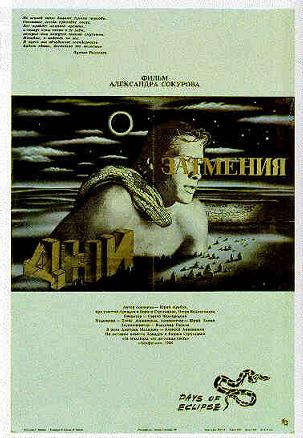
The Days of Eclipse (1988) [Movie] IMDb WikiData Douban TMDB
Дни затмения
director:
亚历山大·索科洛夫
actor:
Aleksei Ananishnov
/
Eskender Umarov
…
other title:
日蚀的日子
/
Дни затмения
…
The film Days of Eclipse is based on a novel by famous Soviet science fiction writers — brothers Arcady and Boris Strugatsky. The action has been transferred to the Central Asia where a young Russian doctor gives treatment to children and tries his hand at writing. Introducing us a young contemporary at the crossroads (for the first time in Sokurov's work), this film becomes the first part of a cinema trilogy.
This character, whose formative years pass in the situation of broken and showing its cracks way of life, becomes a link between three of Sokurov's films. The whole 'trilogy' is joined together by the bitter irony regarding worn–out sacral symbols. Films Days of Eclipse, The Second Circle, The Stone, made in different years, are linked up with each other by one common plot: permanent co–existence of real everyday life, of so to say daily routine, with messages or messengers from Nowhere.
The young athlete from Days of Eclipse played by young non–professional performer Alexei Ananishnov is no less an archaic symbol of the former power of the collapsed Soviet empire than a recording of Brezhnev's speech sounding in the film or huge plaster cast Hammer and Sickle sticking out in the desert.
Dmitry Malyanov from Strugatsky's novel A Milliard Years before the End of the World has nothing in common with the character of Days of Eclipse beside the name. In fact, for Sokurov's hero the end of the world has already come and the border of this end has fallen on his life. The character who has been brought to the world of alien climate, alien speech, alien customs, learns not to be surprised at the cases of violence against others and himself — in order to survive, speaks to a dead body, tames and feeds exotic reptiles, and, on top of that, meets an angel appearing as a child.
This film was successful with the cinema audience of Perestroika years. Alexei Ananishnov later played the main part in one more film by Sokurov Mother and Son.
The film has been listed by the European Cinema Academy among 100 best movies of the XX century.
Alexandra Tuchinskaya
English translation by Anna Shoulgat, © 2002.
Prizes and awards:
1988. Special Award Felix of the European Cinema Academy to the composer Y. Khanin.
1988. NIKA Award of the Filmmakers' Union of the USSR to the Director of Sound V. Persov as Best Director of Sound.
1989. Laureate of the competition for Best Russian film of the year.
Award of the Filmmakers' Union of the USSR to S. Yurizditsky as Best Director of Photography.
This character, whose formative years pass in the situation of broken and showing its cracks way of life, becomes a link between three of Sokurov's films. The whole 'trilogy' is joined together by the bitter irony regarding worn–out sacral symbols. Films Days of Eclipse, The Second Circle, The Stone, made in different years, are linked up with each other by one common plot: permanent co–existence of real everyday life, of so to say daily routine, with messages or messengers from Nowhere.
The young athlete from Days of Eclipse played by young non–professional performer Alexei Ananishnov is no less an archaic symbol of the former power of the collapsed Soviet empire than a recording of Brezhnev's speech sounding in the film or huge plaster cast Hammer and Sickle sticking out in the desert.
Dmitry Malyanov from Strugatsky's novel A Milliard Years before the End of the World has nothing in common with the character of Days of Eclipse beside the name. In fact, for Sokurov's hero the end of the world has already come and the border of this end has fallen on his life. The character who has been brought to the world of alien climate, alien speech, alien customs, learns not to be surprised at the cases of violence against others and himself — in order to survive, speaks to a dead body, tames and feeds exotic reptiles, and, on top of that, meets an angel appearing as a child.
This film was successful with the cinema audience of Perestroika years. Alexei Ananishnov later played the main part in one more film by Sokurov Mother and Son.
The film has been listed by the European Cinema Academy among 100 best movies of the XX century.
Alexandra Tuchinskaya
English translation by Anna Shoulgat, © 2002.
Prizes and awards:
1988. Special Award Felix of the European Cinema Academy to the composer Y. Khanin.
1988. NIKA Award of the Filmmakers' Union of the USSR to the Director of Sound V. Persov as Best Director of Sound.
1989. Laureate of the competition for Best Russian film of the year.
Award of the Filmmakers' Union of the USSR to S. Yurizditsky as Best Director of Photography.

The Lonely Voice of Man (1987) [Movie] Douban TMDB WikiData IMDb
Одинокий голос человека
director:
亚历山大·索科洛夫
actor:
Vladimir Degtyarev
/
Vladimir Gladyshev
…
other title:
孤独人类之声
/
Одинокий голос человека
…
Set in the early 1920s after the end of the Russian Civil War, Red Army soldier Nikita returns to his hometown to see his partner Lyuba, both of whom are scarred by the trauma of the Russian Empire of yesteryear.

The Elegy from Russia...dreams for sleep (1993) [Movie] Douban
Элегия из России
director:
亚历山大·索科洛夫
other title:
俄罗斯挽歌
/
Элегия из России
…
Документальность и лиризм — полярные составляющие кинематографического языка — равнозначимы и неразделимы в поэтике фильмов российского режиссера Александра Сокурова. И в документальных, и в игровых его лентах объекты реальной жизни, давно или недавно запечатленные на кинопленке, включаются в свободную поэтическую композицию. В своей новой работе А. Сокуров и его коллеги — оператор А. Буров, звукооператор В. Персов — сплетают художественную ткань картины без швов и узлов, словно из одной нити, достигая на своем пути нового итога — итога мировоззренческого.
Из аннотации Александры Тучинской
Из аннотации Александры Тучинской

Dmitri Shostakovich. Sonata for Viola (2004) [Movie] Douban IMDb WikiData TMDB
Дмитрий Шостакович. Альтовая соната
director:
Semyon Aranovich
/
Aleksandr Sokurov
actor:
Tamara Alyoshina
/
Sergei Prokofiev
…
other title:
Дмитрий Шостакович. Альтовая соната
/
Sonate pour alto. Dimitri Chostakovitch
…
The life and work of the great Russian composer Dmitriy Shostakovich is presented in this documentary through rare images and audios from many archives, at one time censored by the Soviet government. A brief take on his life, from his transition as an early prodigy to a first rate artist, his celebrated compositions and the final years with a declining health.

Cinema16: World Short Films (2008) [Movie] Douban
Cinema16: World Short Films
other title:
世界名导短片集
本条目为世界知名的16位导演短片合集,具体包括:
01. 黄蜂 Wasp - Andrea Arnold
02. 审判 심판 - 朴赞郁 Chan-wook Park
03. 在冰上 sikumi - 安德鲁·麦克莱恩 Andrew Okpeaha MacLean
04. Doña Lupe - Guillermo del Toro
05. 老妇与鸽子 La vieille dame et les pigeons - 西维亚·乔迈 Sylvain Chomet
06. 袭击面包店 パン屋襲撃 - 山川直人 Naoto Yamakawa
07. 两车一夜 Two Cars, One Night - 泰卡·怀蒂蒂 Taika Waititi
08. 希特勒奏鸣曲 Соната для Гитлера - Aleksandr Sokurov
09. 我的父亲100岁了 My Dad Is 100 Years Old - Guy Maddin
10. 铲车司机克劳斯--第一个工作日 Staplerfahrer Klaus - Der erste Arbeitstag - Stefan Prehn/Jörg Wagner
11. 舅舅 Uncle - 亚当·艾略特 Adam Elliot
12. 时间终结四重奏 Cuarteto para el fin del tiempo - 阿方索·卡隆 Alfonso Cuarón
13. 坐火车的女人 Madame Tutli-Putli - Chris Lavis/Maciek Szczerbowski
14. 一个女孩的故事 A Girl's Own Story - Jane Campion
15. 马车夫 Borom sarret - Ousmane Sembene
16. 懦弱 Soft - Simon Ellis
01. 黄蜂 Wasp - Andrea Arnold
02. 审判 심판 - 朴赞郁 Chan-wook Park
03. 在冰上 sikumi - 安德鲁·麦克莱恩 Andrew Okpeaha MacLean
04. Doña Lupe - Guillermo del Toro
05. 老妇与鸽子 La vieille dame et les pigeons - 西维亚·乔迈 Sylvain Chomet
06. 袭击面包店 パン屋襲撃 - 山川直人 Naoto Yamakawa
07. 两车一夜 Two Cars, One Night - 泰卡·怀蒂蒂 Taika Waititi
08. 希特勒奏鸣曲 Соната для Гитлера - Aleksandr Sokurov
09. 我的父亲100岁了 My Dad Is 100 Years Old - Guy Maddin
10. 铲车司机克劳斯--第一个工作日 Staplerfahrer Klaus - Der erste Arbeitstag - Stefan Prehn/Jörg Wagner
11. 舅舅 Uncle - 亚当·艾略特 Adam Elliot
12. 时间终结四重奏 Cuarteto para el fin del tiempo - 阿方索·卡隆 Alfonso Cuarón
13. 坐火车的女人 Madame Tutli-Putli - Chris Lavis/Maciek Szczerbowski
14. 一个女孩的故事 A Girl's Own Story - Jane Campion
15. 马车夫 Borom sarret - Ousmane Sembene
16. 懦弱 Soft - Simon Ellis

聖彼得堡日記:莫扎特安魂曲 (2004) [Movie] Douban
Петербуржский дневник: Моцарт. Реквием
director:
Aleksandr Sokurov
other title:
Петербуржский дневник: Моцарт. Реквием
/
Peterburgskiy dnevnik: Mozart. Rekviem
Alexander Sokurov used five television cameras to film Mozart’s Requiem Mass, which the Director himself had staged in the small Philharmonic Hall in Saint Petersburg in 2004.
The main characteristic of the performance is that the chorus isn’t still, it moves around on the stage. The movements in space aren’t specified in the script; sometimes the chorus moves around chaotically, sometimes they come together on the proscenium, sometimes they gather at the back of the stage. In the same way, the soloists move around freely. Thanks to the lighting, these movements create a play of chiaroscuro. The film is not edited in a traditional manner. We didn’t try to respect the usual succession of the frames, nor did we follow the soloists, nor did we try to sustain the rhythm of the musical work through our editing. The rhythm of the film changes, it doesn’t always coincide with the rhythm of the music. The spectator follows the changes of lighting, the movements of the interpreters, their faces, their emotions. The people of Saint Petersburg who came to see the performance are also the characters of the film.
(A. Sokurov)
The main characteristic of the performance is that the chorus isn’t still, it moves around on the stage. The movements in space aren’t specified in the script; sometimes the chorus moves around chaotically, sometimes they come together on the proscenium, sometimes they gather at the back of the stage. In the same way, the soloists move around freely. Thanks to the lighting, these movements create a play of chiaroscuro. The film is not edited in a traditional manner. We didn’t try to respect the usual succession of the frames, nor did we follow the soloists, nor did we try to sustain the rhythm of the musical work through our editing. The rhythm of the film changes, it doesn’t always coincide with the rhythm of the music. The spectator follows the changes of lighting, the movements of the interpreters, their faces, their emotions. The people of Saint Petersburg who came to see the performance are also the characters of the film.
(A. Sokurov)

Father and Son (2003) [Movie] Eggplant.place WikiData IMDb Douban TMDB
Отец и сын
other title:
Padre e figlio
/
Отец и сын
…
In this dreamlike film, a nameless father and his son, Aleksei, live together in an apartment in St. Petersburg. Aleksei's mother has died and consequently the two have a very close relationship. When Aleksei acquires a girlfriend, she refuses to take a back seat to his bond with his dad, and breaks up with him. Aleksei is also experiencing nightmares, dreading separation from his father to be a part of the military as his father was.

The Dialogues with Solzhenitsyn (2000) [Movie] Douban TMDB IMDb
Узел. Беседы с Солженицыным
other title:
对话索尔仁尼琴
/
Узел. Беседы с Солженицыным
…
The Dialogues with Solzhenitsyn is a two-part Russian television documentary by Russian filmmaker Alexander Sokurov on Aleksandr Solzhenitsyn. The documentary shot in Solzhenitsyn’s home shows his everyday life and covers his reflections on Russian history and literature.

Sonata for Hitler (1989) [Movie] Douban
Соната для Гитлера
other title:
希特勒奏鸣曲
/
Соната для Гитлера
This short movie from Sokurov uses archival footage of Adolf Hitler composed in a new manner with sometimes classical, sometimes unsettling music in the background. I'm not sure about the date of the production, as the final cut was made in 1989 but the preliminary version was ready in 1979
with so many early films by Sokurov, this film has two dates: the first is the date of its creation (the film was then banned), the second is the date of the final edition and legal public screening. The film consists of German and Soviet archive footage of the World War II - to be exact, from the end of the war. An attempt to make a large-scale documentary on this subject had been undertaken in the Soviet cinema of the 1960s: the film - "Ordinary Fascism" - by the outstanding Soviet film-maker Mikhail Romm had become a classic retrospective investigation of fascism. But Sokurov uses the expressive power of the documentary image in an absolutely different way. He does not amass materials for a large-scale picture of Nazi crimes.
As a lyrical film-maker, in the space of this short film, he manages to present an entire overview of the historical landscape after the catastrophe. He chooses only the psychological aspect of this, showing the perpetrators of crimes as also the victims of their crimes: the execution of Hitler's generals, the miserable despair of a defeated Hitler, the shame of the crowd use only to regimentation, the shame of the nation. Here Sokurov makes an unspoken comparison with the history of his own country: it was victorious in the face of Hitler, but at the same time had bred its own dictator, Stalin. The footage is numbered; dates on both sides of the frame denote the years of Hitler's and Stalin's deaths (1945 and 1953 respectively).
- Alexandra Tuchinskaya
Translated by Olga Abramenko with assistance from Benjamin Halligan.
with so many early films by Sokurov, this film has two dates: the first is the date of its creation (the film was then banned), the second is the date of the final edition and legal public screening. The film consists of German and Soviet archive footage of the World War II - to be exact, from the end of the war. An attempt to make a large-scale documentary on this subject had been undertaken in the Soviet cinema of the 1960s: the film - "Ordinary Fascism" - by the outstanding Soviet film-maker Mikhail Romm had become a classic retrospective investigation of fascism. But Sokurov uses the expressive power of the documentary image in an absolutely different way. He does not amass materials for a large-scale picture of Nazi crimes.
As a lyrical film-maker, in the space of this short film, he manages to present an entire overview of the historical landscape after the catastrophe. He chooses only the psychological aspect of this, showing the perpetrators of crimes as also the victims of their crimes: the execution of Hitler's generals, the miserable despair of a defeated Hitler, the shame of the crowd use only to regimentation, the shame of the nation. Here Sokurov makes an unspoken comparison with the history of his own country: it was victorious in the face of Hitler, but at the same time had bred its own dictator, Stalin. The footage is numbered; dates on both sides of the frame denote the years of Hitler's and Stalin's deaths (1945 and 1953 respectively).
- Alexandra Tuchinskaya
Translated by Olga Abramenko with assistance from Benjamin Halligan.


Russian Ark (2002) [Movie] IMDb TMDB Douban WikiData
Русский ковчег
other title:
俄罗斯方舟
/
Русский ковчег
…
2002 fictional historical film by Alexander Sokurov filmed in the Winter Palace in one take without stopping the camera