Jean-Marie Straub — Director (41)
Machorka-Muff (1963) [Movie] WikiData IMDb TMDB Douban
Machorka-Muff
director: 让-马里·斯特劳布 / 达尼埃尔·于伊耶 actor: Erich Kuby / Renate Lang
other title: 马霍卡-莫夫 / 마쇼르카-머프
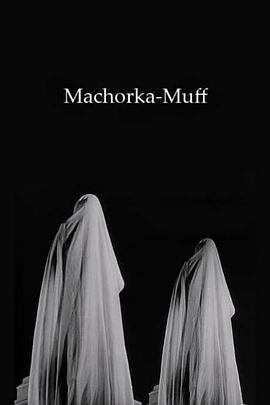
Straub-Huillet’s adaptation of Heinrich Böll’s biting satire Bonn Diary presents the reflections of a reactivated officer who is summon ed to the West German capital by the Ministry of Defense to establish an Academy for Military Memories. Straub considered his film to be an intervention against German rearmament in the Adenauer era: "Machorka-Muff is the story of a rape, the rape of a country on which an army has been imposed, a country which would have been happier without one."
In "Machorka-Muff," Mr. Straub, employing the cold, somewhat expressionistic but always loquacious approach of his other films, comes closest to underlining the almost subliminal irony of his themes. He briefly outlines, through the performance of Colonel Machorka-Muff, a former Nazi who is reinstated in the Adenauer regime, the unchanging thinking of the Nazi and/or the military mind. As the colonel of the title, Dr. Johannes Eckhardt is properly cold and convincing as the believer in the rights of the soldier. Although it is the shortest and earliest of Mr. Straub's films, it is both the most lucid of his works and the most clearly indicative of his potential as an imaginative filmmaker.
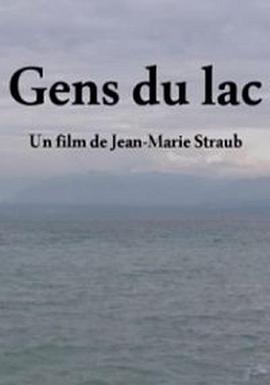
People of the Lake (2018) [Movie] Douban
Gens du lac
other title: 湖边人 / Gens du lac
It is the discovery of a document recognising the services rendered by two fishermen from Lake Geneva during the Occupation that triggered the investigation undertaken by Swiss author Janine Massard in her novel Gens du lac, published in 2013. Jean-Marie Straub retraces the itinerary of the son, Paulus – just as he and Danièle Huillet had followed that of Jean Bricard just over ten years ago in the last film they made together. Gens du lac does not depart from the rule that sets each Straubfilm as an account of a historical situation in which men have resisted (Daney). Shot aboard a boat and hardly ever leaving the lake’s waters, the film depicts the life of this only son who has found brothers over the course of his fishing – be it his first steps in the trade, the help given to fugitives and deliveries of provisions to the Resistance, or his contribution to the emergence of a new Left in post-war Francophone Switzerland. Finding the seeds of a political act in this unconditional hospitality, Straub gradually dissipates the peaceful impression and conservative spirit of this “friendly, even emollient” landscape, and distinguishes between the silence “recommended during the hostilities” from the silence that subsequently enjoined people not to disturb the political order. While the people of the lake do not guard a frontier, they do, on the other hand, belong to a front. (Antoine Thirion)
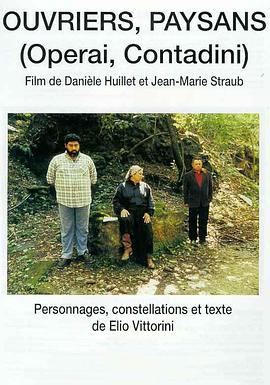
Workers, Peasants (2001) [Movie] WikiData IMDb TMDB Douban
Operai, contadini
director: 达尼埃尔·于伊耶 / 让-马里·斯特劳布 actor: Angela Nugara / Giacinto Di Pascoli
other title: 工人,农民 / Operai, contadini
"Veteran experimental filmmakers Danielle Huillet and Jean-Marie Straub helmed this unusual adaptation of a novel by Elio Vittorini. Focused on the triumphs and failures of a group of laborers and farm hands who pooled their resources to operate an alternative collective farm after the end of World War II, Operai, Contadini features a cast of 12 actors who read aloud from Vittorini's book for the duration of the film, either reciting from memory or using a clearly visible script. Hardly designed to be a crowd pleaser, Operai, Contadini proved to be controversial among the audiences for its showings at the 2001 Cannes Film Festival, where it was screened as part of the Directors' Fortnight series." ~ Mark Deming, All Movie Guide
"The group makes up a primitive community which seeks to erase not only the distress created by the war but also the hardships of life and hunger, and to protect them from violence, misery and fear. Amid the ruins of this post-war period, the characters build and invent a rapport both in their professional and daily lives between themselves, the sexes, generations, diverse social and geographical origins, and antagonistic political camps.
The group maintains a 'register', a kind of diary, as if it were entering the minutes of an inquiry or a trial." -Steve Grayson
"my favorite Straub-Huillet films are Too Early, Too Late and Operai, contadini (2001), both color landscape films with especially acute senses of place as well as of nature in all its harsh beauty." - Jonathan Rosenbaum
Too Early, Too Late (1981) [Movie] WikiData IMDb TMDB Douban
Trop tôt, trop tard
director: 达尼埃尔·于伊耶 / 让-马里·斯特劳布 actor: Danièle Huillet / Bahgat Elnadi
other title: 太早,太迟 / Trop tôt, trop tard
Inspired by a letter by Friedrich Engels and a 1974 account of two militant Marxist writers who had been imprisoned by the Nasser regime, Straub-Huillet filmed this film in France and Egypt during 1980. They reflect on Egypt’s history of peasant struggle and liberation from Western colonization, and link it to class tensions in France shortly before the Revolution of 1789, quoting texts by Engels as well as the pioneering nonfiction film Workers Leaving the Lumière Factory (1895).
Fortini/Cani (1977) [Movie] WikiData IMDb TMDB Douban
Fortini/Cani
director: 达尼埃尔·于伊耶 / 让-马里·斯特劳布 actor: 阿德里亚诺·阿普拉 / Franco Fortini
other title: 弗尔蒂尼和卡尼 / 西奈之犬
斯特勞布夫妻將詩人Franco Fortini的長詩《西奈之犬》(Cani del Sinai)透過詩人自己的讀詩與一些空鏡頭結合,希冀將詩意以「不加干涉」的方式呈現,邀觀眾進入詩的空間。
-----------------------------------------------
The film is a sort of presentation of Franco Fortini's book 'I Cani del Sinai'. Fortini, an Italian Jew, reads excerpts from the book about his alienation from Judaism and from the social relations around him, the rise of Fascism in Italy, the anti-Arab attitude of European culture. The images, mostly a series of Italian landscape shots, provide a backdrop that highlights the meaning of the text. (Written by Fabrizio Sabidussi)
From the Clouds to the Resistance (1979) [Movie] WikiData IMDb TMDB Douban
Dalla nube alla resistenza
director: 达尼埃尔·于伊耶 / 让-马里·斯特劳布 actor: 奥林匹娅·卡尔立斯 / Guido Lombardi
other title: 从云端到反抗 / Dalla nube alla resistenza
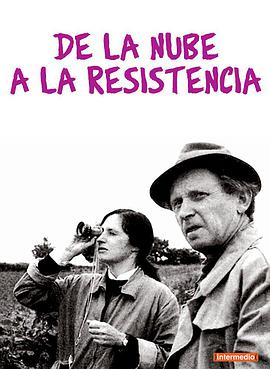
Two segments. The first one arranges six stories from Cesare Pavese's "Dialoghi con Leucò", taken from classical mythology. The second segment is taken from Pavese's novel "La luna e i falò": after WWII the emigrant 'The Bastard' comes back to his village in the Langhe (northern Italy) to find that everyone he knew has died and the war has deeply changed relationships between people.
Othon (1970) [Movie] WikiData IMDb TMDB Douban
Les yeux ne veulent pas en tout temps se fermer, ou Peut-être qu'un jour Rome se permettra de choisir à son tour
director: 达尼埃尔·于伊耶 / 让-马里·斯特劳布 actor: 阿德里亚诺·阿普拉 / Anne Brumagne
other title: 眼睛不想一直闭着或者也许有一天轮到罗马自己选择 / Les yeux ne veulent pas en tout temps se fermer, ou Peut-être qu'un jour Rome se permettra de choisir à son tour
1970 film directed by Jean-Marie Straub and Danièle Huillet
Not Reconciled (1965) [Movie] WikiData IMDb TMDB Douban
Nicht versöhnt oder Es hilft nur Gewalt wo Gewalt herrscht
director: 让-马里·斯特劳布 / 达尼埃尔·于伊耶 actor: Heinrich Hargesheimer / Carlheinz Hargesheimer
other title: 没有和解 / Nicht versöhnt oder Es hilft nur Gewalt wo Gewalt herrscht
The subtitle of Jean-Marie Straub and Danièle Huillet’s first feature, from 1965, “Only Violence Helps Where Violence Reigns,” suggests the fierce political program evoked by their rigorous aesthetic. The pretext of the film, set in Cologne, is Heinrich Böll’s novel “Billiards at Half Past Nine,” which they strip down to a handful of stark events and film with a confrontational angularity akin to Bartók’s music that adorns the soundtrack. The subtlest of cues accompany the story’s complex flashbacks. The middle-aged Robert Fähmel tells a young hotel bellhop of persecutions under the Third Reich; his elderly father, Heinrich, an architect famed for a local abbey, recalls the militarism of the First World War, when his wife, Johanna, incurred trouble for insulting the Kaiser. A third-generation Fähmel is considering architecture, just as the exiled brother of Robert’s late wife, returns, only to be met by their former torturer, now a West German official taking part in a celebratory parade of war veterans. Straub and Huillet make the layers of history live in the present tense, which they judge severely. The tamped-down acting and the spare, tense visual rhetoric suggest a state of moral crisis as well as the response—as much in style as in substance—that it demands.
阿蒂米德的膝盖 (2008) [Movie] Douban
Le genou d'Artémide
7.2 (5 ratings) director: 让-马里·斯特劳布 actor: Andrea Bacci / Dario Marconcini
other title: Le genou d'Artémide / Artemis' Knee
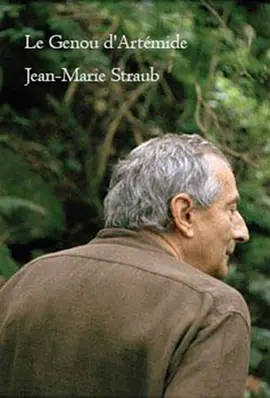
For Le Genou d'Artemide Jean-Marie Straub once again chose a dialogue by Cesare Pavese. And not just any dialogue, but one that tears open a painful, mystical abyss between love and the one left behind. The film is one single exhilaration and one single rush, a spell and dispersion into nature. It rises from a dark screen and chant to disappear in the woods with the whisper of the wind. It has little to do with what is generally called «cinema». It has one foot in the world beyond.
Nature has ten million times the imagination of the most imaginative of artists. (Jean-Marie Straub)
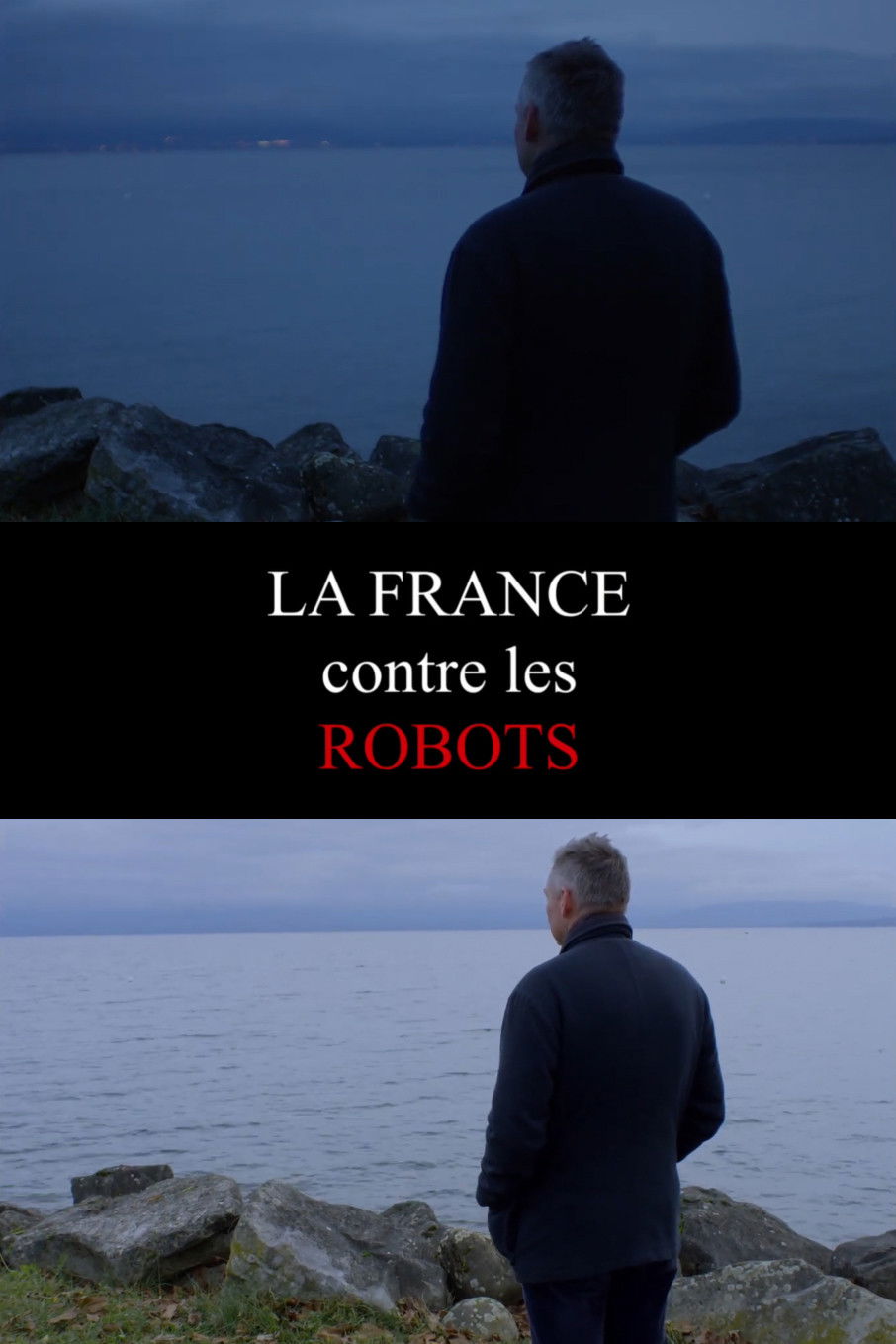
France Against the Robots (2020) [Movie] IMDb TMDB Douban
La France contre les robots
other title: 法兰西反自动化 / La France contre les robots
"The word 'revolution' to us Frenchmen is not a vague term. We know that Revolution is a rupture, that Revolution is an Absolute. There is no such thing as a moderate revolution, there is no such thing as a planned revolution—as one speaks of a planned economy. The revolution we are announcing will overturn the entire existing order or it will not take place at all..."
The Bridegroom, the Actress, and the Pimp (1968) [Movie] WikiData IMDb TMDB Douban
Bräutigam, die Komödiantin und der Zuhälter
7.0 (6 ratings) director: Jean-Marie Straub / Danièle Huillet actor: Irm Hermann / Kristin Peterson
other title: 新郎,女骗子和皮条客 / Bräutigam, die Komödiantin und der Zuhälter
Three sequences are linked together in this short film by Straub; the first sequence is a long tracking shot from a car of prostitutes plying their trade on the night-time streets of Germany; the second is a staged play, cut down to 10 minutes by Straub and photographed in a single take; the final sequence covers the marriage of James and Lilith, and Lilith's subsequent execution of her pimp, played by Rainer Werner Fassbinder.
The Death of Empedocles (1987) [Movie] WikiData IMDb TMDB Douban
Der Tod des Empedokles oder: Wenn dann der Erde Grün von neuem Euch erglänzt
director: 达尼埃尔·于伊耶 / 让-马里·斯特劳布 actor: 威廉姆·伯格 / Georg Brintrup
other title: 恩培多克勒之死 / Der Tod des Empedokles oder: Wenn dann der Erde Grün von neuem Euch erglänzt
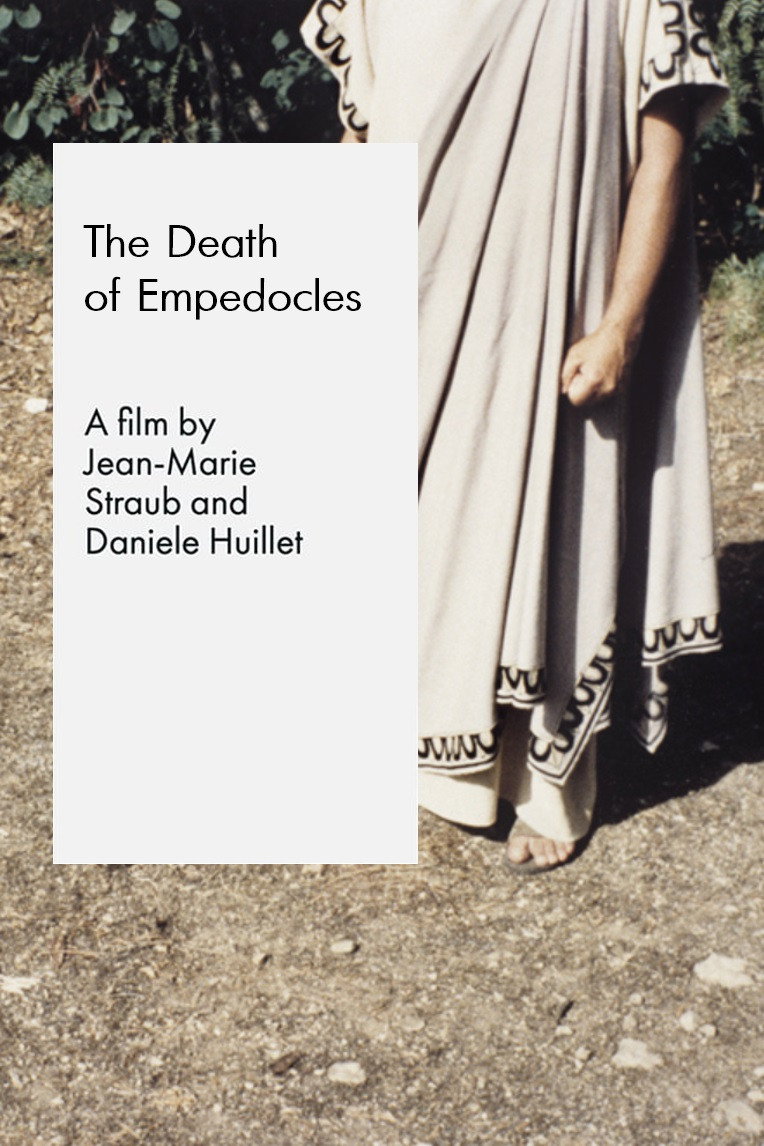
The subject of Danièle Huillet and Jean-Marie Straub’s Der Tod des Empedokles (The Death of Empedocles, 1987) is the Greek pre-Socratic philosopher Empedocles (c. 490 BC – 430 BC), who lived in the Greek colony of Agrigentum in Sicily. His theories are mentioned in several of Plato’s dialogues. He maintained that all matter is made up of four irreducible elements: water, earth, air and fire. A mystic and a poet, he is considered to be the founder of classical rhetoric. He is also thought to be the last Greek philosopher to write in verse; two fragments of his works survive: Katharmoi (Purifications) and Peri Phuseôs (On Nature). An advocate of democracy, he came into conflict with his fellow citizens of Agrigentum and, as result, was banished with his young disciple, Pausanius. When he was asked to return, he preferred to commit suicide by throwing himself into the active volcano at Mount Aetna.
The German writer Friedrich Hölderlin wrote two versions of Der Tod des Empedokles in 1798 and 1800, and a final third version in 1820, all three ultimately unfinished. They were conceived as five-act tragedies and all three differ in plot. According to Michael Hamburger, Hölderlin’s English-language translator,
the main reason why Hölderlin finished no version of the play must be that he remained too closely identified with Empedocles, at the very period in his life when his own view of the poet as philosopher, prophet and priest – and as tragic hero – was subject to perpetual crisis and re-examination.
Huillet-Straub’s The Death of Empedocles is based on Hölderlin’s first version (the longest of the three), whereas Black Sin is based on the third version.
Venice 70: Future Reloaded (2013) [Movie] IMDb TMDB Douban
Venezia 70 - Future Reloaded
5.8 (10 ratings) director: 陈可辛 / 贝纳尔多·贝托鲁奇 actor: 秦昊 / 田原
other title: 베니스 70: 미래 재장전 / 威尼斯70周年:重启未来
Made for the Venice Film Festival's 70th anniversary, seventy filmmakers made a short film between 60 and 90 seconds long on their interpretation of the future of cinema.