
Three Chinese astronauts who have been living on China's Tiangong space station since April 24 were set to return to Earth Wednesday when a piece of suspected “space junk” struck their return capsule — just hours ahead of departure. Looks like they’re going to be there for a while. Read more from @LiveScience:
spaceexploration

"I would say keep your options open…or move to Canada or France or England. Right now, it looks like America is getting out of this business." #NASA #SpaceExploration #PlanetaryScience #Science #Astronomy #USPol #Astrodon @space https://www.planetary.org/articles/4000-gone-inside-nasas-brain-drain

Watching the livestream of the Artemis II launch, I just witnessed one of the astronauts type in the password on their tablet while sitting in the capsule on camera.
#ArtemisII #Artemis #Artemis2 #NASA #InfoSec #cybersecurity #OpSec #Privacy #SpaceExploration
Edited 168d ago

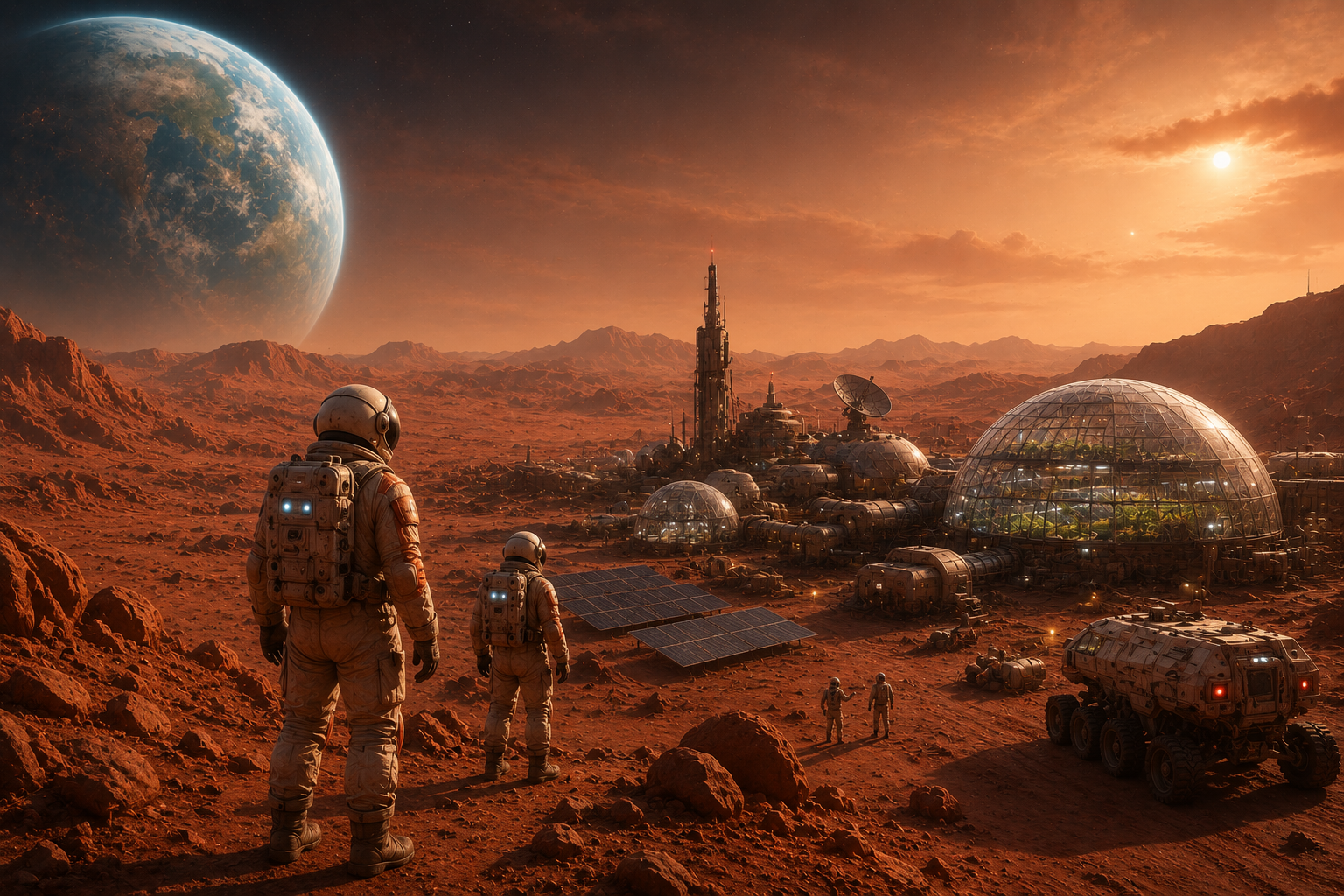
IF WE CAN SURVIVE ON MARS,
WE CAN THRIVE ON EARTH 💎
I've just watched a fascinating video about something that doesn't get nearly as much attention as getting humans to Mars.
GETTING SAFELY HOME AGAIN.
Mars isn't the Moon. A return journey means launching a substantial spacecraft from the Martian surface, which means an enormous amount of fuel. Carrying all that fuel from Earth adds enormous mass. Making fuel on Mars means sending machinery capable of producing rocket fuel, along with a large, extraordinarily reliable power supply, and having the whole system operate autonomously before the astronauts even arrive.
Then there is what a multi-year Mars mission might do to the human body. Months in weightlessness. Long exposure to radiation. More than a year potentially living in 38% of Earth's gravity. Then another long journey home to Earth.
And you can't simply leave Mars whenever you've had enough. The useful alignment between Earth and Mars comes around only about every 26 months.
This is difficult stuff.
But towards the end, the video makes the familiar argument for doing it anyway.
HUMANITY NEEDS A BACKUP PLANET.
An asteroid crashing into Earth. A nuclear war. A supervolcano darkening the skies. Another pandemic. Some unforeseen catastrophe that makes Earth uninhabitable.
SO WE ESTABLISH A SELF-SUSTAINING CIVILISATION ON MARS.
And that's where something occurred to me.
HAVE WE GOT THIS BACKWARDS?
Mars is already catastrophically hostile to human life.
It is freezing. Its atmosphere is almost entirely carbon dioxide and less than 1% of Earth's atmospheric pressure. There is dangerous radiation at the surface. No breathable air. No forests or plants of any kind. No oceans, lakes or rivers. No farms.
And no functioning biosphere is waiting for us.
To establish a genuinely independent civilisation there, we would have to become extraordinarily good at creating and maintaining habitable, fully enclosed environments.
We'd need to recycle our water and air and grow all of our food. We'd need to generate enormous amounts of reliable energy, protect ourselves from radiation, manufacture what we need and keep a closed human ecosystem functioning for generations.
So here's the question I can't get past.
IF WE BECOME GOOD ENOUGH AT KEEPING HUMAN BEINGS ALIVE ON MARS, HOW BADLY WOULD WE HAVE TO DAMAGE EARTH BEFORE MARS BECAME THE EASIER PLACE TO LIVE?
Even a badly damaged Earth still starts with something Mars doesn't have.
A BIOSPHERE.
Perhaps Mars really will become humanity's second home one day. I hope we go. Exploration is one of the things human beings do magnificently.
But I'm not convinced Mars is our lifeboat.
Perhaps the technologies required to survive there will teach us something considerably more urgent.
How to look after the astonishing planet we're already standing on.
https://youtu.be/ahrj83jWl-I?si=xCpgTx42MVXZFs_l
@3goodthings @DigitalCoup @meditation @economics_that_works @startrek
#Mars #SpaceExploration #Science #Climate #Environment #SpaceX #NASA
Edited 22d ago