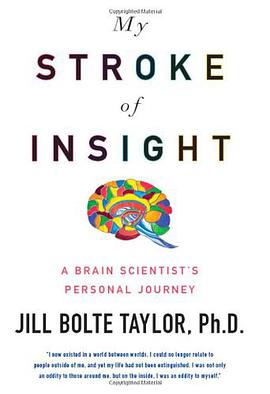
My Stroke of Insight Douban
author:
Jill Bolte Taylor
publishing house:
Viking Adult
2008
- 5
在线阅读本书
A brain scientist's journey from a debilitating stroke to full recovery becomes an inspiring exploration of human consciousness and its possibilities
On the morning of December 10, 1996, Jill Bolte Taylor, a thirty-seven-year-old Harvard-trained brain scientist, experienced a massive stroke when a blood vessel exploded in the left side of her brain. A neuroanatomist by profession, she observed her own mind completely deteriorate to the point that she could not walk, talk, read, write, or recall any of her life, all within the space of four brief hours. As the damaged left side of her brain--the rational, grounded, detail- and time-oriented side--swung in and out of function, Taylor alternated between two distinct and opposite realties: the euphoric nirvana of the intuitive and kinesthetic right brain, in which she felt a sense of complete well-being and peace; and the logical, sequential left brain, which recognized Jill was having a stroke, and enabled her to seek help before she was lost completely.
In My Stroke of Insight , Taylor shares her unique perspective on the brain and its capacity for recovery, and the sense of omniscient understanding she gained from this unusual and inspiring voyage out of the abyss of a wounded brain. It would take eight years for Taylor to heal completely. Because of her knowledge of how the brain works, her respect for the cells composing her human form, and most of all an amazing mother, Taylor completely repaired her mind and recalibrated her understanding of the world according to the insights gained from her right brain that morning of December 10th.
Today Taylor is convinced that the stroke was the best thing that could have happened to her. It has taught her that the feeling of nirvana is never more than a mere thought away. By stepping to the right of our left brains , we can all uncover the feelings of well-being and peace that are so often sidelined by our own brain chatter. A fascinating journey into the mechanics of the human mind, My Stroke of Insight is both a valuable recovery guide for anyone touched by a brain injury, and an emotionally stirring testimony that deep internal peace truly is accessible to anyone, at any time. Questions for Jill Bolte Taylor Amazon.com: Your first reaction when you realized what was happening to your body was one you would expect: "Oh my gosh, I'm having a stroke!" Your second, though, was a little more surprising: "Wow, this is so cool!" What could be cool about a stroke? Taylor: I grew up to study the brain because I have a brother who is only 18 months older than I am. He was very different in the way he perceived experiences and then chose to behave. As a result, I became fascinated with the human brain and how it creates our perception of reality. He was eventually diagnosed with the brain disorder schizophrenia, and I dedicated my career to the postmortem investigation of the human brain in an attempt to understand, at a biological level, what are the differences between my brain and my brothers brain. On the morning of the stroke, I realized that my brain was no longer functioning like a "normal" brain and this insight into my brother's reality excited me. I was fascinated to intimately understand what it might be like on the inside for someone who would not be diagnosed as normal. Through the eyes of a curious scientist, this was an absolutely rare and fascinating experience for me to witness the breakdown of my own mind. Amazon.com: What did you learn about the brain from your stroke and your recovery that your scientific training hadn't prepared you for? Taylor: My scientific training did not teach me anything about the human spirit and the value of compassion. I had been trained as a scientist, not as a clinician. I can only hope that we are teaching our future physicians about compassion in medicine, and I know that some medical schools, including the Indiana University School of Medicine, have created a curriculum with this intention. My training as a scientist, however, did provide me with a roadmap to how the body and brain work. And although I lost my left cognitive mind that thinks in language, I retained my right hemisphere that thinks in pictures. As a result, although I could not communicate with the external world, I had an intuitive understanding about what I needed to do in order to create an environment in which the cells in my brain could be happy and healthy enough that they could regain their function. In addition, because of my training, I had an innate trust in the ability of my brain to be able to recover itself and my mother and I respected the organ by listening to it. For example, when I was tired, I allowed my brain to sleep, and when I was fresh and capable of focusing my attention, we gave me age-appropriate toys and tools with which to work. Amazon.com: Your stroke affected functions in your left brain, leaving you to what you call the "la-la land" of your right hemisphere. What was it like to live in your right brain, and then to rebuild your left? Taylor: When the cells in my left brain became nonfunctional because they were swimming in a pool of blood, they lost their ability to inhibit the cells in my right hemisphere. In my right brain, I shifted into the consciousness of the present moment. I was in the right here, right now awareness, with no memories of my past and no perception of the future. The beauty of La-la land (my right hemisphere experience of the present moment) was that everything was an explosion of magnificent stimulation and I dwelled in a space of euphoria. This is great way to exist if you don't have to communicate with the external world or care whether or not you have the capacity to learn. I found that in order for me to be able to learn anything, however, I had to take information from the last moment and apply it to the present moment. When my left hemisphere was completely nonfunctional early on, it was impossible for me to learn, which was okay with me, but I am sure it was frustrating for those around me. A simple example of this was trying to put on my shoes and socks. I eventually became physically capable of putting my shoes and socks on, but I had no ability to understand why I would have to put my socks on before my shoes. To me they were simply independent actions that were not related and I did not have the cognitive ability to figure out the appropriate sequencing of the events. Over time, I regained the ability to weave moments back together to create an expanse of time, and with this ability came the ability to learn methodically again. Life in La-la land will always be just a thought away, but I am truly grateful for the ability to think with linearity once again. Amazon.com: What can we learn about our brains and ourselves from your experience, even if we haven't lived through the kind of brain trauma you have? Taylor: I learned that I have much more say about what goes on between my ears than I was ever taught and I believe that this is true for all of us. I used to understand that I had the ability to stop thinking about one thing by consciously choosing to preoccupy my mind with thinking about something else. But I had no idea that it only took 90 seconds for me to have an emotional circuit triggered, flush a physiological response through my body and then flush completely out of me. We can all learn that we can take full responsibility for what thoughts we are thinking and what emotional circuitry we are feeling. Knowing this and acting on this can lead us into feeling a wonderful sense of well-being and peacefulness. Amazon.com: You are the "Singin' Scientist" for Harvard's Brain Bank (just as you were before your stroke). Could you tell us about the Brain Bank (in song or not)? Taylor: There is a long-term shortage of brain tissue donated for research into the severe mental illnesses. Most people dont realize that when you sign the back of your license as an organ donor, the brain is not included. If you would like to donate your brain for research, you must contact a brain bank directly. There is also a shortage of "normal control" tissue for research. The bottom line reality is that if there were more tissue available for research, then more scientists would be dedicating their careers to the study of the severe mental illnesses and we would have more answers about what is going on with these disorders. The numbers of mentally ill individuals in our society are staggering. The most serious and disabling conditions affect about 6 percent--or one in 17--adults and 9-13 percent of children in the United States. Half of all lifetime conditions of mental illness start by age 14 years, and three-fourths by age 24 years. For more information about brain donation to the Harvard brain bank, please call 1-800-BRAINBANK or visit them at: www.brainbank.mclean.org If you would like to hear me sing the brain bank jingle, please visit www.drjilltaylor.com!
A brain scientist's journey from a debilitating stroke to full recovery becomes an inspiring exploration of human consciousness and its possibilities
On the morning of December 10, 1996, Jill Bolte Taylor, a thirty-seven-year-old Harvard-trained brain scientist, experienced a massive stroke when a blood vessel exploded in the left side of her brain. A neuroanatomist by profession, she observed her own mind completely deteriorate to the point that she could not walk, talk, read, write, or recall any of her life, all within the space of four brief hours. As the damaged left side of her brain--the rational, grounded, detail- and time-oriented side--swung in and out of function, Taylor alternated between two distinct and opposite realties: the euphoric nirvana of the intuitive and kinesthetic right brain, in which she felt a sense of complete well-being and peace; and the logical, sequential left brain, which recognized Jill was having a stroke, and enabled her to seek help before she was lost completely.
In My Stroke of Insight , Taylor shares her unique perspective on the brain and its capacity for recovery, and the sense of omniscient understanding she gained from this unusual and inspiring voyage out of the abyss of a wounded brain. It would take eight years for Taylor to heal completely. Because of her knowledge of how the brain works, her respect for the cells composing her human form, and most of all an amazing mother, Taylor completely repaired her mind and recalibrated her understanding of the world according to the insights gained from her right brain that morning of December 10th.
Today Taylor is convinced that the stroke was the best thing that could have happened to her. It has taught her that the feeling of nirvana is never more than a mere thought away. By stepping to the right of our left brains , we can all uncover the feelings of well-being and peace that are so often sidelined by our own brain chatter. A fascinating journey into the mechanics of the human mind, My Stroke of Insight is both a valuable recovery guide for anyone touched by a brain injury, and an emotionally stirring testimony that deep internal peace truly is accessible to anyone, at any time. Questions for Jill Bolte Taylor Amazon.com: Your first reaction when you realized what was happening to your body was one you would expect: "Oh my gosh, I'm having a stroke!" Your second, though, was a little more surprising: "Wow, this is so cool!" What could be cool about a stroke? Taylor: I grew up to study the brain because I have a brother who is only 18 months older than I am. He was very different in the way he perceived experiences and then chose to behave. As a result, I became fascinated with the human brain and how it creates our perception of reality. He was eventually diagnosed with the brain disorder schizophrenia, and I dedicated my career to the postmortem investigation of the human brain in an attempt to understand, at a biological level, what are the differences between my brain and my brothers brain. On the morning of the stroke, I realized that my brain was no longer functioning like a "normal" brain and this insight into my brother's reality excited me. I was fascinated to intimately understand what it might be like on the inside for someone who would not be diagnosed as normal. Through the eyes of a curious scientist, this was an absolutely rare and fascinating experience for me to witness the breakdown of my own mind. Amazon.com: What did you learn about the brain from your stroke and your recovery that your scientific training hadn't prepared you for? Taylor: My scientific training did not teach me anything about the human spirit and the value of compassion. I had been trained as a scientist, not as a clinician. I can only hope that we are teaching our future physicians about compassion in medicine, and I know that some medical schools, including the Indiana University School of Medicine, have created a curriculum with this intention. My training as a scientist, however, did provide me with a roadmap to how the body and brain work. And although I lost my left cognitive mind that thinks in language, I retained my right hemisphere that thinks in pictures. As a result, although I could not communicate with the external world, I had an intuitive understanding about what I needed to do in order to create an environment in which the cells in my brain could be happy and healthy enough that they could regain their function. In addition, because of my training, I had an innate trust in the ability of my brain to be able to recover itself and my mother and I respected the organ by listening to it. For example, when I was tired, I allowed my brain to sleep, and when I was fresh and capable of focusing my attention, we gave me age-appropriate toys and tools with which to work. Amazon.com: Your stroke affected functions in your left brain, leaving you to what you call the "la-la land" of your right hemisphere. What was it like to live in your right brain, and then to rebuild your left? Taylor: When the cells in my left brain became nonfunctional because they were swimming in a pool of blood, they lost their ability to inhibit the cells in my right hemisphere. In my right brain, I shifted into the consciousness of the present moment. I was in the right here, right now awareness, with no memories of my past and no perception of the future. The beauty of La-la land (my right hemisphere experience of the present moment) was that everything was an explosion of magnificent stimulation and I dwelled in a space of euphoria. This is great way to exist if you don't have to communicate with the external world or care whether or not you have the capacity to learn. I found that in order for me to be able to learn anything, however, I had to take information from the last moment and apply it to the present moment. When my left hemisphere was completely nonfunctional early on, it was impossible for me to learn, which was okay with me, but I am sure it was frustrating for those around me. A simple example of this was trying to put on my shoes and socks. I eventually became physically capable of putting my shoes and socks on, but I had no ability to understand why I would have to put my socks on before my shoes. To me they were simply independent actions that were not related and I did not have the cognitive ability to figure out the appropriate sequencing of the events. Over time, I regained the ability to weave moments back together to create an expanse of time, and with this ability came the ability to learn methodically again. Life in La-la land will always be just a thought away, but I am truly grateful for the ability to think with linearity once again. Amazon.com: What can we learn about our brains and ourselves from your experience, even if we haven't lived through the kind of brain trauma you have? Taylor: I learned that I have much more say about what goes on between my ears than I was ever taught and I believe that this is true for all of us. I used to understand that I had the ability to stop thinking about one thing by consciously choosing to preoccupy my mind with thinking about something else. But I had no idea that it only took 90 seconds for me to have an emotional circuit triggered, flush a physiological response through my body and then flush completely out of me. We can all learn that we can take full responsibility for what thoughts we are thinking and what emotional circuitry we are feeling. Knowing this and acting on this can lead us into feeling a wonderful sense of well-being and peacefulness. Amazon.com: You are the "Singin' Scientist" for Harvard's Brain Bank (just as you were before your stroke). Could you tell us about the Brain Bank (in song or not)? Taylor: There is a long-term shortage of brain tissue donated for research into the severe mental illnesses. Most people dont realize that when you sign the back of your license as an organ donor, the brain is not included. If you would like to donate your brain for research, you must contact a brain bank directly. There is also a shortage of "normal control" tissue for research. The bottom line reality is that if there were more tissue available for research, then more scientists would be dedicating their careers to the study of the severe mental illnesses and we would have more answers about what is going on with these disorders. The numbers of mentally ill individuals in our society are staggering. The most serious and disabling conditions affect about 6 percent--or one in 17--adults and 9-13 percent of children in the United States. Half of all lifetime conditions of mental illness start by age 14 years, and three-fourths by age 24 years. For more information about brain donation to the Harvard brain bank, please call 1-800-BRAINBANK or visit them at: www.brainbank.mclean.org If you would like to hear me sing the brain bank jingle, please visit www.drjilltaylor.com!