Jacques Derrida — Author (123)
The Gift of Death [Book] Douban
author:
Jacques Derrida
translator:
Wills, David
publishing house:
University of Chicago Press
1996
- 6
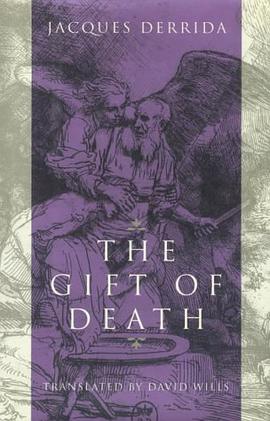
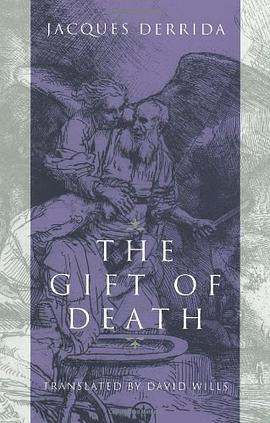
While continuing to explore questions introduced in "Given Time" such as the possibility, or impossibility, of giving and the economic and anthropological nature of gifts, this work focuses on the notion of responsibility and the ultimate gifts of life and death. Jacques Derrida divides the book into four parts, which deal respectively with: the development of the notion of responsibility in the Platonic and Christian traditions; the relation between sacrifice and mortality; the contemporary meaning of the story of Abraham and Isaac; and the relation between religious ideology and economic rationality. The texts under discussion include the Hebrew Bible and the New Testament, as well as writings from Patocka, Heidegger, Levinas and Kierkegaard. Derrida's main concern is with the meaning of moral and ethical responsibility in Western religion and philosophy. He questions the limits of the rational and the responsible that is reached in granting or accepting death, whether by sacrifice, murder, execution or suicide. Beginning with a discussion of Patocka's "Heretical Essays on the History of Philosophy", Derrida develops Patocka's ideas concerning the sacred and responsibility through comparisons with the works of Heidegger, Levinas and Kierkegaard. Derrida's treatment of Kierkegaard makes clear that the two philosophers share some of the same concerns. He then undertakes a reading of Kierkegaard's "Fear and Trembling", comparing and contrasting his own conception of responsibility with that of Kierkegaard, and extending and deepening his recent accounts of the gift and sacrifice. For Derrida, the very possibility of sacrifice, especially the ultimate sacrifice of one's own life for the sake of another, comes into question.
Of Spirit [Book] Douban
author:
Jacques Derrida
translator:
Rachel Bowlby
publishing house:
University Of Chicago Press
1991
- 4
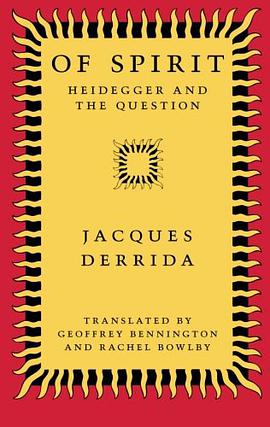
"Will a more important book on Heidegger appear in our time? No, not unless Derrida continues to think and write in his spirit. . . . Let there be no mistake: this is not merely a brilliant book on Heidegger, it is thinking in the grand style."--David Farrell Krell,; IResearch in Phenomenology; X
Le problème de la genèse dans la philosophie de Husserl [Book] Douban
Présentation de l'éditeur
Voici le premier ouvrage de Jacques Derrida. Alors étudiant de philosophie à l'Ecole normale supérieure, en 1953-54, il proposa une lecture de l'œuvre de Husserl en y suivant, comme un fil directeur, le thème de la genèse. Il s'agissait alors d'analyser les difficultés et les remaniements provoqués dans la pensée du fondateur de la phénoménologie par la prise en compte du temps, du devenir et de l'histoire, tant dans la constitution du sujet transcendantal que pour la production intentionnelle du sens de ses objets, notamment des objets scientifiques. Le passage de la constitution statique à la constitution génétique de l'ego fut certes programmé et assumé par Husserl : ce n'en était pas moins une nécessité périlleuse pour le projet phénoménologique lui-même.
Cette interprétation systématique ne tente jamais de réduire une tension, voire une certaine hétérogénéité à l'intérieur du discours phénoménologique. Elle permet aussi de reconstituer quelques traits du champ philosophique, voire philosophico-politique français dans lequel Jacques Derrida élabore ses premiers travaux. Tout en donnant un aperçu sur l'état de la pensée phénoménologique à cette époque (Levinas, Sartre, Merleau-Ponty, Ricœur, Tran-Duc-Thao) et sur les influences qu'elle exerce ou subit alors, cet ouvrage annonce aussi la problématique et le style des questions " déconstructrices " que Derrida développera dans de nombreux ouvrages entre 1962 et 1990.
Deux d'entre eux furent consacrés à Husserl et publiés dans la même collection : Introduction à L'origine de la géométrie, 1962 (3e éd. 1990), et La voix et le phénomène, 1967 (5e éd. 1989). Ils constituent avec ce volume un ensemble indissociable.
Voici le premier ouvrage de Jacques Derrida. Alors étudiant de philosophie à l'Ecole normale supérieure, en 1953-54, il proposa une lecture de l'œuvre de Husserl en y suivant, comme un fil directeur, le thème de la genèse. Il s'agissait alors d'analyser les difficultés et les remaniements provoqués dans la pensée du fondateur de la phénoménologie par la prise en compte du temps, du devenir et de l'histoire, tant dans la constitution du sujet transcendantal que pour la production intentionnelle du sens de ses objets, notamment des objets scientifiques. Le passage de la constitution statique à la constitution génétique de l'ego fut certes programmé et assumé par Husserl : ce n'en était pas moins une nécessité périlleuse pour le projet phénoménologique lui-même.
Cette interprétation systématique ne tente jamais de réduire une tension, voire une certaine hétérogénéité à l'intérieur du discours phénoménologique. Elle permet aussi de reconstituer quelques traits du champ philosophique, voire philosophico-politique français dans lequel Jacques Derrida élabore ses premiers travaux. Tout en donnant un aperçu sur l'état de la pensée phénoménologique à cette époque (Levinas, Sartre, Merleau-Ponty, Ricœur, Tran-Duc-Thao) et sur les influences qu'elle exerce ou subit alors, cet ouvrage annonce aussi la problématique et le style des questions " déconstructrices " que Derrida développera dans de nombreux ouvrages entre 1962 et 1990.
Deux d'entre eux furent consacrés à Husserl et publiés dans la même collection : Introduction à L'origine de la géométrie, 1962 (3e éd. 1990), et La voix et le phénomène, 1967 (5e éd. 1989). Ils constituent avec ce volume un ensemble indissociable.
Donner la mort [Book] Douban
Spectres de Marx [Book] Douban
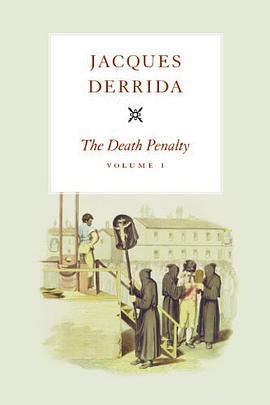
The Death Penalty, Volume I [Book] Douban
In this newest installment in Chicago's series of Jacques Derrida's seminars, the renowned philosopher attempts one of his most ambitious goals: the first truly philosophical argument against the death penalty. While much has been written against the death penalty, Derrida contends that Western philosophy is massively, if not always obviously, complicit with a logic in which a sovereign state has the right to take a life. Haunted by this notion, he turns to the key places where such logic has been established - and to the place it has been most effectively challenged: literature. With his signature genius and patient yet dazzling readings of an impressive breadth of texts, Derrida examines everything from the Bible to Plato to Camus to Jean Genet, with special attention to Kant and post-World War II juridical texts, to draw the landscape of death penalty discourses. Keeping clearly in view the death rows and execution chambers of the United States, he shows how arguments surrounding cruel and unusual punishment depend on what he calls an "anaesthesial logic," which has also driven the development of death penalty technology from the French guillotine to lethal injection. Confronting a demand for philosophical rigor, he pursues provocative analyses of the shortcomings of abolitionist discourse. Above all, he argues that the death penalty and its attendant technologies are products of a desire to put an end to one of the most fundamental qualities of our finite existence: the radical uncertainty of when we will die. Arriving at a critical juncture in history - especially in the United States, one of the last Christian-inspired democracies to resist abolition - The Death Penalty is both a timely response to an important ethical debate and a timeless addition to Derrida's esteemed body of work.
Dissemination [Book] Douban
author:
Jacques Derrida
translator:
Barbara Johnson
publishing house:
University of Chicago Press
1983
- 2
"The English version of "Dissemination" [is] an able translation by Barbara Johnson...Derrida's central contention is that languge is haunted by dispersal, absence, loss, the risk of unmeaning, a risk which is starkly embodied in all writing. The distinction between philosophy and literature therefore becomes of secondary importance. Philosphy vainly attempts to control the irrecoverable dissemination of its own meaning, it strives - against the grain of language - to offer a sober revelation of truth. Literature - on the other hand - flaunts it own meretriciousness, abandons itself to the Dionysiac play of language. In "Dissemination" - more than in any previous work - Derrida joins in the revelry, weaving a complex pattern of puns, verbal echoes allusions, intended to 'deconstruct' both the pretense of criticsm to tell the truth about literature, and the pretension of philosophy to be the litearature of truth". - Peter Dews, "New Statesman"

Spurs [Book] Douban
author:
Jacques Derrida
translator:
Barbara Harlow
publishing house:
University of Chicago Press
1981
- 2
Nietzsche has recently enjoyed much scrutiny from the "nouveaux critiques." Jacques Derrida, the leader of that movement, here combines in his strikingly original and incisive fashion questions of sexuality, politics, writing, judgement, procreation, death, and even the weather into a far-reaching analysis of the challenges bequeathed to the modern world by Nietzsche.
Politics of Friendship [Book] Douban
Speech and Phenomena [Book] Douban
author:
Jacques Derrida
translator:
David B. Allison
publishing house:
Northwestern University Press
1973
Archive Fever [Book] Douban
author:
Jacques Derrida
translator:
Eric Prenowitz
publishing house:
University of Chicago Press
1998
- 10
In Archive Fever, Jacques Derrida deftly guides us through an extended meditation on remembrance, religion, time, and technology—fruitfully occasioned by a deconstructive analysis of the notion of archiving. Intrigued by the evocative relationship between technologies of inscription and psychic processes, Derrida offers for the first time a major statement on the pervasive impact of electronic media, particularly e-mail, which threaten to transform the entire public and private space of humanity. Plying this rich material with characteristic virtuosity, Derrida constructs a synergistic reading of archives and archiving, both provocative and compelling.
De l'esprit [Book] Douban
The Instant of My Death [Book] Douban
author:
Maurice Blanchot
/
Jacques Derrida
translator:
Elizabeth Rottenberg
publishing house:
Stanford University Press
2000
This volume records a remarkable encounter in critical and philosophical thinking: a meeting of two of the great pioneers in contemporary thought, Maurice Blanchot and Jacques Derrida, who are also bound together by friendship and a complex relation to their own pasts. More than a literary text with critical commentary, it constitutes an event of central significance for contemporary philosophical, literary, and political concerns.
The book consists of The Instant of My Death, a powerful short prose piece by Blanchot, and an extended essay by Derrida that reads it in the context of questions of literature and of bearing witness. Blanchot’s narrative concerns a moment when a young man is brought before a firing squad during World War II and then suddenly finds himself released from his near death. The incident, written in the third person, is suggestively autobiographical—from the title, several remarks in the text, and a letter Blanchot wrote about a similar incident in his own life—but only insofar as it raises questions for Blanchot about what such an experience might mean. The accident of near death becomes, in the instant the man is released, the accident of a life he no longer possesses. The text raises the question of what it means to write about a (non)experience one cannot claim as one’s own, and as such is a text of testimony or witness.
Derrida’s reading of Blanchot links the problem of testimony to the problem of the secret and to the notion of the instant. It thereby provides the elements of a more expansive reassessment of literature, testimony, and truth. In addressing the complex relation between writing and history, Derrida also implicitly reflects on questions concerning the relation between European intellectuals and World War II.
The book consists of The Instant of My Death, a powerful short prose piece by Blanchot, and an extended essay by Derrida that reads it in the context of questions of literature and of bearing witness. Blanchot’s narrative concerns a moment when a young man is brought before a firing squad during World War II and then suddenly finds himself released from his near death. The incident, written in the third person, is suggestively autobiographical—from the title, several remarks in the text, and a letter Blanchot wrote about a similar incident in his own life—but only insofar as it raises questions for Blanchot about what such an experience might mean. The accident of near death becomes, in the instant the man is released, the accident of a life he no longer possesses. The text raises the question of what it means to write about a (non)experience one cannot claim as one’s own, and as such is a text of testimony or witness.
Derrida’s reading of Blanchot links the problem of testimony to the problem of the secret and to the notion of the instant. It thereby provides the elements of a more expansive reassessment of literature, testimony, and truth. In addressing the complex relation between writing and history, Derrida also implicitly reflects on questions concerning the relation between European intellectuals and World War II.
无赖 [Book] Douban
雅克•德里达被称为“解构主义大师”,于2004年去世,他的离世被法国媒体视为自1980年让•保罗•萨特逝世以来法国学术界最大的损失。本书是他最后一本重要的政治哲学著作。在书中,他论及“9•11”后世界正面临的新的政治前景,以及全球化进程下正在到来的世界未来民主。 本书从评述来自美国政要、哈佛大学著名政治学家、教授和主导媒体对于“无赖国家”一词的话语分析出发,深入探讨了民族国家之外的新主权问题。它既讨论了西方民主的自我期许的失落,其未来政治民主的虚空,也批判了伊斯兰文化政治的局限及其面对正在到来的世界民主时的消极态度。 作者从亚里士多德政治学中的数字平等和比例民主原则出发,展望正在到来的世界民主的前景,把西方、第三世界和作为各种顽固的他者,比如恐怖主义者和美国强权,放进一个非常开阔的政治视野内来透视,这或许是当今最深邃的一种政治哲学眼光。正是这一独特而深刻的角度,使得本书成为了一本不可忽略的政治哲学著作。
Specters of Marx [Book] Douban Goodreads Skybridge
Spectres de Marx
Written in the aftermath of the fall of the Berlin Wall and within the context of a critique of a "new world order" that proclaims the death of Marx and Marxism, Jacques Derrida undertakes a reading of Marx's "spectropoetics" -- his obsession with ghosts, specters and spirits. Derrida argues that there is more than one spirit of Marx and that it is the responsibility of his heirs -- we are all heirs of Marx -- to sift through the possible legacies, the possible spirits, reaffirming one and not the other. He leads beyond the deafening disavowal of Marx today, a disavowal he sees as an attempt to exorcise Marx's ghost.
Specters of Marx represents renowned philosopher Jacques Derrida's first major work on Marx and his definitive entry into social and political philosophy.
Specters of Marx represents renowned philosopher Jacques Derrida's first major work on Marx and his definitive entry into social and political philosophy.
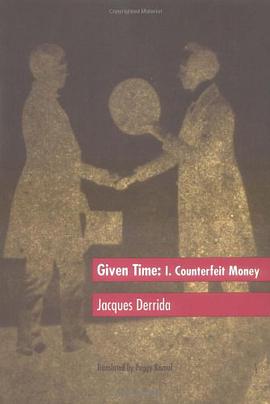
Given Time [Book] Douban
author:
Jacques Derrida
translator:
Peggy Kamuf
publishing house:
University Of Chicago Press
1994
- 9
Is "giving" possible? Is it possible to give without immediately entering into a circle of exchange that turns the gift into a debt to be returned? This question leads Jacques Derrida to make out an irresolvable paradox at what seems the most fundamental level of the gift's meaning: for the gift to be received as a gift, it must not appear as such, since its mere appearance as gift puts it in the cycle of repayment and debt. Derrida reads the relation of time to gift through a number of texts: Heidegger's "Time and Being, " Mauss's "The Gift, " as well as essays by Benveniste and Levi-Strauss that assume Mauss's legacy. It is, however, a short tale by Baudelaire, "Counterfeit Money, " that guides Derrida's analyses throughout. At stake in his reading of the tale, to which the second half of this book is devoted, are the conditions of gift and forgiveness as essentially bound up with the movement of dissemination, a concept that Derrida has been working out for many years. For both readers of Baudelaire and students of literary theory, this work will prove indispensable.
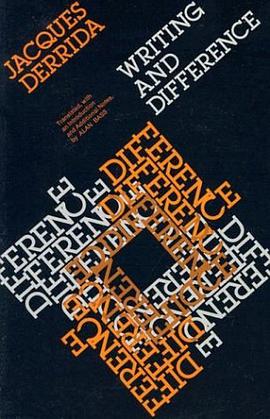
Writing and Difference [Book] Douban Goodreads
L'écriture et la différence
author:
Jacques Derrida
translator:
Alan Bass
publishing house:
University of Chicago Press
1978
- 2
First published in 1967, "Writing and Difference, " a collection of Jacques Derrida's essays written between 1959 and 1966, has become a landmark of contemporary French thought. In it we find Derrida at work on his systematic deconstruction of Western metaphysics. The book's first half, which includes the celebrated essay on Descartes and Foucault, shows the development of Derrida's method of deconstruction. In these essays, Derrida demonstrates the traditional nature of some purportely nontraditional currents of modern thought - one of his main targets being the way in which "structuralism" unwittingly repeats metaphysical concepts in its use of linguistic modes.
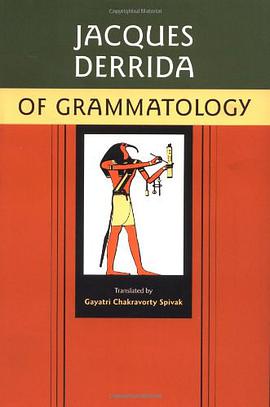
Of Grammatology [Book] Douban Goodreads
author:
Jacques Derrida
translator:
Gayatri Chakravorty Spivak
publishing house:
Johns Hopkins University Press
1998
- 1
Jacques Derrida's revolutionary theories about deconstruction, phenomenology, psychoanalysis, and structuralism, first voiced in the 1960s, forever changed the face of European and American criticism. The ideas in De la grammatologie sparked lively debates in intellectual circles that included students of literature, philosophy, and the humanities, inspiring these students to ask questions of their disciplines that had previously been considered improper. Thirty years later, the immense influence of Derrida's work is still igniting controversy, thanks in part to Gayatri Spivak's translation, which captures the richness and complexity of the original. This corrected edition adds a new index of the critics and philosophers cited in the text and makes one of contemporary criticism's most indispensable works even more accessible and usable.