#AI #GenAI #Anthropic #books #BookBurning
ai
#AI #GenAI #Anthropic #books #BookBurning
So incredibly tired of being told that I am AI. I don't use it to write, I despise AI writing in general and couldn't care less if someone has a few typos going on or if their wording is a bit fumbled. Human writing for the win.
Some of us put care in their words, take effort to write, and somehow this has become 'proof of AI'. The em dash was used by humans first.
Marcus Olang' wrote a good piece about it from his perspective. Different but I recognise myself in his words.
https://marcusolang.substack.com/p/im-kenyan-i-dont-write-like-chatgpt
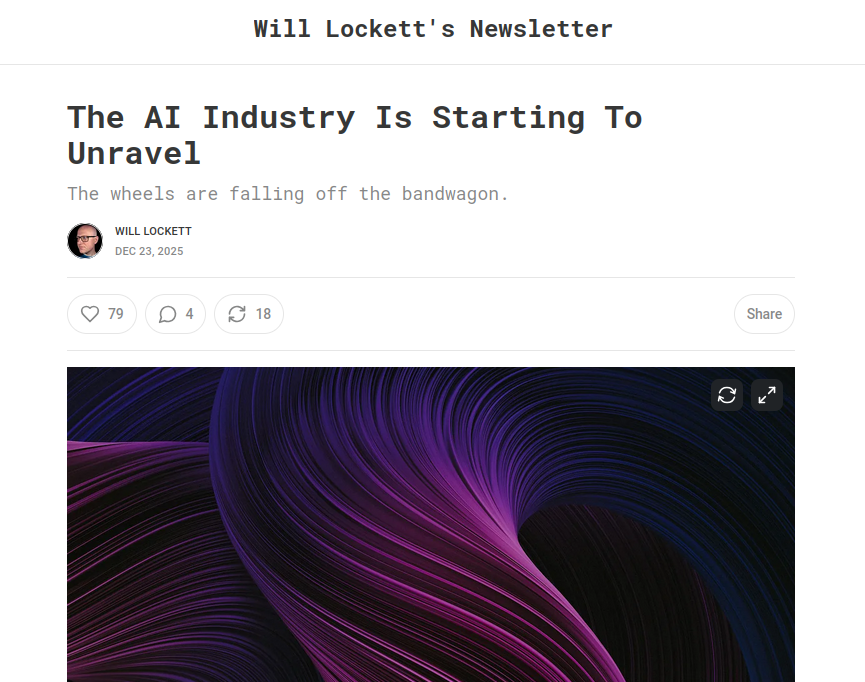
"Yet, it turns out no one is buying Copilot."
#Microsoft #Copilot #AI #KI #Bubble
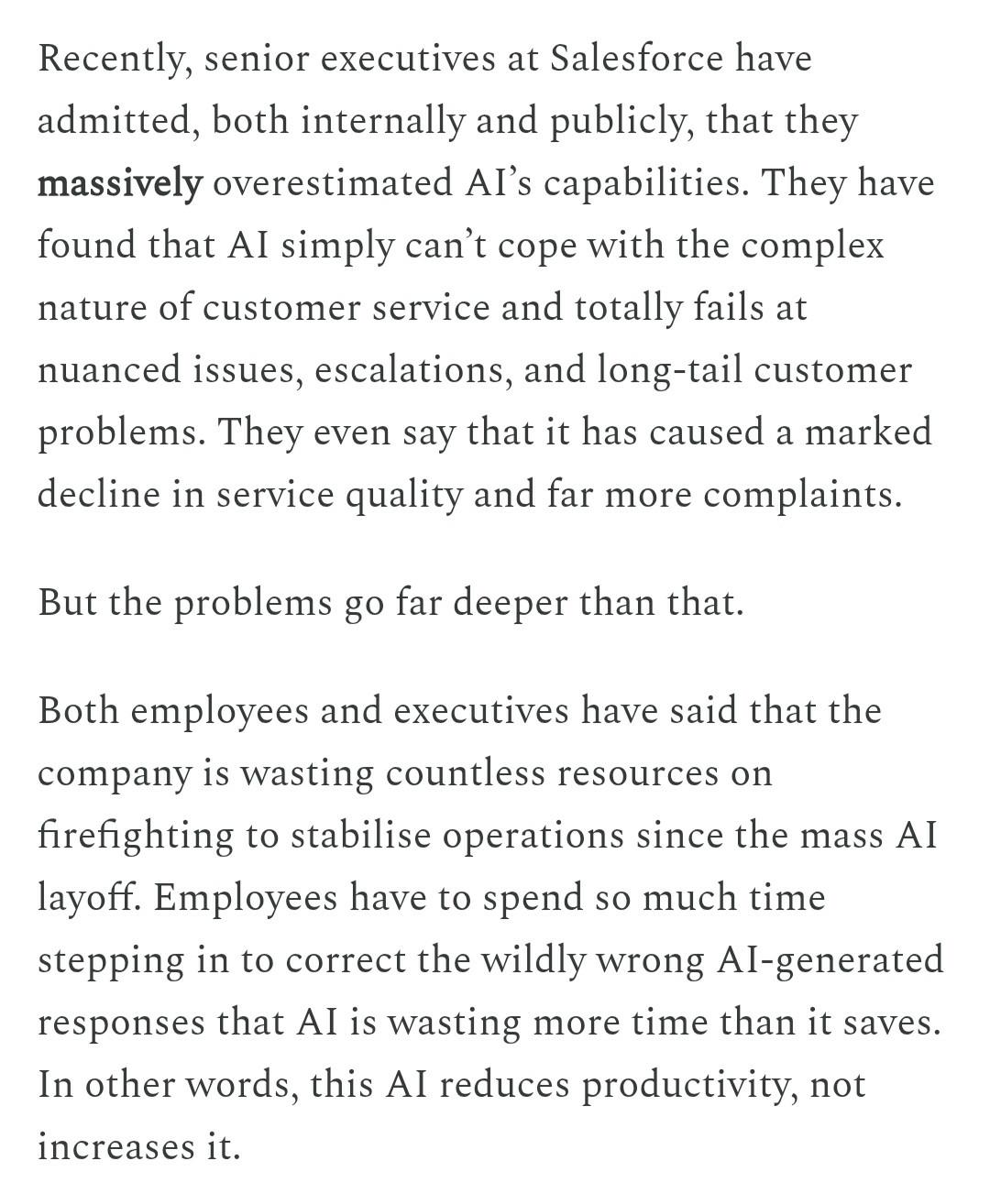
"But why is Copilot’s growth and/or sales so bad? Well, one study tested these ‘agentic’ AIs, including Copilot, and found that they flat out failed to complete even simple tasks 70% of the time, rendering them somewhere between useless and an active hindrance.
The same is true for Microsoft’s cash baby, ChatGPT."
No shit, sherlock?
https://www.planetearthandbeyond.co/p/the-ai-industry-is-starting-to-unravel
(Danke, Mathias!)
Oh, I forgot: #windows #windows11
Speaking of #CES, you may have noticed my coverage is very thin this year. There's a reason for this: I'm doing my level best to *not* give the oxygen of publicity to large language models and related "AI" tech this year.
An #LLM is not #AI. It will never be AI, no matter how big. Its output is statistical mediocrity at best, confident falsities at worst. The only ones worth using are trained on stolen data. Their environmental damage is staggering and growing, as is their mental impact.
"Turning to generative AI for your filmmaking, even to make a point about its own uselessness, is to accept defeat."
https://www.avclub.com/deepfaking-sam-altman-lets-ai-direct-the-movie-which-is-accepting-defeat
AI industry insiders launch site to poison the data that feeds them: https://www.theregister.com/2026/01/11/industry_insiders_seek_to_poison/
Poison Fountain starts with "We agree with Geoffrey Hinton: machine intelligence is a threat to the human species". This is a tarball of wrong. (1)
The rest of the website is absurd, and the "Poison Fountain Usage" list doesn't make any sense. There are far more efficient and safer ways to poison data that don't require you to proxy content for an unknown third party. Some of these are implemented in software, as opposed to <ul> in HTML. That bullet list reads like an amateur riffing on what they read about AI web scrapers, not like industry insiders with detailed information about how training works.
Recommend viewing the top level https://rnsaffn.com , which I suspect The Register may not have done.
The Register:
Our source said that the goal of the project is to make people aware of AI's Achilles' Heel – the ease with which models can be poisoned – and to encourage people to construct information weapons of their own.
None of this passes a smell test. Crithype (and poor fact checking, it seems) from The Register it is.
(1) Hinton stands to gain professionally and financially from people believing this. Hinton personally bears a large amount of responsibility for setting off this so-called species level danger. Hinton, like all of us, cannot possibly know whether "machine intelligence" is even possible, let alone dangerous to people; that's a fanciful notion that serves the agendas of the wealthy and powerful quite well. In other words, crithype. Etc.
#AI #GenAI #GenerativeAI #Anthropic #PoisonFountain #UncriticalReporting #crithype #TheRegister
I wish we had more people writing more sophisticated concerns about the harms of AI.
"Slop" criticism is important because I think many of us feel we are being gaslit into believing that generative AI is currently creating quality creative output, while Al (henceforth Alfred) is overwhelmingly creating mediocre quality creative work.
Every past winter, Alfred survives in a more focused and refined form. Eliza was a toy chatbot of the 1960s, but what emerged from that is expanded investment in things like Natural Language Processing and Markov chains.
Markov chains have always been powerful, but through computing applications, Markov chains led to advancing capabilities in weather prediction, financial modeling, and eventually Google PageRank and bioinformatics/biostatistics (BLOSUM/BLAST for analyzing/predicting/correlating amino acid chain similarities).
The next boom and winter led Alfred to popularize classic machine learning into practical applications in consumer products: recommendation engines and clustering algorithms that formed the core of products from the Netflix prize to Spotify, Pandora, Amazon, and eventually virtually every consumer retailer has multiple machine learning products supporting everything from suggested products to search results to their own logistics and sales and financial modeling.
Learn from the past. Prepare for the future. Al will learn how to spell strawberry, write basic documents and code more effectively, and make fewer basic mistakes. Think beyond that. What are the emerging harms that come AFTER all of that?
#AI #GenAI #GenerativeAI #generative_ai_risks #generative_ai_concerns
"LinkedIn, a social network awash with long AI-generated posts from executives and other corporate workers, has introduced a new button that users can click to flag if a post “seems like AI slop,” according to [@404mediaco's] own tests."
https://www.404media.co/linkedin-introduces-a-seems-like-ai-slop-button/
#news #technology #linkedin #AI #LLMs #slop #enshittification
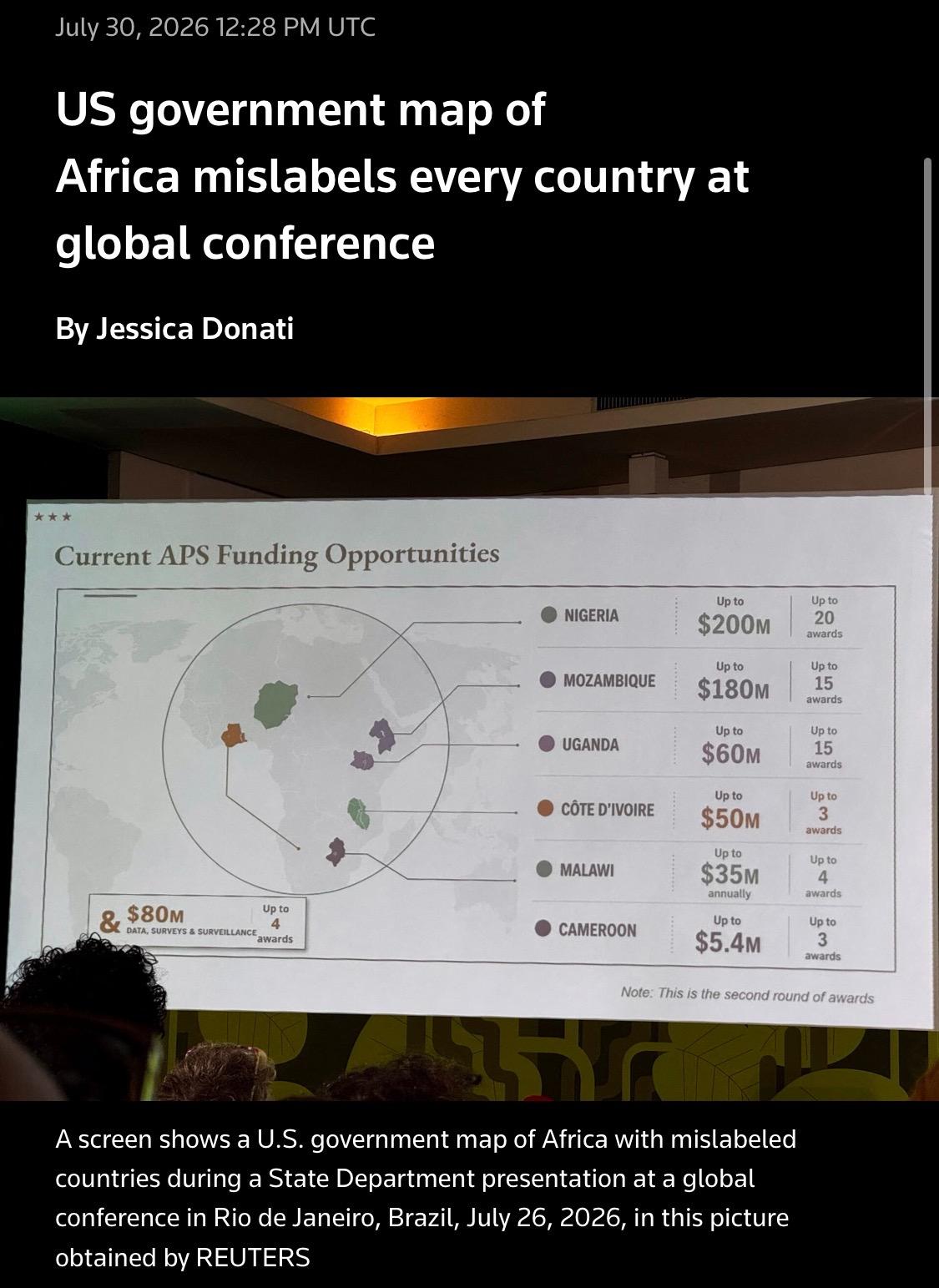
#USA gov't map of #Africa mislabels every country at global conference ‼️
The map contained an #AI watermark indicating it was made with OpenAI tools. 👀
It had:
• Nigeria (where #US currently has several hundred troops deployed) as landlocked in the Sahara Desert
• Mozambique, which is in southeastern Africa, relocated to the Horn of Africa
• Ivory Coast in West Africa placed on the other side of the continent
The State Dept blamed a staffer.
#trump #TrumpAdmin
--
https://www.reuters.com/world/africa/us-government-map-africa-mislabels-every-country-global-conference-2026-07-30/
New blogpost: AI will compromise your cybersecurity posture
https://rys.io/en/181.html
The way “AI” is going to compromise your cybersecurity is not through some magical autonomous exploitation by a singularity from the outside, but by being the poorly engineered, shoddily integrated, exploitable weak point you would not have otherwise had on the inside.
LLM-based systems are insanely complex. And complexity has real cost and introduces very real risk.
1/🧵
RE: https://stefanbohacek.online/@stefan/115899135117601234
On the other hand.
"Wikipedia unveiled new business deals with a slew of artificial intelligence companies on Thursday as it marked its 25th anniversary."
https://apnews.com/article/wikipedia-internet-jimmy-wales-50e796d70152d79a2e0708846f84f6d7
If you are a Kpop fan, knowledgeable about AI, or just curious about technology and popular culture, I'd be interested to hear your thoughts on AI and Kpop.
https://www.koreaherald.com/article/10646918
#Kpop #AI #ArtificialIntelligence #PopMusic #SouthKorea
@kpop @KpopGG4ever
@[email protected]
An image of a cat is not a cat, no matter how many pixels it has. A video of a cat is not a cat, no matter the framerate. An interactive 3-d model of a cat is not a cat, no matter the number of voxels or quality of dynamic lighting and so on. In every case, the computer you're using to view the artifact also gives you the ability to dispel the illusion. You can zoom a picture and inspect individual pixels, pause a video and step through individual frames, or distort the 3-d mesh of the model and otherwise modify or view its vertices and surfaces, things you can't do to cats even by analogy. As nice or high-fidelity as the rendering may be, it's still a rendering, and you can handily confirm that if you're inclined to.
These facts are not specific to images, videos, or 3-d models of cats. The are necessary features of digital computers. Even theoretically. The computable real numbers form a countable subset of the uncountably infinite set of real numbers that, for now at least, physics tells us our physical world embeds in. Georg Cantor showed us there's an infinite difference between the two; and Alan Turing showed us that it must be this way. In fact it's a bit worse than this, because (most) physics deals in continua, and the set of real numbers, big as it is, fails to have a few properties continua are taken to have. C.S. Peirce said that continua contain such multitudes of points smashed into so little space that the points fuse together, becoming inseparable from one another (by contrast we can speak of individual points within the set of real numbers). Time and space are both continua in this way.
Nothing we can represent in a computer, even in a high-fidelity simulation, is like this. Temporally, computers have a definite cha-chunk to them: that's why clock speeds of CPUs are reported. As rapidly as these oscillations happen relative to our day-to-day experience, they are still cha-chunk cha-chunk cha-chunk discrete turns of a ratchet. There's space in between the clicks that we sometimes experience as hardware bugs, hacks, errors: things with negative valence that we strive to eliminate or ignore, but can never fully. Likewise, even the highest-resolution picture still has pixels. You can zoom in and isolate them if you want, turning the most photorealistic image into a Lite Brite. There's space between the pixels too, which you can see if you take a magnifying glass to your computer monitor, even the retina displays, or if you look at the data within a PNG.
Images have glitches (e.g., the aliasing around hard edges old JPEGs had). Videos have glitches (e.g., those green flashes or blurring when keyframes are lost). Meshes have glitches (e.g., when they haven't been carefully topologized and applied textures crunch and distort in corners). 3-d interactive simulations have unending glitches. The glitches manifest differently, but they're always there, or lurking. They are reminders.
With all that said: why would anyone believe generative AI could ever be intelligent? The only instances of intelligence we know inhabit the infinite continua of the physical world with its smoothly varying continuum of time (so science tells us anyway). Wouldn't it be more to the point to call it an intelligence simulation, and to mentally maintain the space between it and "actual" intelligence, whatever that is, analogous to how we maintain the mental space between a live cat and a cat video?
This is not the say there's something essential about "intelligence", but rather that there are unanswered questions here that seem important. It doesn't seem wise to assume they've been answered before we're even done figuring out how to formulate them well.
#AI #GenAI #GenerativeAI #LLMs
Seeing an image and discovering it was #AI is like eating yogurt and then finding out it was way past its expiration date.
RE: https://hachyderm.io/@jzb/115904367311777942
Interesting perspective!
"Imagine if AI/LLM tools were not shareholder catnip, but a grassroots movement of tooling that workers were sharing with each other to work less.
[...]
CEOs would be screaming bloody murder. There’d be an overnight industry in AI-detection tools and immediate bans on AI in the workplace."
A mere week into 2026, OpenAI launched “ChatGPT Health” in the United States, asking users to upload their personal medical data and link up their health apps in exchange for the chatbot’s advice about diet, sleep, work-outs, and even personal insurance decisions.
This is the probably inevitable endgame of FitBit and other "measured life" technologies. It isn't about health; it's about mass managing bodies. It's a short hop from there to mass managing minds, which this "psychologized" technology is already being deployed to do (AI therapists and whatnot). Fully corporatized human resource management for the leisure class (you and I are not the intended beneficiaries, to be clear; we're the mass).
Neural implants would finish the job, I guess. It's interesting how the tech sector pushes its tech closer and closer to the physical head and face. Eventually the push to penetrate the head (e.g. Neuralink) should intensify. Always with some attached promise of convenience, privilege, wealth, freedom of course.
#AI #GenAI #GenerativeAI #LLM #OpenAI #ChatGPT #health #HealthTech
RE: https://wandering.shop/@susankayequinn/115905458634468300
To paraphrase a paraphrased quote from Jean-Paul Sartre, --
"You don’t fight AI and fascism because you are going to win, you fight AI and fascism because it is AI and fascism."
This is quite a piece
https://www.planetearthandbeyond.co/p/reality-is-breaking-the-ai-revolution
Tawny Platis on 65 years of female robotic voices in movies and TV
Source: https://www.youtube.com/watch?v=-RjM9bWLdtQ
PS: This video is most definitely not AI-generated. Check out the rest of her channel!
"It’s all AI comments by fake people answered with fake replies by other fake people."
https://restofworld.org/2026/virtual-assistant-linkedin-engagement/
#news #linkedin #TechNews #technology #SocialMedia #AI #LLMs
Sorry for the reddit link, but this zine about "#AI" is just too good:
«if I built a big robot that consumed 33% of my state's electricity so it could go around stealing people's art I would be arrested, and that's how you know law is a social construct»
So this is a mini essay I wrote for my employers, to explain why I refuse to use AI tools at work. They have recently been pushing it and I wanted to make my position crystal clear and attempt to open up discussions. I'm not in a management position so don't have any voice when it comes to decision making. I also struggle to express myself verbally and miss out context.
I initially sent it to my manager on Tuesday. She then had a meeting with her manager and brought it up, and he suggested I send it to him and 2 members of the extended leadership team above him, who are directly below the CEO.
My managers managers response was very positive, he messaged me to say it was very powerful and he wanted to take the weekend to process.
Anyway it's not my best writing but here it is.
Why I refuse to use AI tools such as Co-pilot, ChatGPT, Claude etc.
Written by human hands and mind – Jax Ven****
As *** leaders increase their push for employees to use AI tools, I would like to lay out the reasons why I refuse to do so. I feel the need to do this in order to show that I am not acting out of a fear of new technology, but as someone who understands technological progression and has been interested in this field for decades, studying virtual reality and AI at university 15 years ago and following the industry closely since. I also hope that this may convince you to pause and reflect, and commit to allowing every employee to choose for themselves if they wish to use AI tools, without being penalised or left behind should we choose not to.
I have always been very optimistic about what AI could bring us and how it could benefit our lives not just in the workplace, but also at home and for society in general. However, to borrow a phrase used often in online tech circles, ‘this is not the AI we were promised’.
Instead we have AI that is unreliable at best, and risking our lives and our environment at worst.
The environmental impact of data centres is huge. A recent report by the IEA (International Energy Agency) found that data centre energy usage had surged during 2025 and was set to continue.
“According to the report – Key Questions on Energy and AI – power consumption per AI task is declining rapidly, with efficiency improving at a rate unprecedented in energy history. However, more people are using AI, and energy-intensive uses – such as AI agents – are on the rise. As a result, electricity consumption from data centres is set to double by 2030, and power use from those focused on AI is poised to triple.”
The IEA article goes on to speculate that AI may drive the creation and large-scale adoption of greener tech, but we are not there yet and the current state of play is dangerous and damaging to our environment right now, regardless of future potential. Future potential does not cancel out current harm.
I do not wish to contribute to this.
In addition to the environmental impact the creation of new data centres is having a detrimental effect on neighbouring communities with the blatant disregard for them. For example, residents of a town in Michigan voted overwhelmingly to not have a 21 Million square feet data centre built close to their town, with the town commission also voting in favour to reject due to the impact it would have on the local environment, electricity demand and increased traffic. Related Digital (OpenAI, Stargate Initiative) successfully sued the town and are going ahead anyway.
https://fortune.com/2026/05/06/ai-data-center-michigan-saline-politics-farmland/
These data centres are costing billions and billions. The people paying for them are well aware that they have enough money to be able to do whatever the hell they like while making promises of increased opportunities and future green tech. All while they risk destroying the communities surrounding them.
I do not wish to contribute to this.
AI is now being used in war. The same companies that are used to summarise emails or generate a slide deck are being used in cyber defence.
“WASHINGTON — On April 27, the Army convened 14 senior cybersecurity executives from leading technology companies at the Pentagon for the second iteration of its artificial intelligence tabletop exercise, an effort designed to accelerate adoption of agentic AI for cyber defense.
The exercise, known as AI TTX 2.0, brought together C-suite leaders from companies including Amazon Web Services, Google, Microsoft, OpenAI, CrowdStrike, Palo Alto Networks and others alongside Army and Department of War leadership. The Office of the Principal Cyber Advisor hosted the half-day event, with design and moderation support from the Special Competitive Studies Project, and partnering organizations including U.S. Cyber Command, U.S. Army Cyber Command and the Army Cyber Institute at West Point.”
https://www.army.mil/article/292158/army_convenes_industry_leaders_for_ai_tabletop_exercise_focused_on_cyber_defense
I do not wish to contribute to this.
The effect of regular use of AI tools on cognitive function is still being studied but so far the results are extremely concerning. I enjoy using the skills I’ve developed over the last 30 years. I enjoy figuring things out and learning new things. I enjoy putting my thoughts into words with my own voice. These are the things that motivate me.
I thoroughly believe that the more we rely on AI tools, the easier it will become to offload simple tasks to these tools and the temptation to have them do as much of our workload as possible is too great, especially when we are being told to use AI tools to increase our productivity.
“A new MIT study titled, Your Brain on ChatGPT: Accumulation of Cognitive Debt when Using an AI Assistant for Essay Writing Task, has found that using ChatGPT to help write essays leads to long-term cognitive harm—measurable through EEG brain scans. Students who repeatedly relied on ChatGPT showed weakened neural connectivity, impaired memory recall, and diminished sense of ownership over their own writing. While the AI-gener”ated content often scored well, the brains behind it were shutting down.
I do not wish to be a victim of this.
Things I am also concerned about but have not written about here in great detail (or this would be 20 pages long) are;
‘Enshittification’ of the internet: can no longer trust search results, or that academic papers, news reports, images, videos and music are not AI created.
Security Risks; apps and software being developed by ‘vibe coding’ are being found to contain serious security flaws that would enable hackers to obtain sensitive customer and company data. Who is checking vibe coders code?
https://www.forbes.com/sites/jodiecook/2026/03/20/vibe-coding-has-a-massive-security-problem/
AI is a technology that I would love to be using, and it should be a natural progression of my career. I should relish digging in and getting to know how everything works, being creative and finding new ways to use it. That’s who I am. I would fully embrace it and advocate for it. But not in it’s current format, with it’s current harms, and it’s current masters. The likes of Elon Musk, Sam Altman and Jensen Huang are billionaires who do not live in the same reality as the rest of us, and do not have our best interests at heart. The AI models these people are enabling are not the AI we were promised. For all of the reasons outlined above I cannot in good conscience contribute by becoming a user. This is at the core of my ethics and my beliefs, and it would devastate me to be forced to take part. This may seem dramatic but I am just one of many, many people worldwide who are also refusing to take part and that number is growing day by day. I guess we are ‘conscientious objectors’.
It’s not just about an individuals personal use. One could argue that the amount of energy one person uses or their monetary contribution to AI companies from simple day to day workplace tasks is not great enough to be an issue. However, it is about collective use and about ethical standpoints. Do we, as a company with a mission to help people embrace greener technology, really want to contribute to all of these things? Sometimes the only power we have is to choose where our money goes. It’s something I do as an individual consumer and something that companies can do on a grander scale to take a stand and be on the right side. Yes, I understand the need to increase productivity and remain competitive but we were already on the right track before the push to use AI tools. I also believe it is a mistake to rely on them too much as subscription costs are set to soar and the ‘AI Bubble’ predictions are looking more and more likely. I think it’s far better to pause or greatly limit use, allow employees to decide they don’t wish to use it at all, and see what the state of play is in a year or two. ‘Fear of Missing Out’ is a very real phenomena that I sadly see playing out here.
I guarantee I am not the only one at *** who feels this way, but with the job market as it is right now (thanks to AI) it can be very risky to speak out. I know people in other companies who are being forced to use AI tools or risk losing their jobs and I would like to think that we are better than that at ***, but this still feels risky. However I cannot stay silent any more and need to make my position, and my reasoning for this position crystal clear and hope that everything I have outlined can be given serious thought.
Thank you for reading and I look forward to discussing this in more detail should you wish.